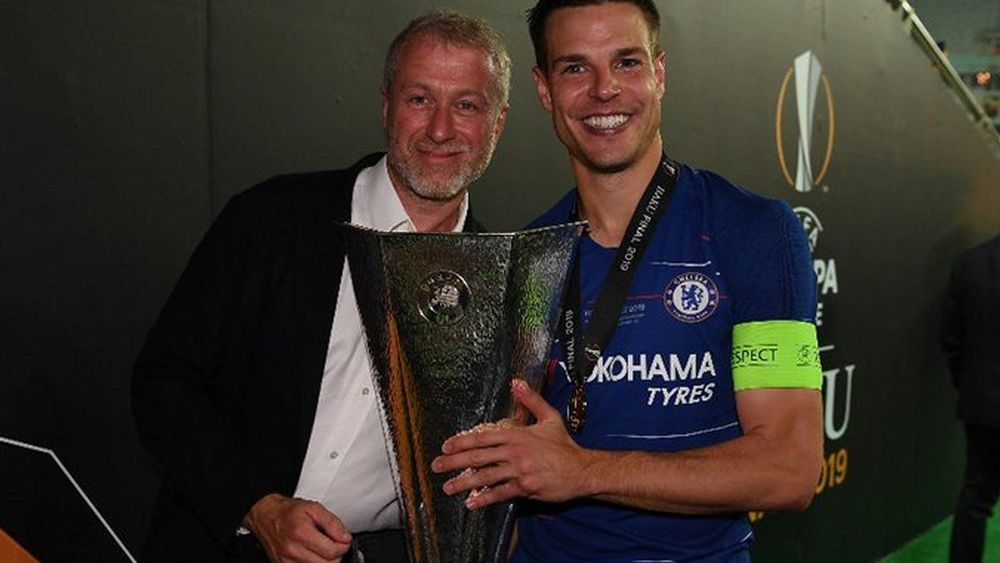
When Roman Abramovich arrived at Chelsea in 2003, he did more than transform one football club. Jimmy Burns believes the Russian billionaire helped change the entire landscape of English football.
Abramovich bought Chelsea in the summer of 2003, beginning a 19-year ownership during which the club won five Premier League titles and its first Champions League.
For Burns, though, the Abramovich story is about considerably more than trophies.
“The Abramovich years, as you know, coincided with about 13 years of Chelsea being at the top of its game,” Burns told Football Presse.
“All right, they went through quite a series of managers, but they won lots of cups. They were very successful.”
And the reaction from Chelsea supporters was striking.
“No one really questioned the Abramovich ownership,” Burns said. “The fans absolutely loved him. He was an absolute hero.”
Burns remembers how Abramovich cultivated an image that distinguished him from the stereotypical distant billionaire owner.
“He was very good at always attending matches,” he said.
“Every time there was a match at Stamford Bridge, you always saw Abramovich there, like one more of the crowd.
“You know, he played his part, as it were.”
That relationship between owner and supporters became one of the defining features of the Abramovich era. Chelsea were no longer simply competing for trophies. They had become one of the clearest examples of what enormous private wealth could do to a football club.
And Burns believes the timing matters.
The Chelsea revolution coincided with a period in which Britain, and particularly the City of London, was welcoming enormous amounts of overseas wealth.
“It coincided, of course, with a time in British, English socioeconomic history where, you know, the City of London, the financial centre — and I say this as a Financial Times journalist at the time — was accepting a lot of pretty dirty Russian money,” Burns said.
“Which was being funnelled through the City and all that.”
That is where Burns' assessment of Abramovich becomes much more uncomfortable. With hindsight, he believes Chelsea became a symbol of a much bigger failure.
“Through the evidence of hindsight, you can see Abramovich and Chelsea as the kind of almost a symbol of how the Premier allowed itself to be corrupted, really, in ethical terms,” he said.
The word “corrupted” is deliberately strong.
Burns is not simply questioning whether football should allow wealthy owners to spend huge sums. He is asking whether football had sufficiently rigorous standards for deciding who should be allowed to control its most important institutions.
The issue became unavoidable after Russia's invasion of Ukraine in 2022.
The British government sanctioned Abramovich and Chelsea operated under a special licence before the club was sold to a consortium led by Todd Boehly and Clearlake Capital in May 2022.
Burns believes the reaction around Stamford Bridge revealed just how deeply the owner had become identified with the club.
“At the high point of this, which I mention in the book, was of course when even after the invasion of Ukraine, and the government came down hard on Abramovich's ownership, and embargoed his assets and things,” he said.
“You know that you had Chelsea fans saying, you know, chanting for Russia.”
For Burns, that episode exposed the extraordinary emotional complexity of football ownership. The supporters had not merely enjoyed Abramovich's money. They had come to regard him as part of Chelsea's identity.
But Burns believes the Premier League cannot allow that emotional attachment to replace ethical scrutiny.
“I think, with the Premier, and I keep returning to this theme in the book, that this is a kind of dilemma you've got in football way beyond the Premier,” he said.
“It's this balance between how far do you go in terms of going for the elite players, the best players in the world that you can pay, the best stadiums, all this sort of stuff, the best managers.
“And where does your moral compass go in parallel with this?”
That question is at the heart of Burns' argument.
Chelsea demonstrated that extraordinary investment could produce extraordinary sporting success. The club's own figures show the Abramovich era delivered 16 major trophies by 2020, including the 2012 Champions League and five Premier League titles by that point.
But Burns believes football cannot judge ownership purely through the trophy cabinet.
“Is football, you and I who are involved in football and like it and write about it, do we completely surrender any kind of moral judgment or ethical judgment or balance?” he asked.
For Burns, Abramovich also represents the beginning of a wider transformation.
“The ownership today in foreign ownership, you could argue, is quite diverse in terms of nationality because it goes from Americans to Arabs and Asians,” he said. “Today, we haven't got any Russian owners for obvious reasons.”
The question is whether the Premier League learned the right lesson. Burns believes Abramovich should have faced much greater scrutiny before he ever became Chelsea owner.
“With the evidence of hindsight,” he said, “I certainly thought as a journalist covering certain companies in the City and generally doing quite a lot of part of the investigative team and things, there were a lot of things that should have put red flags up.
“A powerful Russian, linked or not linked to Putin, there should have been more red flags going up.”
For Burns, that is ultimately the Abramovich legacy: not simply a Chelsea transformed from a successful London club into a global superpower, but a warning about what happens when football's hunger for investment outruns its moral judgement.
The trophies are undeniable.
So is the transformation.
But Burns believes the question Abramovich leaves behind is one the Premier League still has to answer: how much money can football accept before it has to ask where that money comes from?
Jimmy Burns is the author of 'The Premier' from Pitch Publishing - which is available here.