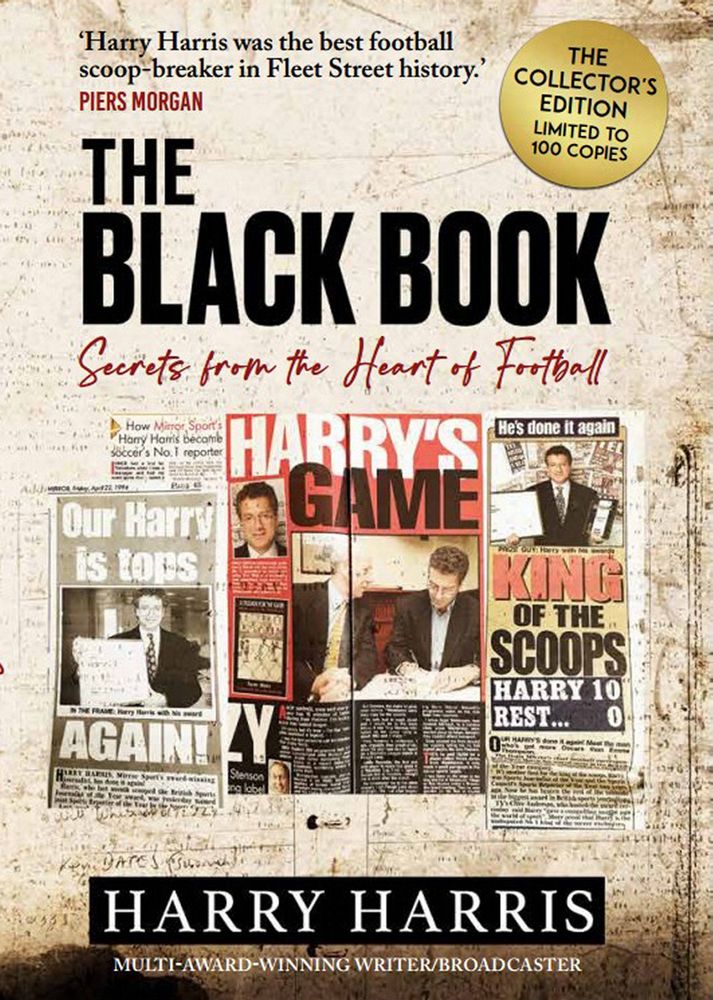

He was chief football writer of the "Daily Mirror" for more than 18 years before spending eight years at the "Daily Express". His career has taken him to five World Cups, earned him 24 industry awards and included two wins as British Sports Journalist of the Year and two Sports Story of the Year awards.
He has witnessed football journalism change from an industry dominated by newspaper exclusives and carefully cultivated contacts to one in which podcasts, social media personalities and instant reaction compete for an audience. Harris has not stood still during that transformation. He helped establish a football fanzine, ran an early football website and developed his own system for assessing the credibility of transfer rumours.
But while he recognises that the industry has to move with the times, he is concerned about the standards of some of its most prominent new voices. His criticism extends beyond social media influencers to former players who have become major broadcasters and podcasters, with Gary Neville's comments about Manchester City's case providing a particularly pointed example.
The difference between journalism and influence
Harris believes the quality of football writing has suffered as personality and instant reaction have become increasingly prominent.
He told Football Presse, "There's certainly a lack of enjoyment because in my time you had some really gifted writers who wrote about the sport in such a colourful way, in such a readable way, in a genuine readable way with a real feel for the game.
"Today, I think you get monopolised by these influencers who have set themselves up as journalists or commentators or whatever they might call themselves. But they're influencers, aren't they? And are popularised by as many expletives as they can actually utter in one sentence.
"For me, it really cheapens the art of communication."
His objection is rooted in the distinction between having an audience and having learned the craft of communicating with one. Harris points to the training and experience that traditionally went into becoming a journalist, and questions whether the same standards are being applied to those now occupying prominent positions in football media.
"You know, the people who have actually trained through months and months of lectures and, and, and scholaring and experienced journalism at all the different levels to come through to be able to achieve a form of communication that's enjoyable and readable and appreciated by the reader.
"But yeah, just have someone set themselves up with a succession of expletives and jumping up and down because their team has scored a goal is not media communication to me. I just don't get it."
Gary Neville and the Manchester City case
Harris's criticism is not confined to people who have built their profiles through social media. He is also uncomfortable with the influence of former professionals who have become major voices through podcasts and other programmes.
He argues that former players do not automatically become trained journalists or presenters simply because they have enjoyed distinguished playing careers.
"They're kind of like the ex-professional influencers rather than the terrorist influencers, but they're the same kind. You know, it's an unprofessional way of going about it. They're not trained journalists.
"And they're not trained presenters, but here they are."
It is in his assessment of Gary Neville's comments about Manchester City's case that Harris becomes particularly forceful. He recalls Neville's reaction when the allegations first emerged and takes issue with the language and the strength of the former Manchester United captain's public response.
"And all I can say about it is Gary Neville was most vitriolic when the Man City case first came to fruition about so-called found guilty charges. So-called, I say, because as I explained, if you wish, why I say they're so-called.
More: Harry Harris exclusive: I have the methods and legal team to get Man City off the hook
"But he's straight out there saying, 'I'm, you know, so traumatised by all of this, like, I can no longer cover a Manchester City game because I, I can't see it as reality, you know, that it's not a real game because they can be docked 80 points and then go to the bottom of the league and be relegated. And I'm watching a game which might have no meaning. I'm going to tell Sky that I don't want to cover any more Man City games.'"
Harris's response was blunt. Rather than treating Neville's declaration as an expression of genuine professional difficulty, he questioned why the broadcaster should continue covering those matches if he felt unable to do so.
"And I'm saying, can you just tell Sky he doesn't want to cover any games? Exactly. But certainly take him up on that offer. God's sake, get rid of him at least for those games."
It is a revealing example of the wider argument Harris is making. He is not suggesting that former players should be excluded from football broadcasting. Rather, he questions the standards expected of those who now occupy influential positions, particularly when strong personal opinions become part of the coverage.
Transfer speculation and the value of getting it right
Harris also sees a significant difference between the way transfer stories were handled during his newspaper career and the constant circulation of rumours online.
When millions of readers bought his newspaper every morning, he understood that they were relying on him to provide information that was as accurate as possible. Speculation was always part of football journalism, but he believes the present volume of claims makes it increasingly difficult for supporters to distinguish reporting from repetition.
"When people read my newspaper, five million of them every single morning, that's how they got their news. So they relied on that news for me to be as accurate as possible.
"Although in my time, there was much speculation, much very vague speculation. But this is speculation of the vaguest type because, you know, on the social media platforms, you can pick up all this gossip from other platforms and regurgitate it into your own platform.
"And you may have some contacts, but, you know, it's far too immediate to be really on the ball. Because whatever's going on in the transfer market or anywhere else in sport, in life, it's just there within seconds."
He is not dismissive of the appetite for transfer stories. Supporters have always wanted to know who their club might sign, and Harris accepts that journalists made mistakes in his era too. His challenge is to assess the people making predictions by looking at what actually happens.
"But we all got it wrong back in our day as well, you know. So I'm not going to criticise that. It is something that fans genuinely love to read about. They love the speculation.
"But I think if you ever did a league table of these kind of influencer types on social media speculating about this player's about to join that club any minute now and actually said which ones actually happened, there'd be very few of them."
The lost anticipation of the Sunday newspaper
Harris remembers the excitement of the major Sunday newspaper transfer stories, when supporters would go to bed knowing a story was developing and wake up to discover what had happened.
"There was a sense of anticipation. You weren't being bombarded in all directions by people telling you he's going to sign, he isn't going to sign, but he might sign today, he might not sign tomorrow, the other clubs. You know, it's just a bombardment.
"And people are bound to get something right eventually, you know. But the sense of anticipation is you go to sleep and wake up in the morning, you buy a paper, go, 'Wow, look what they're saying now.'
"And that paper would last all day until the next day. So either the next day someone would say, 'No, that was a pile of junk, isn't it? That's never going to happen.' Or it is happening, or it might happen. But you had to get your paper."
He recognises that the newspaper industry has changed beyond recognition. The readership figures he once worked with belong to another era, and he does not pretend that the old model can be brought back.
"All newspapers have been lost. They don't exist anymore. You know, I talk about five million readers. There's probably only about 200,000 copies of every single newspaper combined now bought.
"So it's just a different kind of world. So you have to move on with the times. You have to live with it. So you have to accept it and you have to read it and try and make a judgment."
An early move into the digital game
Harris is not someone who resisted the internet or refused to experiment with new forms of football coverage. Around 15 years ago, he was running one of the early football websites, having previously helped establish a football fanzine with colleagues.
He also developed a feature that assessed the credibility of transfer rumours, using the BBC's daily round-up of speculation as a starting point.
"I actually ran the first football fanzine with a few colleagues of mine, and I did the first football website. And one of the things I did was to take the BBC, which I think is very good, a combination of all the speculation from the main sources of newspapers.
"They do a column saying who's moving where. So what I did was to assess it. What did I believe this particular rumour? And give it a mark out of 10. Did I believe that one? And then go back to it and say, this is my assessment."
The exercise appealed to Harris because it allowed him to test his judgement against the eventual outcome.
"Even by just looking at it without even checking it, I can tell you whether it's true or not. And then assessing it afterwards, my assessment, was I right to say that?
"You know, it was interesting, it was enjoyable doing it because just reading that list, and you get it every day on the BBC, of all these players that go into all these clubs, somehow you just know whether they are going to happen or they're not."
Harris has therefore experienced both sides of the transformation. He understands the attraction of instant football news and has been willing to embrace new platforms, but believes the responsibility to communicate accurately and intelligently should remain.
For him, the issue is not whether football journalism should change. It is whether the craft, judgement and standards that made it valuable can survive the noise.
Harry Harris is author of "The Black Book: Secrets from the Heart of Football" from Legacy 11 Books - which is available here.