Speaking with Football Presse, Harris explains how an anonymous envelope, a network of independent sources and a series of documents changed his view, why Spurs supporters turned on Sugar, and how the fallout ultimately overshadowed one of England's most gifted coaches.
The partnership that was supposed to save Tottenham
Harry Harris has spent much of his journalistic career investigating the people and events that others would rather leave alone. Few stories, however, divided opinion quite like the extraordinary breakdown between Terry Venables and Alan Sugar at Tottenham Hotspur in the early 1990s.
For supporters, it was a battle between a popular footballing hero and an unpopular businessman. For much of Fleet Street, it was a similarly straightforward choice: Venables was the football man who understood Tottenham, while Sugar was the outsider who had walked into the club and removed him.
Harris saw something different. Having initially supported Venables, he began examining the allegations surrounding the former Tottenham manager's business dealings, eventually finding himself almost alone among the football writers prepared to challenge the accepted version of events.
To understand why the story became so explosive, it is necessary to go back to the partnership that had originally been celebrated as Tottenham's salvation.
In 1991, Spurs were in serious financial difficulty. The club was carrying substantial debts, its finances were under pressure from Midland Bank, and Robert Maxwell was pursuing an interest in taking control. Venables, who had returned to Tottenham as manager in 1987, wanted to secure the club's future and had already explored a takeover bid with American businessman Larry Gillick.
The solution came through a partnership with Sugar, the Amstrad entrepreneur who could provide the financial muscle Venables lacked.
It appeared an ideal arrangement. Venables would bring his football knowledge, connections and understanding of the club, while Sugar would provide the commercial experience and financial backing. They secured control in June 1991, with Sugar becoming chairman and Venables chief executive.
The partnership was initially successful. Tottenham's financial position improved, the club returned to profitability, and the football side was developing an exciting team. Venables had helped deliver the 1991 FA Cup, while Sugar's investment had provided the stability needed to keep the club operating.
But the relationship was never quite as straightforward as the public presentation suggested.
Sugar's investment increased his shareholding to approximately 47.8 per cent following a rights issue, while Venables held around 22–23 per cent. The businessman had become the dominant shareholder, but Venables remained the club's most influential football figure and its chief executive.
The question of who really controlled Tottenham was becoming increasingly important.
The battle for control and the breakdown
The disagreement was not simply about football results or the manager's position. It concerned the running of the company, the influence of Venables' associates, the management of the club's commercial affairs and the extent to which Sugar was prepared to allow his partner to operate independently.
One particularly important figure was Eddie Ashby, Venables' business associate and consultant at Tottenham. He was regarded as a key part of Venables' power base, with considerable influence over the club's commercial operation. Jonathan Crystal, another director, was also closely aligned with Venables.
Sugar became increasingly uncomfortable with the influence of those around his chief executive. His position was that the problem was not Venables' footballing ability but the way the club was being run and the influence exercised by his associates.
The dispute became increasingly bitter. Ashby was dismissed, Crystal's position on the board came under pressure, and the relationship between the two men deteriorated beyond repair.
By May 1993, Sugar had decided to act.
The decision to remove Venables as chief executive on 14 May would produce one of the most extraordinary boardroom battles English football had witnessed. Venables immediately went to the High Court and obtained an injunction reinstating him, temporarily overturning the board's decision.
He was not prepared simply to walk away. He wanted to take control of Tottenham himself, seeking to force Sugar to sell his 47.8 per cent shareholding at a price determined by the court.
The battle was now about ownership as much as employment.
The reaction from the Tottenham dressing room was immediate. Players who had worked under Venables regarded him as their mentor and were appalled by the decision. Teddy Sheringham, Neil Ruddock, Jason Cundy, Gary Mabbutt and Vinny Samways were among those whose support was recorded during the court proceedings.
Ruddock indicated that he would consider leaving if Venables was forced out, while the players' statements emphasised the manager's importance to the football side.
Outside the court, supporters rallied behind Venables. Sugar, meanwhile, was confronted by angry fans, with some threatening violence and others organising protests and boycotts.
The businessman who had helped rescue Tottenham was now being treated as the villain.
Why Harry Harris refused to follow Fleet Street
It was against that background that Harris's own investigation began to take shape.
He had not started out as an opponent of Venables. Indeed, his earlier opinion of the former Tottenham manager was quite the opposite.
Harris told Football Presse, "Prior to his fallout with Alan Sugar, I respected Terry Venables. In fact, when Graham Kelly (the FA chief executive at the time) asked me who should be the next England manager, I advocated, as you say in the book, I advocated Terry Venables, which would be a surprise to a lot of people.
"But come the fallout, 99.9% of the media were backing Terry Venables.
"And as a journalist, I always felt, you know, there's always another side to the story. So by just joining and following the sheep in Fleet Street, just joining the party by backing Terry Venables, what was the point of that?"
Harris decided that Sugar needed to be heard. He approached the chairman for an interview, with the arrangements made through his public relations adviser, Nick Hewer.
Hewer understood that Sugar was fighting a losing battle in the court of public opinion. The chairman needed somebody in the football media prepared to listen to his side of the story.
"So I sought out an interview with Alan Sugar and through his PR advisor, Nick Hewer.
"Nick was very astute, and he realized that his client needed some support within Fleet Street media. And my request to interview him was agreed upon."
Harris went to Sugar's home in Chigwell. It was an important meeting, not least because the chairman was about to explain his position to a football audience that had overwhelmingly decided he was responsible for the destruction of Tottenham's most popular partnership.
"And I went round to his Chigwell home, brought my sports editor with me because it was such a special occasion.
"And during that interview, he uttered the famous line, you know, that he's been treated like the man who shot Bambi."
The description captured the extraordinary imbalance in public sympathy. Sugar believed he was being portrayed as the heartless businessman who had destroyed a much-loved football figure, regardless of what had actually happened behind the scenes.
But Harris was not satisfied with simply publishing the chairman's version of events.
"Yeah, exactly. And of course, you know, his view was that there's a lot more to it.
"But from that point onwards, I can see there was a clear case. It was obvious to me that more investigation was needed."
The anonymous envelope that started the investigation
What followed was not, as some people assumed, a stream of information simply handed to him by Sugar.
Harris began approaching people who might have knowledge of the internal workings of Tottenham and Venables' wider business affairs. He was looking for individuals who could provide documentary evidence, rather than relying on competing versions of events from the two central protagonists.
"And the first document came through the post anonymously to me.
"So everyone assumes that Alan Sugar just hand-fed me all the pieces of evidence. But that's not how it worked.
"I went to people like Alan Sugar and many others, many others who might have known the inside track, and whittled it down to a handful who actually knew the inside track and had the documentation.
"And then whittled it down to maybe 3 or 4."
The care Harris took over those sources was considerable. He wanted each of them to understand that he was speaking to other people with independent knowledge of the same affairs, without revealing their identities to one another.
He also wanted to protect them from being traced back to the material they supplied.
"I said to these 3 or 4, look, it's gonna come out eventually, so why not let it come out via my Daily Mirror column?
"So look, I told all 4, not who I was speaking to, but I told 'em that I was speaking to 3 or 4 people in the know who had all the documentation. And I've asked them the same thing.
"Here's my private address, not the Mirror's address, my home address. Just send it to me in an unmarked envelope and make sure that you get a friend to post it for you so it's not easily traceable back to wherever you might be.
"And send me some, whatever you might think that I could make a start on. And that's what happened."
The first document was particularly significant. Harris describes it as a fraudulent sham invoice, and its arrival marked the beginning of a much larger investigation.
"First, the first fraudulent sham invoice popped through my letterbox. And that's the starting point.
"And, you know, going back to the others saying, look, I've got the evidence, why not give me the rest of it? So it snowballed from there."
He is also adamant that the first anonymous delivery did not originate with Sugar.
"But the first piece of evidence was sent anonymously. Now, look, I might have a clue because it was only 3 or 4 people who sent it, so I obviously got a clue who might have sent it.
"But I'm pretty well convinced that envelope and that first piece of evidence did not come from Alan Sugar."
The significance of that distinction should not be underestimated. Sugar was already being portrayed by many of Venables' supporters as the businessman orchestrating a campaign against a popular manager. Harris was making clear that his investigation had developed its own sources and was not simply an extension of the chairman's public relations operation.
The financial questions that divided the football world
The financial questions surrounding Venables were becoming increasingly serious.
His stake in Tottenham had been financed through borrowing, and the arrangements behind the money would eventually attract scrutiny from the Department of Trade and Industry, the Serious Fraud Office and investigative television programmes.
One of the most controversial areas concerned a loan of more than £1 million associated with Venables' purchase of Tottenham shares. The subsequent investigations examined whether assets connected to Transatlantic Inns, a company with which Venables had been involved, had been used to secure the money through leasing arrangements.
A Cardiff pub known as The Miners became a particularly extraordinary part of the story, with investigators questioning whether the establishment actually existed and whether assets had been used without the proper authority.
Venables consistently denied wrongdoing. His position was that the money was an unsecured personal loan and that the allegations about the use of company assets were unfounded.
The controversy extended beyond the financing of his shareholding. Allegations also emerged concerning the transfer of Sheringham from Nottingham Forest, including claims about improper financial arrangements. Those allegations were contested, and Venables denied that he had acted improperly.
For Sugar, the financial questions were central to the breakdown of the partnership. For Venables' supporters, they were part of an attempt to undermine him after he had been removed from the club.
The distinction between football reporting and financial investigation became increasingly apparent.
Almost alone against the Venables consensus
Harris remembers Fleet Street as being overwhelmingly on one side.
"It was split in two, but it was 99.9% one way and me on the other. Yeah, there wasn't really many of me.
"There was a couple enlightened journalists, one on the Mail on Sunday.
"You know, I named two or three journalists who had seen through Terry Venables and, and beyond to, to the, to getting the truth. Otherwise, it was unanimously on Terry Venables' side."
There was a wider cultural dimension to the divide. Venables was an established football personality, a charismatic manager who had built relationships throughout the game and enjoyed enormous popularity among supporters. Sugar was a businessman whose approach to football was seen by many as an unwelcome intrusion into a world that had traditionally been run by people who understood the game.
The sportswriters were familiar with Venables. They knew his character, his humour and his footballing achievements. Sugar was the man who had arrived with money and commercial demands, and who had ultimately removed the man they regarded as the club's guiding light.
It was an easy story to tell: the romantic football man against the ruthless businessman.
The investigation by the BBC's Panorama, broadcast in October 1993, and a subsequent Channel Four programme would challenge that narrative. Their examination of Venables' business affairs brought the financial allegations into the public domain on a much larger scale.
The programmes were fiercely contested, with Venables threatening legal action and disputing the material presented. But the issue could no longer be dismissed as merely a disagreement between two men at Tottenham.
For Harris, the consequences of standing against the prevailing opinion were personal as well as professional.
"And it wasn't a very easy two years for me because Spurs fans, 99.9%, were backing Terry Venables, and I was receiving an awful lot of personal abuse and threats."
There was a particular irony in the fact that Harris was himself a Tottenham supporter. He was not attacking the footballing achievements of a manager he had previously admired. He was trying to separate those achievements from the questions about the way the club and its associated businesses had been managed.
The England job and the cost of the fallout
Harris believes the football authorities could have handled the situation differently.
He had originally recommended Venables to Graham Kelly for the England position, and he did not believe that the FA needed to allow the controversy to continue indefinitely without reaching a footballing decision.
"Yeah, so to speak, quite clearly. I mean, when Graham Kelly asked me who should be the next England manager, I said Terry Venables.
"I said, but I said, but Graham, first thing you do, if you can, if you can see the obvious, because I've been publishing it all and this is more of a, you know, a matter for the police and the DTI and all the other authoritative city bodies.
"I said, but from a football point of view, if you feel that this impinges on football rules, well, charge him.
"Charge him with bringing the game into disrepute, which covers all, all ills from the Football Association. Hear his case and if you feel he's brought the game into disrepute in any way, you know, ban him from 3 or 4 games and give him a fine of £100,000 and close the book and then move on."
The FA did not follow that course. Instead, the continuing disputes and legal proceedings became a distraction from Venables' work with the national team.
Harris believes the uncertainty surrounding his future ultimately prevented England from retaining a manager who could have remained in the position for many years.
"But he didn't take my advice. So eventually, all those issues of Terry Venables taking his issues to court and insisting on that was time-consuming for him.
"And the FA felt that he was being defected from his job as the England coach.
"And they didn't want him to go. Who would? because he could have been England coach for 10, 15, 20 years. He could.
"But they didn't want to give him a long-term contract. They just—he said he wanted a 2-year contract to the World Cup from the Euros, which wasn't unreasonable.
"But because of all the FA's concern, they said they'd give him only 1 year, and he wasn't going to accept that."
Venables eventually left the England position after Euro 96, having led the team to the semi-finals. For Harris, the outcome was a significant loss for English football.
The court battle, the angry supporters and the missed opportunity
The relationship between Venables and Sugar, meanwhile, remained one of the great missed opportunities in Tottenham's modern history.
Sugar had provided the financial backing that had helped secure the club's future. Venables had brought the footballing leadership, the connections and the personality that made him such an important figure at White Hart Lane.
Neither man was willing to surrender control, and the partnership that had once been celebrated as Tottenham's dream ticket ended in a bitter public confrontation.
Harris believes the split was unnecessary, and that Sugar made genuine attempts to prevent it from reaching that point.
"People were throwing eggs at Alan Sugar and he came to the High Court and they were out there in force with their banners supporting Terry Venables.
"But, you know, all these years later, if they read these books and they take in all the information, that they'll be much wiser and have a different view.
"But even saying that, you know, Terry Venables was a great coach for Spurs and he should never have fallen out with Alan Sugar. Yeah. You know, Alan Sugar gave him plenty of opportunities not to fall out with him.
"And I was privy and reporting on all of those opportunities behind the scenes.
"But Spurs fans didn't believe them. They believed Terry Venables at the time. But now they would have mixed feelings. They could see that both of those guys should not have fallen out. They should have continued and how successful the team could have been had they done so."
It is a striking conclusion from a journalist who endured years of hostility for challenging the popular version of events. Harris does not deny Venables' importance to Tottenham, nor does he dismiss his qualities as a coach. His argument is that the footballing achievements should not have placed the business questions beyond scrutiny.
And he remains convinced that the fallout deprived England of something special.
"I think he would have—if they reconciled, he would have been England manager eventually, but he might have stayed a bit longer at Tottenham.
"Maybe not, might have taken the England job, but England would have been hugely successful under Terry Venables, I've no doubt about it."
For Harris, the story is ultimately about the responsibility of a journalist to look beyond the accepted narrative, even when doing so means standing almost entirely alone. He had once recommended Venables for England. He admired his work at Tottenham. But when the evidence and the questions demanded investigation, he refused to let popularity determine what could and could not be reported.
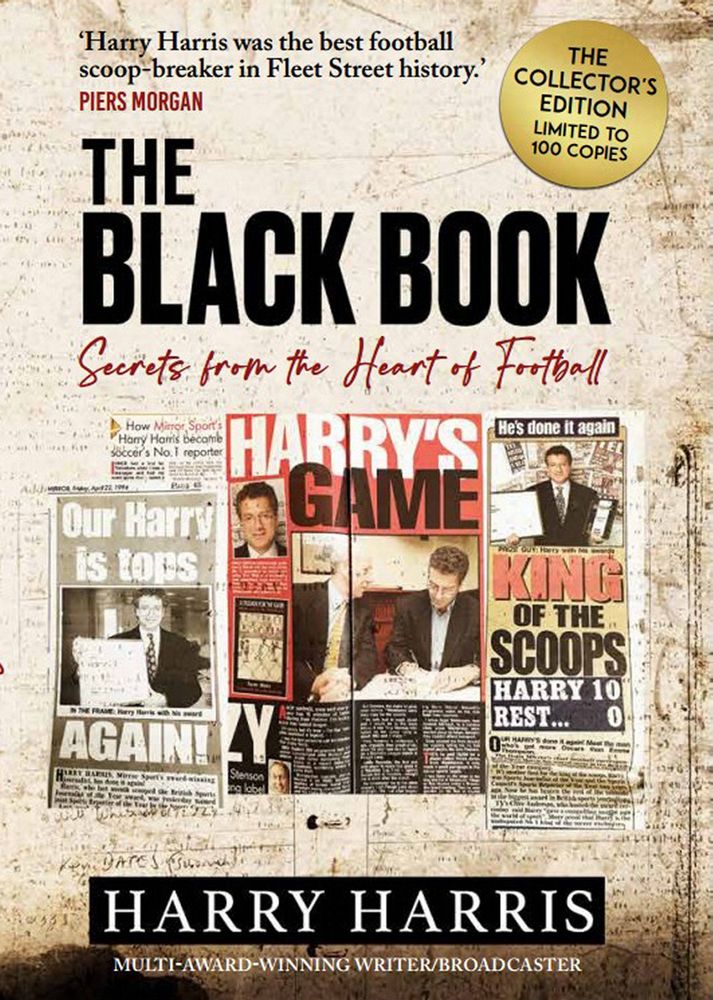
Harry Harris is author of "The Black Book: Secrets from the Heart of Football" from Legacy 11 Books - which is available here.