
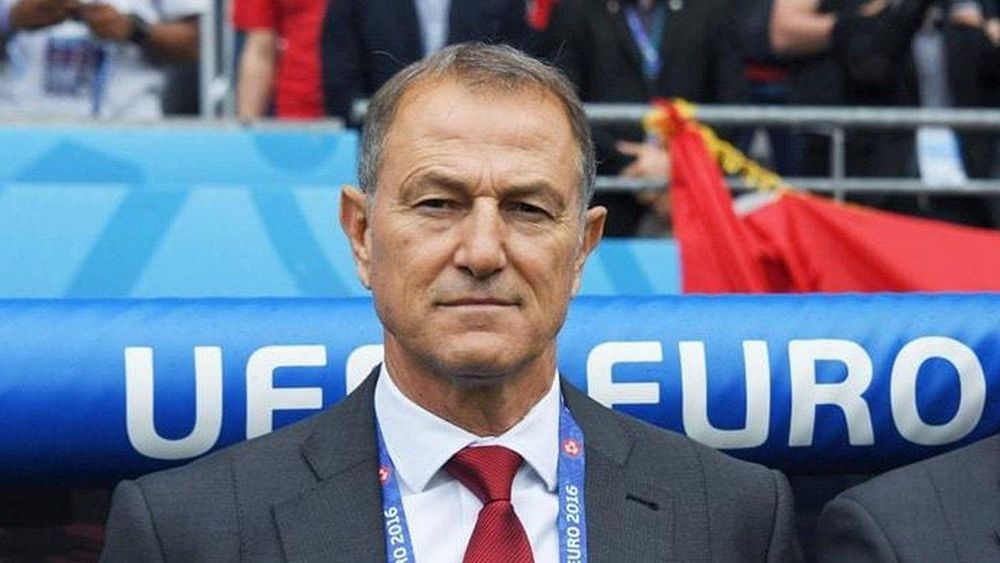
he Italian coach had taken charge of the national team with the challenge of building a competitive side from a relatively small footballing nation. But after the opening matches of the qualifying campaign, he began to believe something much bigger was possible.
“After our first qualifying match, when we won 1-0 in Portugal. Then we drew at home against Denmark,” De Biasi told Football Presse.
“From that moment, I realised that my team could create an important future.”
That belief ultimately became reality as Albania qualified for UEFA Euro 2016 in France, reaching a major European tournament for the first time in the country's history.
For De Biasi, the achievement was about more than simply qualifying for a competition. It represented the culmination of a process involving players, staff and a football culture that was beginning to develop beyond Albania's borders.
When asked which players from that historic team were underrated, De Biasi struggled to single anyone out.
“Many, too many, I think.”
He also sees a wider explanation for Albania's subsequent development. The country has benefited from generations of Albanians who moved abroad and gave their children access to footballing structures in countries with more developed youth systems.
“I would say that perhaps it is connected to the fact that many Albanians who left Albania and rebuilt their lives in Italy, Switzerland, Germany and elsewhere in Europe gave their children the opportunity to train at clubs in those countries and develop technically and tactically.”
That development has become increasingly visible in the years since Euro 2016, with Albanian players appearing more regularly in major European leagues.
For De Biasi, the progress is therefore not simply the result of one generation of players. It reflects a broader change in the opportunities available to young Albanians growing up both inside and outside the country.
His work with the national team helped bring those strands together.
The challenge for a national-team coach is fundamentally different from managing a club. There is limited time with the players, fewer opportunities to correct weaknesses and no traditional transfer market through which to reshape the squad.
De Biasi nevertheless managed to create a side capable of competing against established European nations and eventually securing its place at the European Championship.
The victory in Portugal was the early signal. The draw with Denmark strengthened the belief. From there, Albania began to see the possibility of achieving something that had previously appeared beyond its reach.
The qualification changed De Biasi's relationship with the country permanently.
Years after leaving the national team, he remains warmly regarded by Albanian supporters, something he regards with considerable pride.
“I am certainly proud to have been the first coach to take Albania to a major European tournament, and to have been accepted and considered one of them.”
That final phrase is significant. De Biasi was an Italian coach working with an Albanian national team, yet the success created a bond that went beyond the normal relationship between a foreign manager and the country he coaches.
He became associated with the moment Albania moved onto a much larger footballing stage.
The achievement also provided evidence for De Biasi's belief that emerging football nations can make significant progress when they are given time and the right structures.
He would later experience a similar challenge with Azerbaijan, where the available pool of high-level players was limited. His conclusion from those experiences was straightforward.
“That with patience, ability and competence, you can achieve something worthwhile even in smaller footballing environments.”
Albania remains the clearest example of that philosophy.
The Euro 2016 qualification was the historic headline, but the significance of De Biasi's work can also be seen in what followed. Albanian players have continued to emerge in stronger European leagues, while the national team has remained capable of competing on the international stage.
For De Biasi, that progression is linked to a change that began well beyond the national team itself. Albanian families establishing new lives across Europe created opportunities for their children to develop within established football systems, producing players who could eventually return and contribute to the national side.
His achievement was to recognise the potential within that group and turn it into a functioning international team.
The first signs came in Portugal and against Denmark. The historic destination was France.
And for De Biasi, the most enduring reward was not simply qualifying for Euro 2016, but becoming part of Albania's footballing story.
“I am certainly proud to have been the first coach to take Albania to a major European tournament, and to have been accepted and considered one of them.”