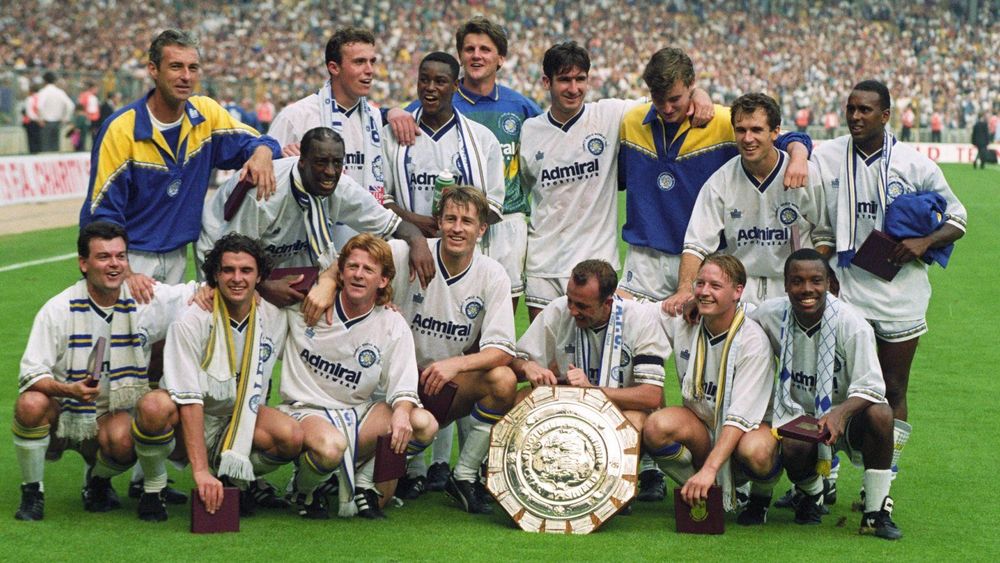
There was no obvious reason why Leeds United should have gone from champions of England to 17th in the space of 12 months.
Howard Wilkinson's side had lost only four league games in winning the 1991-92 First Division title. They had Gordon Strachan, Gary Speed, David Batty, Gary McAllister and Tony Dorigo, while Lee Chapman remained one of the country's most effective forwards.
Yet in the first season of the Premier League, Leeds won only 12 of 42 games, lost 15 and, remarkably, failed to win away from Elland Road all season.
For Rocco Dean, author of a book examining Leeds' extraordinary 1992-93 campaign, one of the biggest clues lies in a rule change that arrived at exactly the wrong time for Wilkinson's football.
The back-pass rule was introduced at the beginning of the 1992-93 season, preventing goalkeepers from picking up deliberate passes from teammates. For a Leeds team built around direct football, it fundamentally altered one of the ways they escaped pressure.
"It probably did have a lot to do with it, especially away from home," Dean told Football Presse.
"Because you could pass the ball back to Lukic, he'd pick it up, he'd reset and then he'd lump it up to Chapman and you'd get your team up the pitch."
That simple escape route disappeared.
Instead of John Lukic being able to take possession and launch the ball towards Chapman, Leeds' defenders increasingly had to deal with the ball at their feet under pressure.
"And then when the back-pass rule came in, you couldn't do that anymore," Dean said.
"You'd pass it back to Lukic and he'd have to clear it, usually out for a throw-in, and then you're back defending again."
The effect was particularly damaging away from Elland Road.
Leeds had been exceptionally difficult to beat at home during the title-winning season, and that remained broadly true in 1992-93. They collected 44 of their 51 league points at Elland Road, losing only once at home. Away from home they won none, drawing seven and losing 14.
The contrast is startling.
"It just seemed to happen time and time again," Dean said.
"They'd be away from home, they'd be under pressure, they couldn't get out, they'd give the ball away and they'd be back defending."
There were other problems, of course.
Dean points to a defence that suddenly became extraordinarily vulnerable after being such a strength during the title campaign. Leeds conceded 62 league goals, compared with only 37 the previous season, and their goal difference fell from +37 to -5.
The collapse at set pieces was particularly difficult to explain.
"We went from the best team at set pieces to the worst," Dean said.
"That was just stark and unexplainable."
Chris Whyte, one of the central defenders who had been so important to the championship, also found the new demands difficult. The irony was that Wilkinson had rated Whyte so highly the previous season that he had become an integral part of the title-winning defence.
The change in goalkeeping duties was part of a much wider transformation. The Premier League's first season was also the first campaign in which defenders and goalkeepers had to adapt to a completely different rhythm when building from the back. Peter Schmeichel, for example, responded by training as an extra outfield player to prepare for the new demands.
Leeds were slower to adapt.
There is an even greater irony to their collapse. Wilkinson's football had been built around directness, physicality and getting the ball into dangerous areas quickly. The back-pass law was supposed to encourage more attacking football, but it instead removed one of the mechanisms that allowed Leeds to play their own game.
Michael Cox, writing about the tactical history of the Premier League, has similarly identified Leeds as one of the biggest casualties of the change, noting that Wilkinson's direct side struggled because they could no longer rely on the old method of recycling possession through the goalkeeper.
But Dean does not believe the rule alone explains how champions ended up fighting relegation.
There was a collective deterioration.
John Lukic had a difficult season, mistakes cost goals and the defence became increasingly unreliable. Meanwhile, the team that had been so ruthless the previous year appeared to lose its ability to control matches once things started going against it.
Dean remembers Leeds still being capable of producing excellent football. They famously beat Tottenham 5-0 in August and produced a remarkable 4-1 victory over Stuttgart in the European Cup after losing the first leg 3-0. They also remained extraordinarily strong at home.
But away from home, the weaknesses kept resurfacing.
"The defence was calamitous at times," Dean said.
"And when you add in the back-pass rule and the fact that they couldn't get out, it just became this perfect storm."
The final numbers tell the story better than almost anything else.
Leeds finished 17th with 51 points, only one place above relegation. They had 12 wins, 15 draws and 15 defeats, with a goal difference of minus five.
Yet the most revealing statistic is still the simplest: 0 away wins.
For a reigning champion, it remains one of the strangest seasons in English football.
And Dean believes that is why the 1992-93 Leeds story should not simply be remembered as a team that suddenly became bad.
They were caught between two versions of football.
The champions who had mastered Wilkinson's methods in 1991-92 were still there. But the rules, tactical demands and defensive weaknesses around them had changed.
"The players didn't suddenly become bad players," Dean said.
"But the game changed, and Leeds didn't adapt quickly enough."
Within two years, they had recovered to finish fifth twice in succession, with Tony Yeboah providing the goals that gave Wilkinson's side a second life.
The 17th-place finish, then, was not the end of Wilkinson's Leeds. It was the season when the old formula finally stopped working.
Rocco Dean's book "Sgt Wilko's defending champions" is from Pitch Publishing - which is available here.