
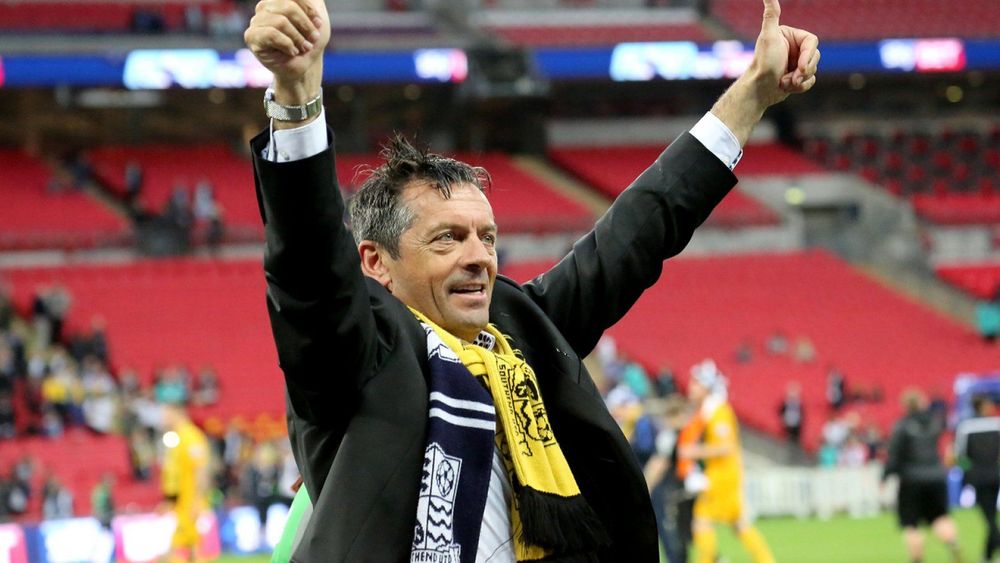
Decades later, when Sam Allardyce offered him the chance to join his staff at the Stadium of Light, Brown faced another opportunity to become part of the club he loved.
This time, however, he turned it down. The decision was understandable: Brown was the manager of Southend United, with his own ambitions and a career he was reluctant to put aside. Yet when he looks back, he admits there is a part of him that wonders what might have happened had he said yes.
Brown told Football Presse, “I'd had trials with Sunderland but I was too old. I was 18 when I had a trial at Sunderland, and I didn't fail the trial. I was just 18, and apprenticeship started at 16, so you were just too old, unfortunately.”
For Brown, the disappointment was not simply about missing out on a football apprenticeship. Sunderland was his team, and the chance to play for the club would have meant something beyond the usual dream of a young footballer making it as a professional.
He knew what it meant to watch Sunderland from the terraces. He also knew what it was like to come close to the club without quite getting through the door. When he eventually entered professional football and found himself sharing a changing room with former Sunderland captain Bobby Kerr, the experience brought that childhood connection into sharp focus.
“Bobby Kerr came to us at the end of his career from Sunderland and he had lifted the FA Cup. He was the captain of Sunderland. Sunderland was my team as a supporter and I was a step away from that.
“You know, like I'm on the terraces at Sunderland watching Bobby Kerr lift the FA Cup, and then a year, two years, three years later, he's sitting in the same changing room as me. He's next to me, and I'm his captain.”
It was a remarkable reversal of perspective: the supporter who had watched Sunderland's cup-winning captain from the stands was now sharing the pitch and dressing room with him. But the attachment to the club never disappeared.
“I still go back there. And I still slaughter Newcastle. And I still sing the praises of Sunderland, but I just want to see all the Northeast clubs doing well.”
That loyalty made the opportunity to work for Sunderland particularly difficult to dismiss. By the time Allardyce contacted him in 2015, Brown had established himself as a manager in his own right. He had spent four or five years at Southend United, helping the club climb from the fourth tier into League One and coming close to another promotion. The prospect of joining Allardyce as his assistant meant returning to a role he had previously occupied at Bolton Wanderers and Blackpool.
Brown had already decided that his future lay in management. Taking a job as somebody else's number two was not an easy step to contemplate, even if that person was a trusted former colleague and the club was Sunderland.
“I had an opportunity. I was Southend United manager. And I had probably a four or five year stint at Southend where we went from the Second Division to the First and just missed out by about 10 minutes of getting into the Championship. You know, playoffs, Millwall beat us, scored a goal, a late goal, and that was it. They went in the playoffs and we didn't. They got promoted to the Championship.
“But I had a chance of getting Southend United to the Championship. And I thought, I'm a manager. I thought I made my decision. And once I'd made that decision, I was never going to go back to being an assistant manager or being a first-team coach.”
It was not a decision made lightly. Brown understood what Allardyce was offering, but he also understood the risk of stepping away from his own managerial career. He had ambitions beyond the immediate future at Southend, including the possibility of coaching abroad, and he was conscious that returning to assistant management might close off opportunities he had spent years working towards.
“When Sam phoned me up, it was the hardest decision of my life. There were certain things that Sam said that I agree 100% with, and there were certain things that he said that I didn't. But that was always going to be the case. He had his career as a manager for sure. And I had my career behind me as a manager as well, or in front of me, whichever the case may be.
“And I thought, if I go back to being assistant manager, does that draw the line in management? I didn't want to. I always felt like there was life in me for a long, long way, you know. I had unfulfilled ambitions, coaching abroad, for instance, being one of them.”
Ultimately, Brown stayed at Southend. He did not simply decline Allardyce and move on without a second thought. The decision left a mark, precisely because it involved two powerful ambitions: the desire to continue building his own career and the lifelong pull of Sunderland.
“When he offered me the position, I not only turned him down, okay, I went back to being Southend United manager, but there's a big chunk of me went missing after that. There's a big chunk of me went missing.
“And I'm not saying that caught me out or that, that upset my flow, my rhythm. But regardless, it was something that I look back on and I probably regret. I know people say don't have any regrets, but I'll probably regret because at the end of the day, Sam not only kept them in the Premier League, he then got the England job straight on the back of that.”
The timing gives the decision its particular sting. Allardyce took Sunderland away from the relegation zone and secured their Premier League survival in 2015-16 before being appointed England manager in July 2016. Brown could see how accepting the Sunderland position might have opened up a succession of possibilities.
“I could have fulfilled two ambitions. I could have been manager or managing Sunderland, which is my hometown club, or my club that I supported. And then if Sam had took me with him, I could have gone with him to England. If Sam hadn't have took me with him, I could have been left as managing Sunderland.
“There's all sorts of ifs, buts, and maybes, but I can't seriously, Jacob, I can't think that way because I'll end up demented.”
Brown knows the alternative history can never be resolved. He cannot know whether he would have remained at Sunderland after Allardyce's departure, whether he would have followed his former boss into the England set-up, or whether returning to Southend was ultimately the right choice for his career. Those possibilities are compelling precisely because none can be proved.
What makes the memory endure is the personal connection. Sunderland was not simply another job on the managerial circuit. It was the club he had supported, the club where he had once hoped to become a professional and the club that had remained close to his heart even as his career took him elsewhere.
As a teenager, Brown had been told he was too old to begin an apprenticeship. Years later, when a route back into Sunderland finally appeared, it came in a different form and at a different stage of his life. This time, the obstacle was not his age but the ambitions he had developed for himself.
He chose to remain a manager. He has never claimed that the decision ruined his career, nor does he pretend to know how the story would have unfolded. But his admission is revealing: even a career built on taking opportunities and making difficult decisions can leave one question unanswered.
For Phil Brown, Sunderland remains the opportunity that might have changed everything.