
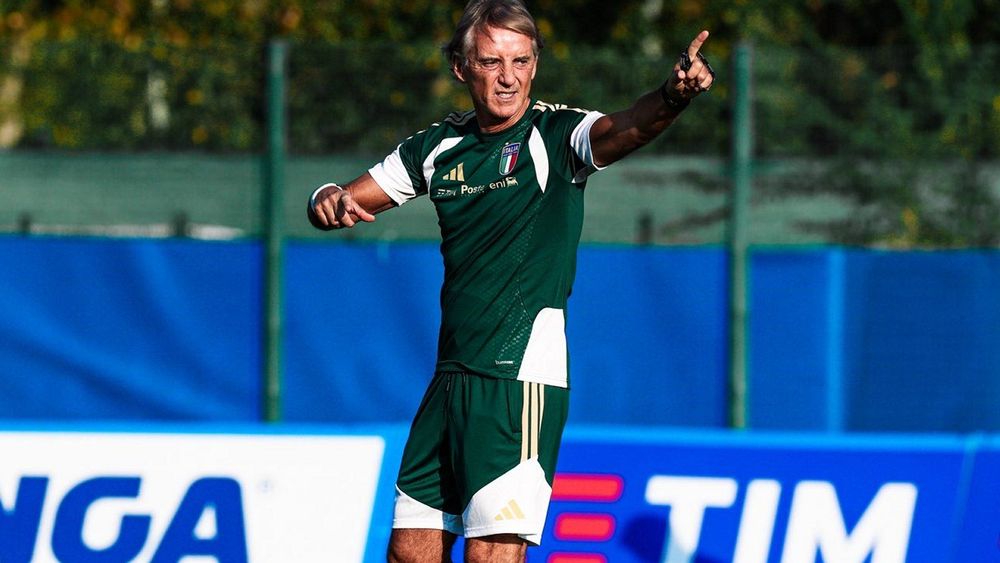
The former Sampdoria defender had the opportunity to observe Mancini's coaching at close quarters during a three-month spell training with Fiorentina after returning from Spain. It was a relatively brief experience, but one that left a considerable impression.
Lanna had known Mancini as a teammate during their time at Sampdoria, yet seeing him working on the training ground revealed qualities he had not previously appreciated.
Asked about Mancini's return to the national team, Lanna is unequivocal in his assessment.
“I believe Roberto is the perfect national-team coach," Lanna told Football Presse. "When he left, they criticised him, but there are reasons for that which perhaps will never be known, or perhaps will emerge further down the line.
“Regardless of that, I rarely used to watch the Italian national team because, generally, Italy had never really played particularly beautiful football. Perhaps the 2006 World Cup was an exception, although I'm not even sure about that.
“But with Roberto at the European Championship, I saw an Italy team that wanted to play football. It had an idea of how it wanted to play, something different from what we had generally seen.”
For Lanna, the change was about more than results. He appreciated seeing an Italian national team that wanted to dictate games through its football rather than simply concentrate on defensive organisation.
His opinion was also informed by his own experience of Mancini's work at Fiorentina, where he had an opportunity to observe the manager developing players in ways that went beyond the traditional understanding of tactical preparation.
Discovering Mancini the coach
“I had him as my coach in Florence. I spent three months there when I came back from Spain, and I discovered a really, really good coach.
“Not just in the tactical side and preparing for matches, but also in teaching the tricks of the trade.
“For me, it was a real surprise to see him actually teaching the forwards their movements and showing the defenders how to mark an opponent.”
It was this attention to the individual that particularly impressed Lanna. Mancini was not simply organising players into a formation and explaining how the team should operate collectively. He was working on the details of individual positions, helping footballers understand what was required of them in different situations.
For Lanna, who had spent his career operating in defence against some of the strongest attackers in European football, that practical understanding was particularly valuable.
He continues:
“He is a coach who can give you a great deal and teach you so much. It isn't only about the tactical side, about how he positions you on the pitch. He also helps you develop as an individual player.
“And then he has the credibility and charisma to make these players want to follow him.
“That is important because you need players to believe in what you're doing. You need them to understand what you are asking of them and to have the confidence to carry it out.”
Lanna's assessment provides an interesting insight into a side of Mancini that is not always discussed when his managerial career is evaluated.
His reputation has often been associated with his personality, playing achievements and the trophies won during his time in club management. Lanna, however, identifies a more hands-on coaching approach, particularly his willingness to work with individuals and teach the finer details of the game.
It was something he experienced personally, rather than simply observing from a distance.
An Italy team with a different identity
Lanna's admiration for Mancini also extends to the football he has wanted Italy to play.
He acknowledges that the national team has experienced setbacks in the Nations League, including a defeat against Belgium, but believes there is considerable room for improvement.
“Of course, there have been some disappointments, but that is understandable in these Nations League matches. There have been some defeats, including the latest against Belgium.
“Nevertheless, this is a team that can only grow. We have seen matches where everything has worked well, where the team has played great football and taken on strong opponents without any fear. It has gone out there, played its football and won those matches.”
For Lanna, the willingness to approach difficult opponents without abandoning an attacking identity is one of Mancini's most important qualities.
He contrasts that approach with the traditional perception of Italian football, in which defending and counterattacking have often taken priority.
“It's a style of football that isn't what you might traditionally associate with Italy, where we defend and then go forward on the counterattack.
“We want to propose football. We defend, of course, but then we move forward, and when we do, we can hurt the opposition.”
It is an endorsement rooted in both personal experience and what Lanna has seen from the national team. He believes Mancini understands how to organise a side, improve individual players and create an environment in which footballers are prepared to follow his ideas.
Those qualities, rather than the reputation of a former international star, are what convince him that Italy have the right person in charge.
He returns to the point with a final assessment that leaves little room for doubt.
“I believe he is the perfect man in the right place.”
For Lanna, Mancini's value as a coach became clear during those three months in Florence. Watching him work with players, explain movements and develop individual understanding offered an insight that a shared dressing room at Sampdoria could never quite provide.
It was a different perspective on a footballer he had known for years, and one that convinced him Mancini possessed the qualities required to lead a national team.
His return to Italy's touchline is therefore something Lanna welcomes, not simply because of what Mancini achieved in his first spell, but because he knows the attention to detail, teaching ability and personal authority that lie behind the results.