
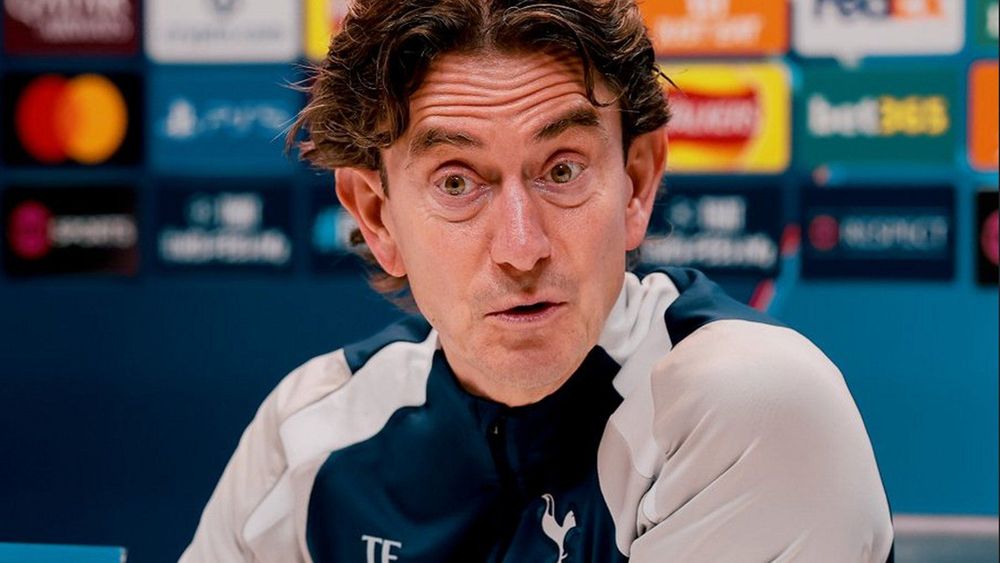
The Danish coaches worked together at Brentford, where Friis was part of Frank’s coaching staff during the club’s remarkable rise into the Premier League. They also completed their coaching education alongside each other, developing not only a professional relationship but a friendship which remains strong.
So when Friis discusses Frank’s difficult start at Tottenham, he does so from experience.
“He’s not only a good coach, he’s also a good friend of mine,” Friis told Football Presse. “We have worked together, and we have also done our coaching education alongside each other.”
Frank was appointed Tottenham manager in June 2025, taking over after Ange Postecoglou had led Spurs to Europa League glory but finished 17th in the Premier League.
The early months were difficult.For Friis, however, that did not mean Frank was the wrong man for the job.
“If he gets the right backing and the right time, of course he can do it,” he said. “He’s got all the tools in his backpack to do things like this.”
Friis had seen the same process play out at Brentford.
Frank did not transform the club overnight.
“The same at Brentford, it was a very hard first one-and-a-half, two months,” Friis recalled. “And then it was rolling.”
Frank eventually guided Brentford into the Premier League and established them as one of English football’s most intelligently run clubs.
Friis was there to see the process from inside the coaching staff. What impressed him most was Frank’s ability to deal with people.
“Thomas is really, really good in man-management,” Friis said.
“The way he looks at people — he’s a very positive guy who sees opportunities instead of all the mistakes, failures and so on.”
That positivity, however, should not be mistaken for weakness.
“Don’t get me wrong, he can also be very, very hard, and he has to be as a head coach,” Friis added.
What really stood out to Friis was Frank’s approach to the everyday work of coaching.
“He came in every single day and tried to make things a little bit better than they were yesterday,” he said.
That meant the training ground mattered enormously.
“He’s really, really happy with training,” Friis explained. “He’s not a typical manager who is living for Saturdays. Thomas is living for every day, working on the training pitch, working on small things, creating drills and doing stuff like this.”
It was a lesson Friis took with him.
And it was why he believed Tottenham had to resist the urge to judge Frank before he had been able to put his stamp on the club.
“He needs to have his own touch on staff, his own touch on players, his own touch on the daily environment and so on.
“You cannot do that in a couple of weeks. You need time to do that.”
That is the central argument Friis makes about coaching.
Results matter. But so does the environment in which those results are expected to arrive.
“In football, it sounds like an excuse when coaches are talking about long-term,” he said. “It sounds like, ‘Ah, I just want more time, give me a little bit more chances.’”
Yet Friis believes the clubs who genuinely want sustainable success have to think beyond the next result.
“It’s not on the coach only,” he said.
“It needs to come from the club. It needs to be part of the culture, the DNA, the values you have in the club.”
That belief was shaped partly by his time at Brentford.
And Friis is now applying those lessons himself at Cercle Brugge. After leaving Sparta Prague, he returned to coaching abroad by taking charge of Cercle, inheriting a club fighting to avoid relegation in Belgium.
The circumstances were very different from Tottenham. There was no long bedding-in period. Cercle needed results immediately. Friis delivered enough to secure their top-flight status and has now been given the opportunity to build further with the club.
It gives him an interesting perspective on the very issue he discussed when talking about Frank.
“You can do both,” Friis said of development and results. “But you need wins to do it.”
That sentence perhaps explains more about Frank’s Tottenham experience than anything else.
A manager can need time. But he also has to earn it.
And Friis knows that better than most because he has experienced the pressure himself.
His Cercle appointment has also brought him back into the sort of working environment he values: developing players, creating a clear identity and building something rather than simply surviving from Saturday to Saturday.
It is an approach he saw Frank employ at Brentford.
“He has his values, and I really like them,” Friis said. “He fitted perfectly into how Brentford was working.”
That relationship remains one of the defining influences on Friis’s own coaching career.
He saw how Frank created an environment in which staff and players could improve. He saw how much attention Frank gave to training.
And he saw first-hand that the work required to establish a team cannot be compressed into a few weeks.
Now, with Frank’s Tottenham tenure having come to an end and Friis beginning to establish himself at Cercle, their paths have taken different directions.
But the lesson Friis took from their years together remains unchanged.
“You need time to do that.”
For Frank, Tottenham ultimately decided there was not enough of it.
For Friis, the challenge at Cercle is to make sure he earns enough time for his own ideas to take hold.