
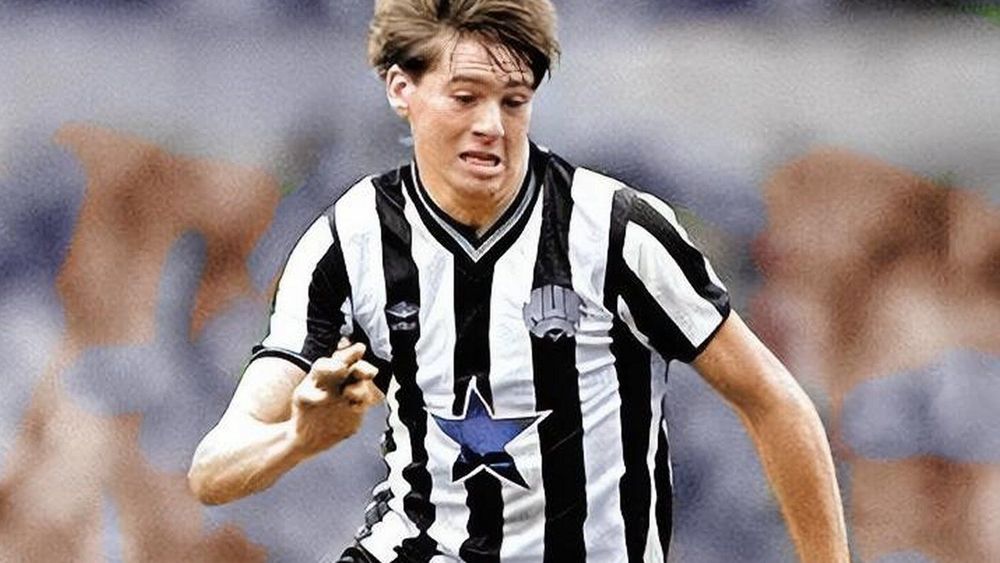
Phil Brown played on the same local pitches as Waddle before facing him as a professional, while Newcastle writer and historian Gary Sherrard was at St James’ Park to see the winger make his debut. Together, their memories trace the emergence of a remarkable talent, the Newcastle side that helped bring him to prominence, and the departure that left supporters wondering what might have been.
On 22 October 1980, Waddle made his Newcastle debut against Shrewsbury Town. He was 19, had been playing for non-league Tow Law Town, and was about to begin a five-year spell that would establish him as one of the club’s most exciting players. 
For Sherrard, it was a night that has stayed with him.
“I remember being at Chris Waddle’s debut. It was against Shrewsbury on a Tuesday night," he recalled to Football Presse. "Chris Withe, who’s the younger brother of the centre-forward Peter Withe, who played for us probably six or seven years earlier than that, made his debut the same night at left-back.
“I think Chris Withe only played two games for the club before he had a long stint in the lower leagues, but Chris Waddle obviously made much more of a career for himself at Newcastle.
“He had periods out of the team quite early on, and I think it was a case of convincing Chris Waddle that he was capable of playing that level as much as it was a case of him convincing other people that he could play there.”
The early uncertainty would not last. Under Arthur Cox, Newcastle United found a way to bring more out of Waddle, whose versatility made him difficult to pin down.
“Once Arthur Cox had come in as manager and had given him that confidence and given him a sort of unique role at that stage, there weren’t many inverted wingers in the early ’80s, and Chris Waddle became the kind who would wander.
“He’d be on the left wing for a while, be on the right wing, he’d crop up centrally. He made his debut as a number nine. He’d scored goals in the reserves.”
It was a distinctive style, one that would become increasingly valuable as Waddle developed. He was not simply a winger who stayed wide and waited for the ball. He could move across the pitch, find space in central areas and take defenders into unfamiliar territory.
Sherrard remembers Waddle alongside Peter Beardsley as two players who brought something genuinely different to Newcastle.
“They ploughed their own way, they had their own style, and it was brilliant to see the early days of their international careers starting with Newcastle.”
For former Hull City manager Brown, the story began earlier, on the pitches of the North East, where Waddle was already a name people knew.
The football community was close-knit, with players moving through local clubs and non-league sides while trying to find a route into the professional game. Brown was a right-back who hoped he might eventually come up against the young winger.
“Tow Law was lower division again, you know, and non-league football," Brown told Football Presse. "And everyone talked, you know, who were the up-and-coming players in the area. Of course you do, because they’re the go-to players for a conversation.
“There used to be places on the A19, the main road going back to South Shields from Hartlepool, passed through, almost through Sunderland. But you had Durham, and eventually on the other side of South Shields you had Newcastle. So it was just a close-knit community. The football community was very close-knit, so everybody knew of Chris.
“And I was just hoping that one day I would come up against him because, you know, he’s one of them wiry kind of wingers — left winger, right winger, whichever. He could go either way. And I was a right-back at the time, so I thought at some stage I’m going to come up against him.”
Brown knew the type of opponent he might face. Pace and unpredictability were difficult qualities for a defender to contain, particularly when the winger could attack from either side.
“I always thought I could play against somebody like that, you know, a stop-start winger, somebody who had absolute blistering pace. I always struggled. I wasn’t the quickest defender in the world, you know, I hold my hands up to that.
“In the modern-day game, can you improve people’s pace? Absolutely. But what I was trying to do was just improve my passing, improve my technical side of the game. And running, in my head, wasn’t a technical side of the game, but absolutely it is now.”
The anticipated meeting came later, after Brown had made his own way into professional football with Hartlepool United and then Bolton Wanderers. Waddle had moved far beyond the local scene, establishing himself at Newcastle, then Tottenham, before eventually joining Sheffield Wednesday later in his career after time in France with Olympique Marseille.
“I think the first time I did come up against him was when I was playing for Bolton Wanderers and he was at Sheffield Wednesday. And I think that was the first time I met him because he was at a different level. He was at a different level from what I was, you know.”
The distance between the two careers had grown, but the qualities Brown had heard about around the North East were now there to be tested on the pitch.
The freedom to be different
Waddle’s Newcastle years coincided with a period in which the club had the ingredients to build something special. Kevin Keegan arrived as a major attraction, Beardsley followed, and the emergence of Paul Gascoigne offered the prospect of a side built around several players capable of doing things others could not.
For supporters, watching Waddle develop was part of that wider excitement. Sherrard had grown up hearing stories of Newcastle’s great teams and the crowds they attracted, but the players of the 1980s were creating memories of their own.
He saw something unusual in the young Waddle and Beardsley, players who did not fit conventional moulds.
“Peter Beardsley came in in the second Keegan season, ’83-’84. We knew about Peter Beardsley because, in Look North TV, Carlisle, although it’s over on the West Coast, Carlisle came into our TV region, and he seemed to be one of two Carlisle players who ever got a mention before he went to Canada and his short spell at Manchester United.
“So we knew something about him, but he was a unique player. He didn’t have a format of any other player I had seen at a young age, when I’d been in my mid-teens, and probably not that many since. And Chris Waddle, the same really.”
Waddle’s versatility meant Newcastle could use him in different positions, but that flexibility also created challenges. When Jack Charlton succeeded Keegan, the team’s approach changed, with two centre-forwards brought in and Waddle and Beardsley moved away from their most dangerous positions.
Sherrard felt Newcastle were not making the best use of what they had.
“They were the two best strikers around at that stage, so it wasn’t a great mix. And you could see he was trying to be direct, he was trying to get the team on the front foot by playing direct, but if I was a player in that team, my first thought would be, where’s Peter Beardsley? Because he’s getting this pass. Or, where’s Chris Waddle? He’s getting this pass.
“I wouldn’t have thought about lumping it long for people to chase after when you’ve got that much ability in your team.”
For a supporter who had watched Waddle’s early development, the issue was not simply where he played, but whether Newcastle could build a side that made the most of his ability.
“If one manager believes in one particular style of play and the players have been used to something else, and you don’t want to waste the attributes that you’ve got from unique talents like Waddle, Beardsley, and then hot on their heels, Paul Gascoigne, you obviously want to get the ball to him as quick as you can.”
The possibility of keeping those players together became one of the great unanswered questions of that Newcastle era.
Waddle had become an established first-team player, Beardsley was flourishing and Gascoigne was coming through. There was a sense that the club could have built a side around its own emerging talents, but Newcastle struggled to turn the promise into sustained progress.
Then Waddle left.
The departure that stayed with Newcastle
In 1985, Waddle joined Tottenham Hotspur. Newcastle received a fee of £590,000, but the move was painful for supporters who had watched him grow from a promising teenager into one of their most gifted players.
Sherrard remembers the feeling of losing a player who had become part of the club’s identity.
“You lose Keegan for retirement, that’s fine. And then a year, 18 months later, Chris Waddle’s gone, having really made his name at Newcastle, and you think there’s no reason for him to go.
“He joins Tottenham. Okay, they’re flashy, they’re London. Then Peter Beardsley goes for a record fee to Liverpool.”
There was an understandable difference between losing a player who wanted to compete for major honours and losing one whose departure seemed harder to reconcile with what Newcastle might still achieve. Beardsley’s subsequent move to Liverpool offered the prospect of trophies; Waddle’s departure to Tottenham was another blow to a club already struggling to hold on to its best players.
The sales also helped finance Newcastle’s attempts to rebuild, without guaranteeing that the replacements would be equally effective.
“Unfortunately for Newcastle, it was the sale of Waddle, then Beardsley, then Gascoigne that financed any real impact in the transfer market, and there weren’t great impacts in the transfer market.”
For Sherrard, the frustration lies in what those players represented together. Waddle and Beardsley had already demonstrated their individuality, while Gascoigne’s arrival suggested another exceptional talent was on the way. With the right management and investment, Newcastle might have developed that group into something much more substantial.
“It would have been amazing, wouldn’t it, if he’d had the next step after Keegan had left as a player.”
Brown’s recollection provides a different perspective on the same footballer. He knew Waddle first as a name circulating around the local game, a wiry winger with the ability to go either way, and later as an opponent whose pace and unpredictability made him a formidable challenge.
By then, Waddle had become a player whose career extended well beyond Newcastle. He went on to represent Tottenham, Marseille and Sheffield Wednesday, as well as England, earning a reputation for his creativity and technical ability.
But his Newcastle story remains especially significant because of how it began. A young player emerging from the North East's non-league scene had earned his chance, found confidence under Cox and developed into a footballer capable of captivating a crowd.
Sherrard was there at the start, watching Waddle make his debut on a Tuesday night against Shrewsbury. Brown had followed his progress from the local football community before eventually facing him in the professional game.
Their memories meet at the same point: the recognition of a player who was different, and the sense that Newcastle had possessed a special talent during a period when the club had the potential to build a team around him.
For those who watched Waddle come through at St James’ Park, the departure was not the end of his story. It was the moment when the possibilities of what he and Newcastle might have achieved together became a question that would never be answered.