
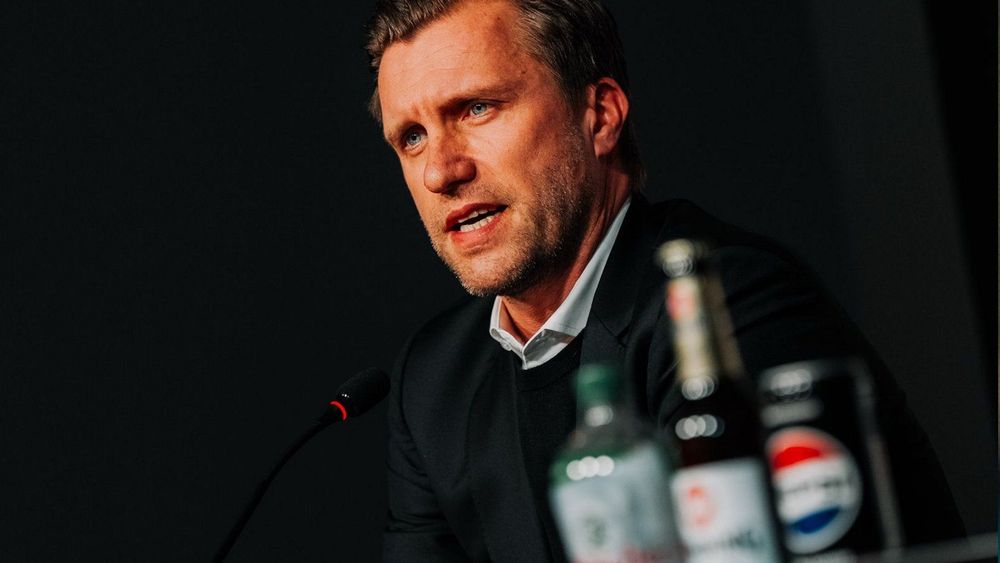
Krösche's exit was confirmed ahead of the club's annual general meeting, where 1,341 members gave the departing sporting executive an emotional send-off. Hellmann, now the club's chairman, has taken over responsibility for sporting matters on an interim basis while Frankfurt search for a successor.
Christoph Spycher, currently associated with Swiss club Young Boys, has been identified in reports as the preferred candidate to replace Krösche.
Speaking at the meeting, Hellmann acknowledged that Frankfurt needed to rethink the financial model that had helped drive their progress in recent years.
“One lesson should be that we must systematically reduce our dependence on transfer income,” he said.
Frankfurt had built a successful approach around recruiting promising players, developing them and selling them on for substantial profits, particularly to clubs in the Premier League. But the most recent summer window exposed the risks of relying too heavily on that model.
“Five or six years ago, we took on the task of deliberately driving players' development on the pitch in order to make economic progress. To achieve a different level and be successful, we used international markets such as the Premier League.
“This path did not work in the same way because of the particular circumstances of this summer's transfer window,” Hellmann explained.
English clubs have increasingly looked to keep their spending within their own market, making deals more difficult to complete on Frankfurt's preferred terms. Jean-Mattéo Bahoya and Hugo Larsson were among the players whose moves to England took time to resolve, with both ultimately leaving on loan arrangements that included purchase agreements.
Frankfurt now want to strengthen the foundations beneath their first team rather than depend on large sales to sustain their finances.
Hellmann described the shift as a need to “sweep in front of our own doorstep” — a commitment to making better use of the club's existing resources and developing more players from within.
That means giving greater attention to the academy and looking more closely at young talent in the wider Rhine-Main region. The intention is to build a stronger local pipeline, providing the first team with homegrown options while reducing the pressure to sell established players to balance the books.
The change comes at a moment of transition for Frankfurt, with a new sporting leader expected to help shape the club's next phase. Krösche's departure leaves an important vacancy, but Hellmann's comments suggest that the review will extend beyond simply appointing a replacement.
Frankfurt want to preserve their ability to compete for European places while making their financial model less vulnerable to the changing transfer market.