
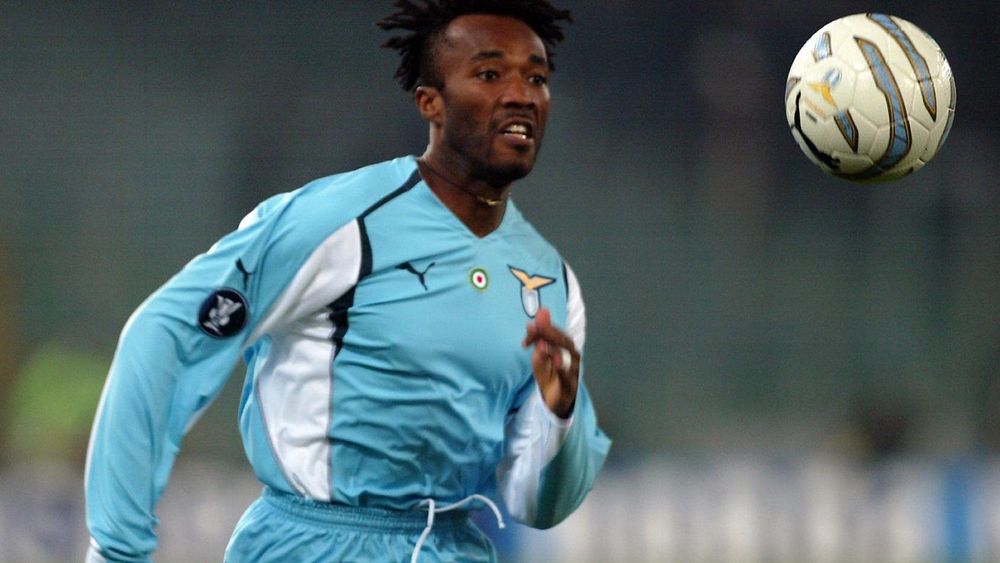
He remembers a team that learned to believe in an ambitious coach's attacking ideas, and a move to Rome that forced him to change his game alongside more accomplished teammates.
His time at Chievo remains one of the most treasured experiences of his career.
“Before arriving at Chievo, I had moved around quite a few teams after Juventus sent me out on loan," Manfredini told Football Presse. Then, finally, I found this environment in Verona that helped me express myself at the highest level.
“I remember a healthy, peaceful environment and a wonderful city, as beautiful as Verona. I remember so many good things, including a fantastic coach who helped us grow enormously, technically, tactically and in terms of personality.
“I also remember a wonderful president who helped us and made us feel so welcome. Chievo was a fantastic period for me, an experience that I still carry in my heart.”
How Luigi Delneri made Chievo believe
Under Luigi Delneri, Chievo became one of the great surprises of Italian football. The club's success was not simply a matter of enthusiasm or a group of players enjoying an unexpected run of form. Delneri had a clear tactical idea, and Manfredini remembers the work required to make it function.
“The coach had developed a slightly attacking idea of football, with two wingers playing alongside two forwards. We could help the strikers score goals, but at the same time, when the team was defending, we had to get back into the defensive line.
“That meant we had to train to be able to carry out this idea of football. We trained enormously hard to develop the athletic strength needed to play that way. Through all that work, we gradually began to understand his ideas.
“Match after match, he convinced us, and we also convinced ourselves that we could make it work. In the end, we enjoyed ourselves enormously, but we also ran a lot. We managed to put everything together.”
The system demanded a great deal from Manfredini and the other wide players. They had to provide an attacking threat while accepting the responsibility of tracking back, making the physical demands of the role central to the team's identity.
The results justified Delneri's approach. Chievo competed against clubs with considerably greater resources and finished fifth in the Italian championship, an achievement Manfredini still regards as extraordinary.
“We managed to compete with the strongest teams in Italy. In my opinion, they were much stronger than us, but we did our job and finished fifth in the Italian championship.
“For Chievo, that was a wonderful result. I think it was a magnificent achievement for the club.”
Why Manfredini could not turn down Lazio
Chievo's performances attracted attention from elsewhere, giving Manfredini a choice about the next stage of his career. Remaining in Verona was a genuine possibility, but Lazio offered the opportunity to test himself at a major club and experience the demands of playing before one of Italy's biggest crowds.
“I was doing well that season, and there were several clubs interested in me. Staying was also an option. I could have remained at Chievo, and I thought about it many times.
“But when a big club calls you, it is difficult to say no. Joining a club of that stature, going to compete with players who were better than me or at least had a bigger reputation, and playing in a stadium like the Olimpico in front of 70,000 people was something that really appealed to me.
“It made me feel genuinely proud. So I accepted Lazio's offer, and it was a very important moment in my career.”
For a player who had found his feet at Chievo after several loan spells, the move represented both recognition of his progress and a new challenge. At Lazio, he was surrounded by teammates whose experience and quality required him to reassess his own approach to the game.
Manfredini does not pretend the adjustment was effortless. Rather than simply enjoying the prestige of joining a major club, he recognised that he would have to adapt if he wanted to continue developing.
“I had to change the way I played because I found myself alongside teammates who were much better than me. But that helped me grow, helped shape me as a player and helped me understand what top-level football was really about.”
That is what makes his recollection of the move particularly revealing. The opportunity to play for Lazio was a source of pride, but it also taught him that reaching a higher level demanded more than simply possessing talent. He had to learn from those around him and adjust to a different standard.
His experience at Chievo had given him the confidence to compete with Italy's strongest teams. Lazio then offered a different kind of education: the chance to understand what was expected of a player at a club where the pressure, the audience and the competition were greater.
Looking back, Manfredini remembers both chapters with affection. At Chievo, he found an environment in which he could express himself and contribute to an extraordinary collective achievement. At Lazio, he discovered how much more he could learn when surrounded by players operating at the highest level.
Together, they marked two defining stages of a career in which hard work, opportunity and the willingness to adapt proved just as important as natural ability.