The architect had to make his vision fit a tightly constrained site — and even he sometimes wondered whether the project would work.
That was one of the most revealing details Chris Beesley discovered when he travelled to Manhattan to speak to the American architect behind Hill Dickinson Stadium.
“I was in his office in the heart of Manhattan on Third Avenue, and he had a model of the stadium,” Beesley recalled to Football Presse. “And he admitted to me, he said he used to wake up in the middle of the night thinking the site wouldn't be big enough because it's quite tight, the stadium footprint.
“He'd be ringing up his guys and his team and he'd be saying, ‘Just go and measure it again,’ or he'd go on to Google Maps or Google Earth.”
For Beesley, the admission was striking. Supporters see the finished stadium rising above Liverpool’s waterfront, but the person responsible for designing it had spent sleepless nights worrying about whether it could physically fit.
“Just learning that the architect wasn't convinced it was actually going to sit on site — that was the big one for me.”
The concern was not an abstract architectural problem. The stadium’s orientation, footprint and available space all had to be considered together. Most football grounds are aligned north to south, partly to limit the sun’s impact on players, particularly goalkeepers.
Meis had considered whether the site restrictions might force him to orientate the stadium differently.
“At one point he thought he might have to go west-east just because of the site constraints,” Beesley explained. “But he was okay.”
It was a glimpse into the practical challenges behind a project that, from the stands, can look deceptively straightforward.
Why Everton could not simply build a bigger stadium
The question of capacity was another major issue Beesley explored with people involved in the project.
Everton’s new home holds 52,769 spectators, and the club attracted its biggest regular crowds in its history during the first season there. Yet some supporters wondered why the stadium had not been built to accommodate 60,000 or more, particularly when rival Premier League clubs have expanded to those levels.
Meis offered one explanation based on the economics of stadium construction.
“He's always argued that he thinks that there is actually value in having scarcity of tickets,” Beesley said. “And he's pointed out that as an architect, the last 5,000 seats are the most expensive to build.”
But Beesley also spoke to Richard Kenyon, the club executive, who provided another crucial piece of the picture.
“Richard Kenyon at the club basically told me, he said, you couldn't have built 60,000 on that site.”
The choice, as Beesley understood it, came down to competing priorities: a larger stadium somewhere else, or a stadium on the preferred site.
“It was either go for the bigger stadium and sacrifice that location, or you go for the location. So that's the payoff, basically.”
It helps explain why the capacity debate cannot be separated from the decision to build on Liverpool’s waterfront. A larger ground might have accommodated more supporters, but the project would have lost one of its defining features: its position within the city.
For Everton, whose identity is closely bound to Liverpool’s north end, that was no small consideration.
A stadium shaped by listening to supporters
The location mattered for another reason. Everton had spent decades searching for a replacement for Goodison Park, with previous proposals failing to materialise. The prospect of moving outside the city boundaries had proved particularly contentious.
Beesley recalled how the club had once explored a move to Kirkby in partnership with Tesco, a plan that would have taken Everton beyond Liverpool.
“For Everton to move outside the city boundaries, it would have been a real sort of public relations own goal,” he said.
The eventual move to the waterfront offered a very different outcome. And, according to Beesley, the process of consulting supporters helped make the transition more successful.
“Every step of the way the club was consulting the supporters. What do you want?”
Meis himself engaged directly with fans online, inviting feedback on ideas and listening to what they wanted from their new home.
“Dan Meis, the architect, would be able to have conversations with the supporters. That was one of the positive things about it. He'd go on Twitter, which is now X, and he would just put ideas to supporters and they would let him know what they wanted.”
Beesley believes that helped produce a stadium that met many of the expectations of the people who would use it.
“Everything kind of came together to actually be a real exemplar of how to go about building a new stadium as well as you can do, in terms of its location and the way the stadium was built.”
He recognises that leaving Goodison Park after 133 years was emotionally difficult. But the new stadium’s location, design and consultation process helped soften the break with the past.
The financial argument for Everton’s new home
The stadium’s significance extends beyond its architecture. Beesley also discussed its potential economic impact with Kieran Maguire, the University of Liverpool academic known for his work on football finance.
Beesley said financial experts had forecast that the new ground could bring in an additional €60 million a year in revenue. While he was careful not to claim expertise in every detail of the financial regulations, he highlighted Maguire’s view that the changing rules could favour clubs with large supporter bases.
“He told me this new system would sort of favour teams who have a lot of fans, who have big supporter bases,” Beesley explained.
That could give Everton an opportunity to turn the loyalty of their supporters into a more powerful financial platform. The stadium has also hosted international rugby fixtures and is due to stage matches at a future European Championship, extending its use beyond Everton’s home games.
For Beesley, the combination of the ground and the club’s following offers considerable potential — provided the people running Everton can make the right decisions.
“You've got that huge supporter base, probably that the club don't deserve in many ways in terms of what they've achieved or not achieved in recent times,” he said.
“And you combine that with the new stadium, and it's actually — if somebody does have a vision —”
That final qualification matters. A new stadium can provide the facilities, matchday income and wider commercial opportunities, but it cannot guarantee sporting success on its own.
The work is not finished
Beesley’s conversations also made clear that a successful stadium project is not judged solely by its appearance or seating capacity.
He believes Everton’s new home has been embraced more quickly than might have been expected, with the supporters generally adapting well despite the emotional significance of leaving Goodison. Yet there are details still to address, from the stadium’s relatively bare concourses to the transport arrangements after matches.
His own experience of taking his three daughters to the FA Cup tie against Sunderland in January exposed one of the practical shortcomings.
“Getting away at full time — that was a nasty surprise about how long that took just to get out the car park and then the roads were so slow.”
He also believes the club could add more personal touches to make the stadium feel unmistakably Everton. Ideas include further recognition of the club’s history, more prominent Everton branding and statues celebrating figures such as goalkeeper Neville Southall and former manager Joe Royle.
The foundations, however, are in place. Meis had to solve a difficult architectural puzzle; Kenyon explained why the chosen site imposed limits on capacity; and Maguire’s analysis offered a perspective on the financial opportunities ahead.
Together, those conversations helped Beesley understand the project as more than an impressive building. It is a stadium shaped by compromises, supporter input and the need to balance ambition with the realities of a restricted site.
For Everton, the next challenge is to make the most of what has been built.
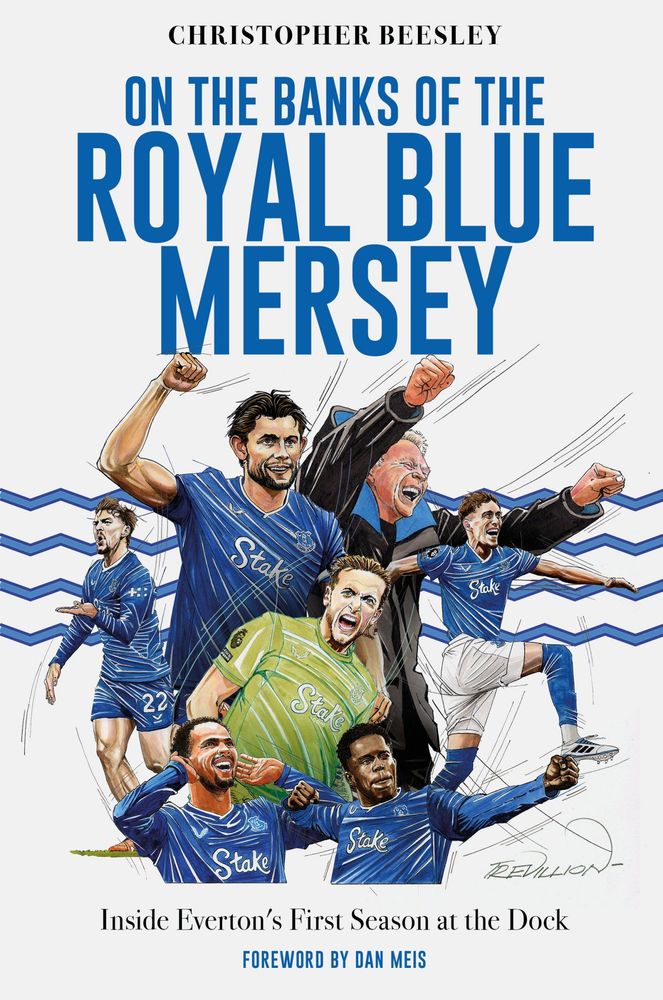
Christopher Beesley is author of "On the Banks of the Royal Blue Mersey: The Inside Story of Everton's First Season at Bramley Moore Dock" from Pitch Publishing - which is available here.