
That gives Simões a particular perspective on the Portuguese coach. One of Benfica's great players of the 1960s, Simões won the European Cup with the club in 1962, collected 10 Portuguese league titles and represented Portugal at the 1966 World Cup. He was only 18 years and 139 days old when Benfica beat Real Madrid 5-3 in that European Cup final, making him the youngest player to win the competition, a record that still stands.
So when Simões speaks about Mourinho, he is not looking back at the finished career of a famous manager. He is remembering the young man he encountered at Benfica, before Mourinho became José Mourinho.
“I have good impression about him," he tells Football Presse. "I think he born to be a coach, not to be a player, because he never was a good player. But he was very interesting and to learn how to be more than be a coach, to be a leader. He understood when he was young that, that, that part of to be, um, with the, with the players or with the team was to be a leader.”
That distinction is important to Simões. Mourinho's gift, in his eyes, was not simply an understanding of football. It was an understanding of people and the ability to persuade them to follow him.
“He had a good speech. He convinced the players the way they have to go to get success, and I think he has that merit. We have to recognize that this guy, uh, born to be a coach, and he did very well, and he had incredible success very young until today how a coach.”
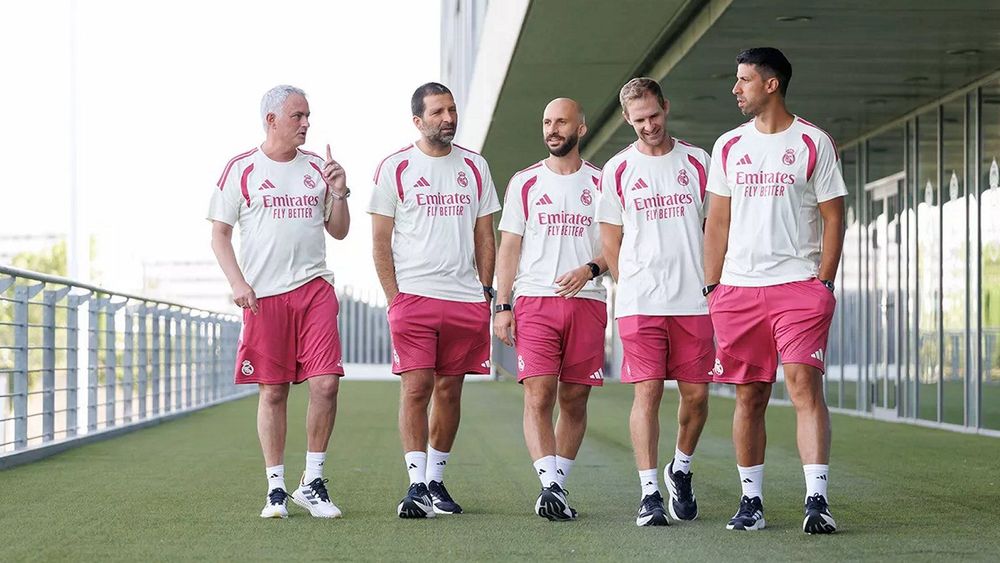
Mourinho's subsequent career would make that early impression look remarkably prescient. After beginning his senior managerial career with Benfica and União de Leiria, he won the UEFA Cup and then the Champions League with Porto, before adding Premier League titles with Chelsea, a Champions League and Serie A title with Inter, La Liga with Real Madrid and further major honours with Manchester United and Roma. He has now returned to Real Madrid for a second spell, taking charge again in 2026 after leaving Benfica.
Yet Simões' description of the young Mourinho points towards something broader than tactical ability. For him, the defining quality of a coach is leadership.
That is a theme Simões returns to elsewhere in the conversation. He argues that coaches matter, but that they cannot create the fundamental footballing talent possessed by the players. A manager can organise, educate and lead, but the player ultimately has to perform.
That makes his assessment of Mourinho particularly interesting. He did not simply see a young man who understood tactics. He saw someone who already understood how to get footballers to believe in an idea.
For Simões, that ability separates coaching from leadership.
It also explains why he is cautious when asked whether Mourinho should eventually take charge of Portugal.
“I think it's a good question. I don't know what José Mourinho think about that. I don't know if he's prepared, mental prepared, to be, um, national team coach. I don't know if he wants to training every day or if, uh, decide to make the next steps, uh, working less but with, with the same enthusiasm, uh, with the same motivation to get success.”
There is no suggestion from Simões that Mourinho would lack the authority or footballing knowledge for the job. His uncertainty is about something much more personal: what Mourinho wants from the next phase of his career.
“I believe so. So depends what he wants to do. He wants to be in the game every single day or maybe a game per month. That is the question. He's ready to leave what he loves or to get parts of what he loves to be in the national team.”
That question has become more intriguing with time. Mourinho has remained on club football's frontline for more than two decades, and even after spells at Tottenham, Manchester United, Roma and Fenerbahce, he returned to Benfica in 2025 before accepting Real Madrid's offer to come back this season.
His return to Madrid also illustrates the extraordinary longevity of the career Simões could already envisage in that young coach. Mourinho is now working at the same club where he previously managed between 2010 and 2013, having already won the Champions League twice in his career, with Porto and Inter.
But Simões' memory of Mourinho remains rooted in something much simpler than trophies.
He saw a young man who understood that being a coach was not enough.
The coach had to become a leader.
And for Simões, that was the quality Mourinho possessed before the titles, before the Champions League nights and before his name became synonymous with winning.
“He understood when he was young that, that, that part of to be, um, with the, with the players or with the team was to be a leader.”
More than two decades after Mourinho began his senior managerial career, that remains one of the most revealing descriptions of him from someone who knew him before the rest of football did.