
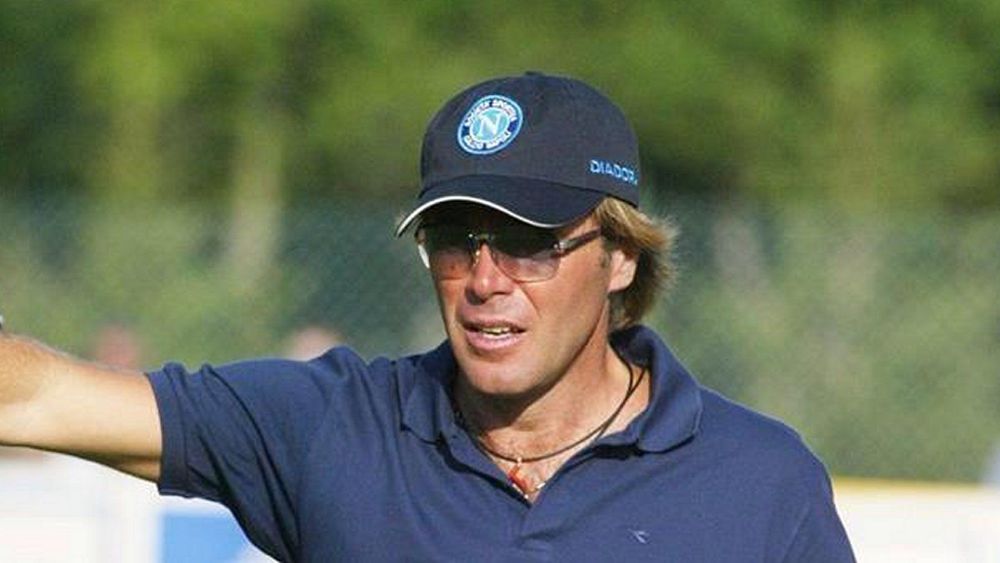
He came through the Lazio youth system, made his Serie A debut as a teenager and eventually played alongside some of the most recognisable figures of his generation. He later moved into coaching, working in Serie A and Serie B before taking his career abroad, including spells in Albania that gave him a very different perspective on the game.
For Agostinelli, though, the memories are not separated neatly between player and coach.
They are all part of the same football life.
“I can tell you that Lazio and Atalanta are the teams where I performed best,” Agostinelli told Football Presse.
“With Lazio, I became known at 18. I made my Serie A debut and from there I became known. I went into the Under-21 national team and was among the 40 players considered for the World Cup.”
Those early years at Lazio placed Agostinelli alongside players who would become part of the club's history.
Among them were Giorgio Chinaglia and Bruno Giordano.
For Agostinelli, the two strikers represent very different parts of Lazio's identity.
“Giorgio Chinaglia and Lazio are the same thing,” he said. “You could wait a thousand years, but Giorgio Chinaglia equals SS Lazio.”
That does not mean Agostinelli considers Chinaglia the greatest striker he played with.
“I'm not saying he was the best centre-forward,” he explained.
“For me, Bruno Giordano, who is like a brother to me, was one of the first three centre-forwards in Lazio's history in terms of technique and importance.”
And Agostinelli has a simple argument for Giordano's place among the club's greats.
“He was Serie A's top scorer, but above all, think about what Diego Armando Maradona said when he was at Napoli. Giordano, Maradona, Careca. That's enough to make you understand what kind of centre-forward he was.”
Agostinelli's own playing career eventually took him to Atalanta, where he found perhaps the most successful period of his career.
“I spent three spectacular years there,” he said.
“Two years in Serie B and one in Serie A. I lost only one or two matches.”
His second season in Bergamo brought individual recognition as well.
“In Serie B I won the award for the best player in the championship, ahead of Vialli and Matteoli. Then in Serie A it was a great season.”
The move from player to coach eventually became inevitable.
Agostinelli worked his way through the Italian leagues before taking charge in Serie A, including at Piacenza. It was there that he coached a young Enzo Maresca, whose subsequent managerial career has taken him all the way to Manchester City.
Agostinelli remembers seeing something unusual in the midfielder.
“I thought he could become a great coach,” he said.
“He was a young guy who was obviously playing regularly with me in Serie A, but he already had the idea of the great midfielder, the great coach.”
The coaching career took Agostinelli into environments ranging from Napoli to smaller clubs and, eventually, overseas.
He refuses to rank those experiences simply by the size of the stadium.
“I coached Napoli in front of 50,000 people,” he said. “And I coached in Malta in front of 200 people.”
“For me, when a coach coaches, he experiences the same emotions regardless of the importance.”
That philosophy helps explain why Agostinelli has continued to seek opportunities outside the biggest stages.
His first move abroad as a coach came with Partizani in Albania in 2016, followed by Skënderbeu later that year. He subsequently worked in Malta before returning to Albania with Flamurtari in 2024.
His affection for that part of the football world is clear.
But his most memorable coaching experience in Italy remains Piacenza.
“I would say Piacenza in Serie A,” he said.
“I had players like Maresca, Di Francesco and Hubner. It was an important Serie A experience.”
There is also something revealing in the way Agostinelli talks about Flamurtari, where he enjoyed a remarkable run before eventually leaving the club.
“I had won too many games,” he joked. “What could I do?”
That sentence captures something of Agostinelli's personality: competitive, self-deprecating and still clearly fascinated by the daily business of football.
His assessment of his own future is similarly straightforward.
“I still have a lot of desire and a lot of experience to give to young players and teams.”
That desire has survived the changes in the game and the passage of time.
Agostinelli has been the teenage Lazio midfielder, the Serie A player, the Atalanta standout, the coach under pressure, the manager working in front of 50,000 people and the Italian willing to take his career abroad.
The settings changed.
The emotion did not.
“When a coach coaches,” he said, “he experiences the same emotions regardless of the importance.”
For someone who has lived almost every version of football, that may be the simplest explanation for why Andrea Agostinelli is still here.