
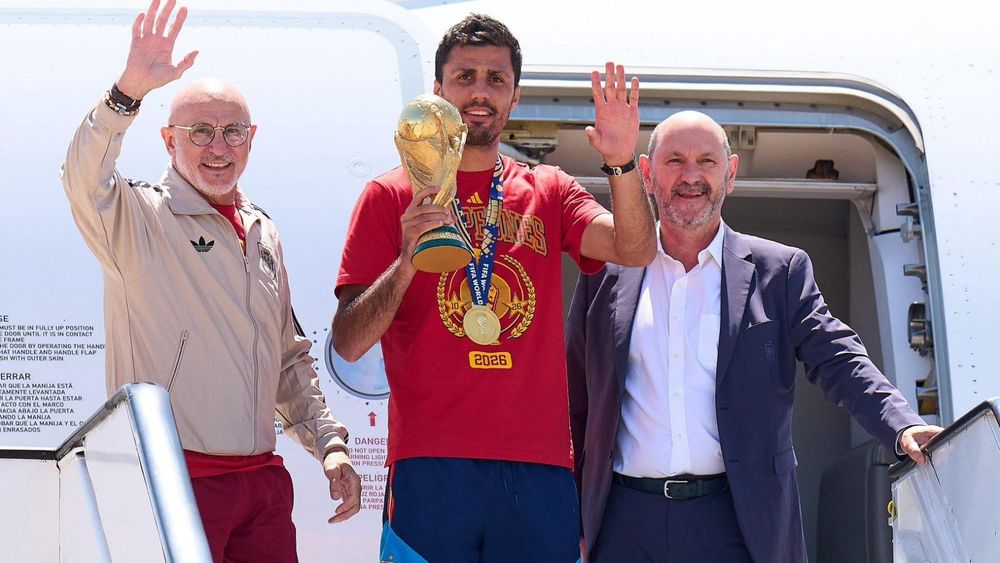
The story begins in 2019, when Rodri was still at Atlético Madrid and Pep Guardiola's Manchester City had identified him as a target. That summer, the midfielder waited until the last moment hoping an offer would arrive from Real Madrid, but with Toni Kroos, Luka Modrić and Casemiro still established in the squad, a move to the Bernabéu was never a realistic option.
Rodri instead paid his release clause to join City, a decision that, with hindsight, transformed his career under Guardiola.
Real Madrid's interest resurfaced this summer, but the club was never fully convinced. It was only after the World Cup final, once Rodri had produced a string of standout displays, that the club's resistance finally gave way, driven by his contract entering its final year, Guardiola's own departure from City removing one reason to stay, and a growing sense that Rodri offered something Real Madrid's squad was missing.
But that hesitation may have been the problem: Real Madrid moved to sign a superstar without the total conviction the moment demanded, and the player noticed.
According to reports, doubts persisted even after Real Madrid's president, Florentino Pérez, and chief executive José Ángel Sánchez made contact. One phrase said to have circulated within the club's Valdebebas training complex summed up the hesitancy: "He sits on the ball too much, he's not what we're looking for" — a striking assessment given Rodri completed more passes than any other player at the World Cup, at a completion rate above 93%.
Real Madrid, reportedly, had been looking for a more dynamic, physical profile in midfield.
By contrast, Barcelona pursued Rodri with total conviction. Sporting director Deco, president Joan Laporta, head coach Hansi Flick and much of the first-team squad all made contact with the midfielder personally. The financial offers from both clubs were reportedly identical, suggesting money was not the deciding factor.
Instead, Rodri appears to have been swayed by the strength of Barcelona's project, built around a clearly defined playing style that mirrors the one used by the World Cup-winning Spain side, with an established hierarchy already in place within the squad — in contrast to what was seen as a more uncertain project at Real Madrid under Mourinho.
Once his decision was made, Rodri is said to have called José Ángel Sánchez directly to thank Real Madrid for their interest and respect before closing the saga, then waited for Barcelona to reach an agreement with City — a deal that reportedly required five separate offers before Manchester City accepted the terms.
Reacting to the transfer on Movistar Plus, former Real Madrid player, coach and sporting director Jorge Valdano offered a pointed assessment of what the move means for both clubs.
"For me, Rodri is worth €35 million in what he adds to Barcelona, and €40 million in what he takes away from Real Madrid," Valdano said, describing the signing as "a strategic move by Barcelona."
He predicted the midfielder's influence at Camp Nou would be understated rather than transformative.
"He's not going to influence Barcelona's play all that much, though he'll put an accent on everything Hansi Flick proposes."
Valdano was more emphatic about what Real Madrid have missed out on.
"Real Madrid would have revolutionised the team's play and improved everything around it. The ball would have reached the forwards sooner, and in better condition," he said. "That's the kind of influence players like this create — not so much an effect on scoring, but an effect on the game itself. That's why he's the best player in the world."