
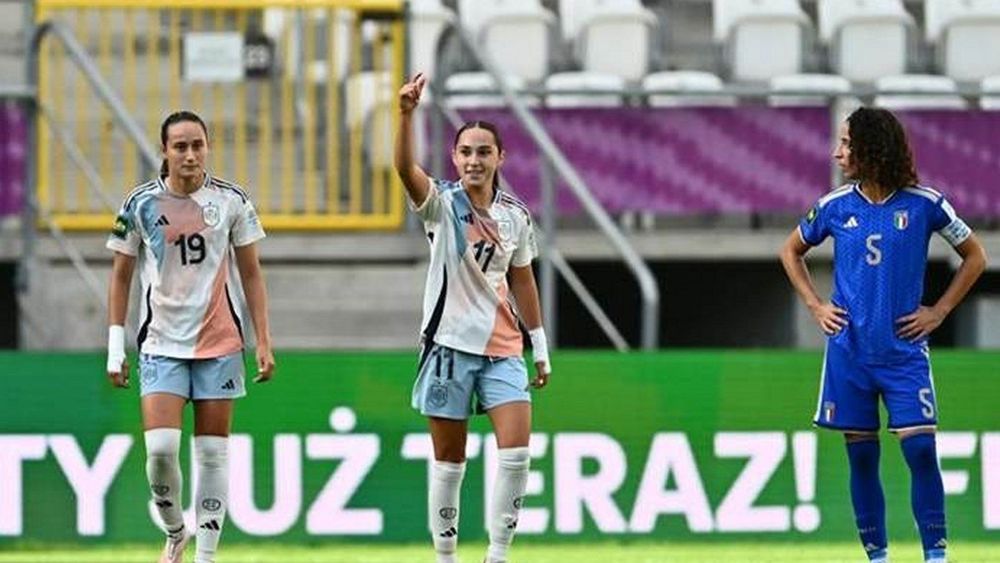
It was Spain’s second championship in three tournaments, following their 2022 triumph in Costa Rica, and ended DPR Korea’s attempt to become the first nation to win the competition in consecutive editions.
The tournament also offered a broader picture of the development of the women’s game, with all four Asian teams advancing from the group stage, six European nations reaching the knockout rounds and Colombia producing its best-ever U-20 World Cup finish.
Poland make an immediate impact
Hosts Poland were one of the stories of the group stage, winning all three games on their debut to top Group A.
Their opening 3-0 victory over Argentina in Katowice, watched by 4,401 spectators, proved decisive in a group that also contained Mexico and debutants Benin.
The tournament's opening match also included a significant gesture away from the pitch, with children from Poland's Ukrainian refugee community serving as player escorts through a joint FIFA Foundation and UNHCR initiative.
Benin were another important part of the tournament's story despite finishing bottom of the group.
Forward Romaine Gandonou, just 15, scored both goals in their 2-2 draw with Mexico and also found the net against Poland.
Gandonou plays for Tambours FC and has already established an extraordinary scoring record at domestic and youth international level.
She scored 53 goals in 14 matches in Benin's second division in 2023-24 before adding 19 goals in 15 top-flight appearances the following season.
Her international progression has been even more remarkable. Gandonou made her senior debut for Benin at 14 and scored 14 goals in six U-20 World Cup qualifying matches, including hat-tricks against Guinea and Egypt.
She also trialled with Paris Saint-Germain in May. Her performances in Poland will only increase interest in a player who appears likely to move into European football before long.
Canada survive after a difficult start
Brazil won all three Group B matches, while England finished second ahead of Canada on fair-play points after the two sides finished level on points, goal difference and goals scored.
Canada advanced as one of the best third-placed teams after recovering from a 3-0 defeat to Brazil by beating Tanzania 6-0.
Notre Dame forward Annabelle Chukwu scored twice against Tanzania and has now established herself as Canada's all-time leading scorer across the women's youth national teams, surpassing the previous mark held by Christine Sinclair.
Kaylee Hunter of AFC Toronto was another standout, scoring a hat-trick against France in the Round of 16 as Canada won 3-1.
Canada's progress eventually ended against DPR Korea in the quarterfinals, but the tournament represented another strong showing for the reigning CONCACAF U-20 champions.
Asia and Europe set the standard
France and Korea Republic advanced from Group C, while Italy topped Group D ahead of Japan.
The United States squeezed through as the best third-placed team after a 9-0 victory over New Zealand, setting a new record for the largest U.S. margin of victory at a U-20 World Cup.
Bay FC midfielder Kennedy Fuller scored a hat-trick, while Alex Buck of the University of Washington scored twice.
The U.S. subsequently lost to Brazil on penalties in one of the tournament's best matches.
After a 1-1 draw, Brazil won the shootout 5-4. Seattle Reign's Emeri Adames saw her first penalty saved, while Brazilian goalkeeper Thais Lima stopped the decisive American attempt.
The result extended a disappointing trend for the U.S. at this level. After winning three of the first six editions between 2002 and 2012, the Americans have not returned to the final and have managed only one third-place and one fourth-place finish since 2014.
The loss also renewed questions over the availability of players for the tournament, with several NWSL clubs declining to release American prospects.
Nigeria offer a glimpse of the future
Nigeria were the only African team to reach the knockout rounds and defeated England 3-0 in the Round of 16.
Tosin Rafiu opened the scoring before Benfica-bound Janet Akekoromowi and Mary Manadu completed the victory.
Akekoromowi had attracted interest from Barcelona and PSG before signing a two-year contract with Benfica after moving from Bayelsa Queens.
Nigeria's squad was particularly young, containing three 16-year-olds, four 17-year-olds and six players aged 18.
Coach Moses Aduku was therefore able to take considerable encouragement from the tournament despite the quarterfinal defeat to Colombia.
"I think, in Nigeria, we have seen the future of our players," Aduku said. "And I think the future is very bright."
He was right to focus on the development aspect, particularly after Nigeria's senior side suffered a disappointing Women's Africa Cup of Nations campaign in Morocco.
Colombia reach new heights
Colombia eliminated hosts Poland in the Round of 16 and then defeated Nigeria 1-0 in the quarterfinals before losing 3-0 to DPR Korea in the semifinals.
Portland Thorns midfielder Valerin Loboa scored the late winner against Nigeria after her initial shot was saved, while San Diego Wave goalkeeper Luisa Agudelo produced an outstanding performance.
Agudelo then became decisive again in the third-place match against Italy, saving two penalties as Colombia won 4-3 after a 1-1 draw.
The result gave Colombia its best-ever U-20 World Cup finish, improving on fourth place in 2010.
Marseille forward Sintia Cabezas scored Colombia's equaliser after Italy had taken the lead.
Cabezas' career has already taken her through Colombia, the NWSL, the USL Super League and Spain before she joined Marseille.
Spain's Comendador becomes the tournament's breakout star
Spain defeated Brazil 1-0 in the quarterfinals, with Real Madrid forward Pau Comendador scoring the only goal.
Comendador was one of the tournament's revelations.
She joined Madrid CFF at eight, spent six seasons there and moved to Real Madrid in 2021. After progressing through the club's youth structure and B team, she made her senior debut in 2023.
In Poland she became Spain's leading scorer and finished with six goals and one assist, winning the Golden Boot.
She was joined among the tournament's award winners by Barcelona's Rosalia Dominguez, who received the Golden Ball, while Real Madrid goalkeeper Laia Lopez won the Golden Glove.
Lopez conceded only once throughout seven matches.
That came against China in Spain's 3-1 group-stage victory.
Spain then defeated Italy 2-0 in the semifinal, with Daniela Agote involved in both goals and Comendador scoring her sixth of the tournament.
Italy could nevertheless look back on its campaign with considerable pride. After group-stage exits in the previous two tournaments, the Azzurrine reached the semifinals and ultimately finished fourth, their best-ever result at the U-20 World Cup.
DPR Korea remain a youth powerhouse
DPR Korea defeated Japan, Canada and Colombia without conceding a goal on their way to the final.
Their semifinal victory over Colombia was 3-0, extending their extraordinary tournament record to 13 consecutive victories dating back to their championship run in 2024.
They also entered the final having gone nine consecutive matches without conceding a goal.
DPR Korea already had three U-20 titles, level with Germany and the United States, and could have become the first repeat champions.
Instead, Spain's Laia Lopez saved two penalties in the shootout to secure the title.
Lopez also made an important save during regulation time, getting a hand to a Ho Kyong effort.
The result confirmed Spain's position at the top of the women's youth game. They are now the reigning senior Women's World Cup and U-20 World Cup champions, while their U-17 side will soon have an opportunity to add another global title.
For DPR Korea, the challenge remains converting extraordinary youth success into senior-level results. Their U-20 and U-17 teams remain among the world's best, but the senior side has reached the knockout stage only once in its last three World Cups.
Club release issues return to the spotlight
The tournament again highlighted the tension between international youth football and club priorities.
Five American players were not released by NWSL clubs for the U-20 World Cup, while England also lost several players to club commitments.
North Carolina Courage did not release England youth international Meg Parkinson, while San Diego Wave withheld Laila Harbert. Aston Villa also did not release Lexi Potter.
There was an irony to the situation involving Parkinson. She was subsequently called into England's senior squad for their 2027 Women's World Cup playoff matches against Poland, where the games fall inside a FIFA international window and clubs are required to release players.
The U-20 World Cup did not carry the same release obligation.
Aston Villa did release Rachel Maltby, however, and she finished the tournament as England's leading scorer with four goals.
A tournament with an attendance problem
The quality on the field was often high, but attendance was a clear weakness.
Poland's home matches produced the strongest crowds, including 5,026 for their Round of 16 defeat to Colombia.
Many other matches attracted only a few hundred spectators. The two semifinals drew fewer than 1,000 combined, while the third-place match attracted 1,205.
One reported tournament total was 37,307 spectators, an average of around 717 per match, although the final attendance figure was not available at the time of publication.
That is a concern for FIFA and the host market, but the tournament still represents an important development opportunity for Poland ahead of its upcoming Women's World Cup qualifying play-offs against Belgium.
The global picture
The confederation breakdown tells its own story.
All four AFC representatives — China, Japan, Korea Republic and DPR Korea — advanced from the group stage, with DPR Korea reaching the final and Korea Republic making the quarterfinals.
UEFA also performed strongly, with Spain and Italy reaching the semifinals and England, France, Portugal and Poland reaching the Round of 16.
CONMEBOL had three of its four teams reach the knockout rounds, with Colombia taking third place and Argentina and Brazil also advancing.
CONCACAF saw Canada and the United States progress, although the Americans went out to Brazil on penalties.
Nigeria were the only CAF team to reach the knockout stage, while New Zealand and New Caledonia both failed to collect a point for Oceania.
The results underline how widely the women's game has developed.
Spain ultimately lifted the trophy, but the most significant conclusion from Poland may be that the next generation is coming from an increasingly broad range of countries, clubs and development systems.
That is the real legacy of the 2026 U-20 Women's World Cup.
- Read the full version at Tim Grainey's Substack. His latest book is Beyond Bend it Like Beckham on the global game of women’s football. Get your copy today. Follow Tim on Twitter: @TimGrainey