
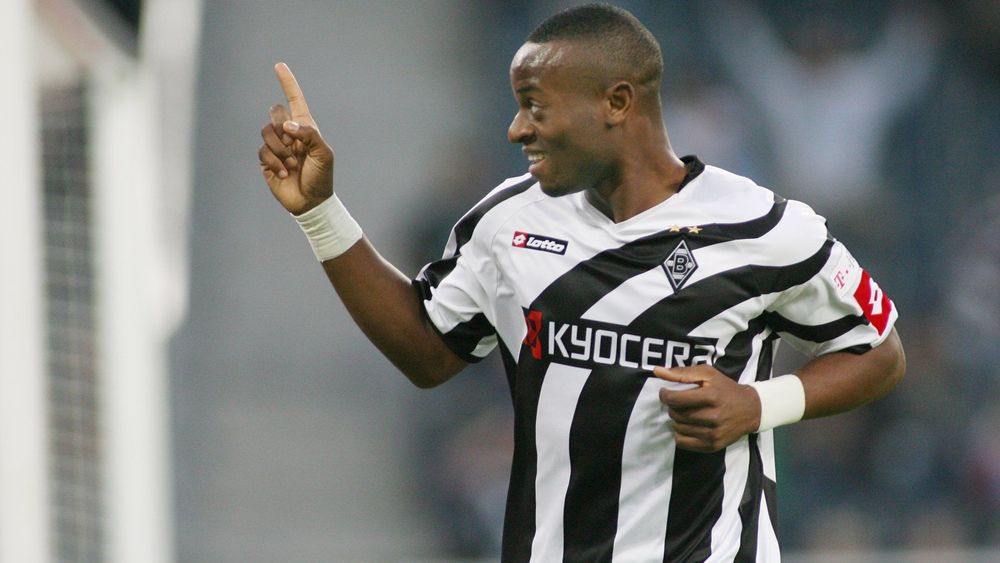
He wanted Arsenal.
The former Hertha BSC, Borussia Mönchengladbach and Augsburg forward believed Denmark could provide the platform for the next step, even if it meant leaving Germany and taking what looked like a step down.
“I was eager to play in the Premier League. I always had that feeling that I would like to play in the Premier League,” Rafael tells Football Presse.
“If I can do well there, I might be playing for my favourite club, which is Arsenal. That was the dream. That was something that I really wanted to achieve.”
The thinking behind his move to Denmark was straightforward. Rafael believed that playing regularly, scoring goals and performing in the Danish league could put him back on the radar of clubs in England.
“That was the reason why I took the decision to play in the Danish league, performing there, because if you can compare Bundesliga and the Danish league, you have a huge difference.
“I thought I could take advantage of that. I could go there, perform, score goals and then from that particular space go to the Premier League.”
It was a gamble based on ambition rather than necessity.
Rafael had already experienced German football at the highest level. He had played for Hertha and Borussia Mönchengladbach, had experienced the pressure of fighting at both ends of the Bundesliga and had established himself as a player capable of operating at that level.
But he wanted something more.
“I wanted to play more regularly and I wanted to have the opportunity to show what I could do. I thought that if I could go to Denmark and perform there, it could be the bridge to England.”
Instead, the move became one of the more difficult periods of his career.
“I had some injuries and some physical problems, so it was not really the experience that I wanted to have.
“It was difficult because when you have these kinds of problems, you cannot really get the rhythm that you need. You want to play, you want to score, you want to perform, but your body is telling you something different.”
The problem was not simply that Denmark had failed to provide the expected route into the Premier League. Rafael was also having to adapt to a different football culture after years in Germany.
“When you move from Germany to Denmark, it's not only about the football. Everything is different. The culture is different, the way people see football is different, the way the game is played is different.
“And when you are coming with the idea that you have to perform, that you have to score goals, that you have to show that you are ready for the Premier League, you put a lot of pressure on yourself.”
The plan had been to use Denmark as a launchpad.
Instead, the injuries meant Rafael was fighting simply to establish continuity.
“You need to be fit. You need to be able to play every week. You need to have that rhythm, because that's how you can show people what you're capable of.
“When you're injured, you can train, you can come back, then something happens again. It's frustrating because you know what you want, but you cannot control everything.”
And so the Arsenal dream gradually moved further away.
Rafael did not abandon the ambition because he stopped believing in himself. Football simply took him somewhere else.
China.
“When I went to China, there was also the financial part. You have to think about your career, you have to think about your family. But I also wanted to experience something different.”
What he encountered was considerably different from anything he had experienced in Europe.
“At first I had the feeling, okay, they're recognising me as a new signing of the club. But that was completely the opposite. It was pure, ‘Oh man, we're seeing a black guy.’
“People were looking at me, following me, taking pictures. Sometimes they would even touch my hair. Some people thought I was American.
“At the beginning it was ridiculous, really, and I'm like, what the f***?”
But Rafael chose to respond with curiosity rather than hostility.
“I'm a guy who, if I see things like that, I give the people the opportunity to come closer, really to experience that I'm a human being like they are.
“The only difference between us is the language and, of course, the culture.”
That approach eventually transformed his experience.
“I had an amazing experience. It showed me also that the world is so big and there are so many things to learn.”
He had to learn how to live in an environment where even ordinary tasks could be difficult because of the language and cultural differences.
“I had to learn how to order food, how to go to restaurants, how to live there. At the beginning you don't know anything. You don't know what people are saying, you don't know what they're thinking.
“But after a while you start understanding things and you start adapting. That was something that I really enjoyed.”
The irony was that Rafael had gone to Denmark believing it would take him closer to England, only for the journey to take him in the opposite direction.
Yet he now sees that chapter differently.
“Football is not only about playing football. It's also about experiencing life, experiencing different cultures and understanding how other people live.
“You can play football in China, Japan, Korea, and you can really learn something. I always say to people, if you have the opportunity to live in a country like that, take it.”
Arsenal never arrived.
The Premier League dream that had driven the decision to leave Germany remained unfulfilled, but Rafael's career continued to take him places he could never have mapped out when he was dreaming of playing in England.
Denmark had been intended as a stepping stone.
China became something else entirely — not the destination he had planned for, but an experience that ultimately gave him a much wider view of football and life.