
He left Angola when he was nine, almost 10, and eventually joined Ajax, where he learned a football that demanded far more than technical ability.
"When I left Angola, there was a huge reason why I left Angola," he tells Football Presse. "But coming to Holland and being part of the Ajax Academy, it gave me trust, how to believe in myself that I'm able to create something big.
"It gave me a lot of confidence as well in my own person. And the Ajax DNA back in the day, even now, but it wasn't the way it was before, is the winning mentality.
"Becoming second in a competition, which is a huge effort, or a good thing to do if you become second, but for Ajax mentality it wasn't acceptable. They say if you become in second place, you are the first loser. For us it was, either you become number one or no."
The academy also taught Rafael to see football from positions other than his own. Players were expected to understand the responsibilities of teammates, while coaches encouraged them to take risks and learn through mistakes.
"You have to make mistakes so you can learn from those mistakes. And when you are in the game, you're not just playing the game to win the game, you have to play the game to dominate.
"The coach was asking me to play in different types of positions, so I could get the understanding of what the fullback does, what the attacking forward does, number 10, number seven, number eight. I should really know the function.
"So the details and the tactical discipline that I learned in Holland, and also the technique, how to handle the ball, because this is something we did every single day, passing drills. That made me able to play in different types of leagues."
Rafael's first taste of senior football came with Hertha BSC Berlin, where he arrived as a young player and immediately found himself in one of Germany's most visible football environments.
"Coming into the Bundesliga as a young player, living my dream at Hertha BSC Berlin, that was one of my first experiences, the most exciting experience, coming new into the league. Everything is new, just to start my career.
"Berlin was very exciting. Every eye is on Berlin, playing in a stadium, a historic stadium, the first Olympic Games in Germany in 1936, and playing for such a big club with a large fan base was very exciting for me."
He scored his first professional goals against Kaiserslautern, finding the net twice in a match Hertha needed to win to qualify for the UEFA Cup. He actually completed a hat-trick, although his first goal was ruled offside.
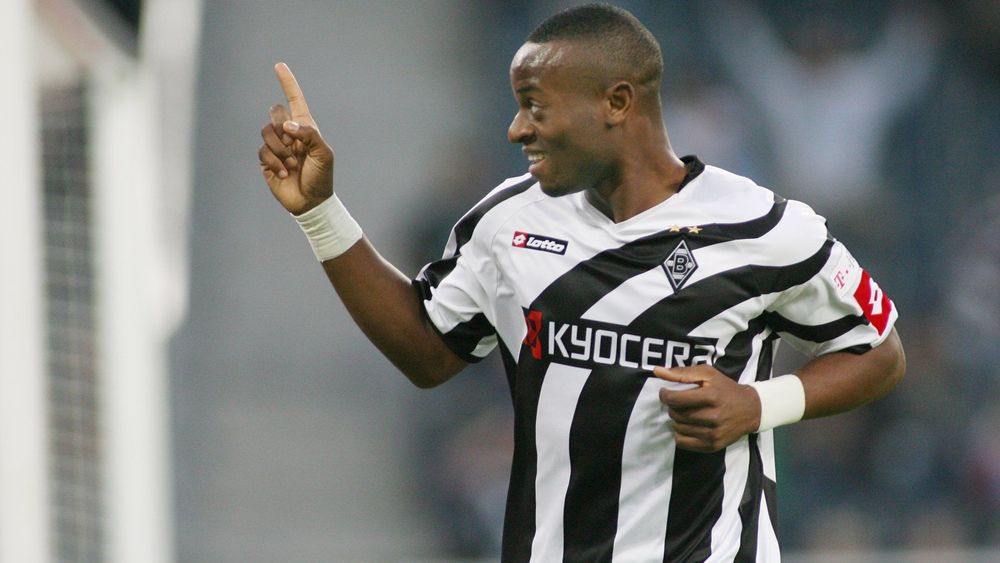
His career subsequently took him to Borussia Mönchengladbach, where the education became considerably harsher. Gladbach survived relegation during his first season before going down the following year, exposing Rafael to a different side of German football.
"It was my first time really playing against relegation, learning to fight. Sometimes it's really only about the results, and the fighting mentality.
"That was also my first experience playing in the second Bundesliga. I learned there as well how the second Bundesliga is, because the quality of the players is a bit different. In the first Bundesliga you have a lot of international players. Every single mistake in the first Bundesliga you can be punished, and in the second Bundesliga you fight more."
Rafael considers Augsburg the most successful period of his playing career. He arrived with Bundesliga experience and quickly became more than a striker, helping connect the younger players with the experienced core of the squad as Augsburg pushed for promotion.
"I came as the missing piece that the club and the team needed. I had to take the responsibility on the pitch and off the pitch, also in the dressing room.
"In my character as a person, I always build a golden bridge between young players and an older player. I had already experienced playing Bundesliga, and we didn't really have many players who played the Bundesliga.
"So I became one of the guys who had to take this type of responsibility, to be able to manage, to help the younger players in the locker room and on the pitch."
His career then took him beyond Germany. Denmark was an attempt to create a route towards his ultimate ambition of playing in England.
"I was eager to play in the Premier League. I always had that feeling that I would like to play in the Premier League. If I can do well there, I might be playing for my favourite club, which is Arsenal.
"That was the reason why I took the decision to play in the Danish league, performing there, because if you can compare Bundesliga and the Danish league, you have a huge difference. I could take advantage of that and then from that particular space go to the Premier League."
It never happened. Injuries made his time in Denmark difficult and his next adventure was China, initially for financial reasons but ultimately for something much more valuable: a completely different perspective on the world.
Rafael arrived in a country where his presence could make him an object of intense curiosity. People stared, followed him, photographed him and sometimes touched his hair, with some assuming he was American.
"At first I had the feeling, okay, they're recognising me as a new signing of the club. But that was completely the opposite. It was pure, oh man, we're seeing a black guy.
"At the beginning it was ridiculous, really, and I'm like, what the fuck? But I'm a guy who, if I see things like that, I give the people the opportunity to come closer, really to experience I'm a human being like they are.
"The only difference between us is the language and of course the culture. I had an amazing experience. It showed me also that the world is so big and there are so many things to learn."
Eventually, Rafael returned to his football beginning by representing Angola at senior level, including the Africa Cup of Nations. At the same time, Germany had become home. His children were born there and his family remains there.
"In the end of the day, that was the first country or the first place in my life falling in love with football, seeing national team players and watching the game. I said to myself, I want to be like these guys.
"Then I had the opportunity to play for Angola. It was very, very emotional for me. It was also the first time going back after me leaving Angola.
"So for me it was like the circle being round, right? To play for Angola."
Today, Rafael looks back on a career shaped as much by the places he played as the clubs themselves. Ajax taught him how to think about football. Germany taught him how to fight. Augsburg taught him responsibility. Denmark showed him the uncertainty of a career path. China showed him another culture.
And Angola remained where it all began.