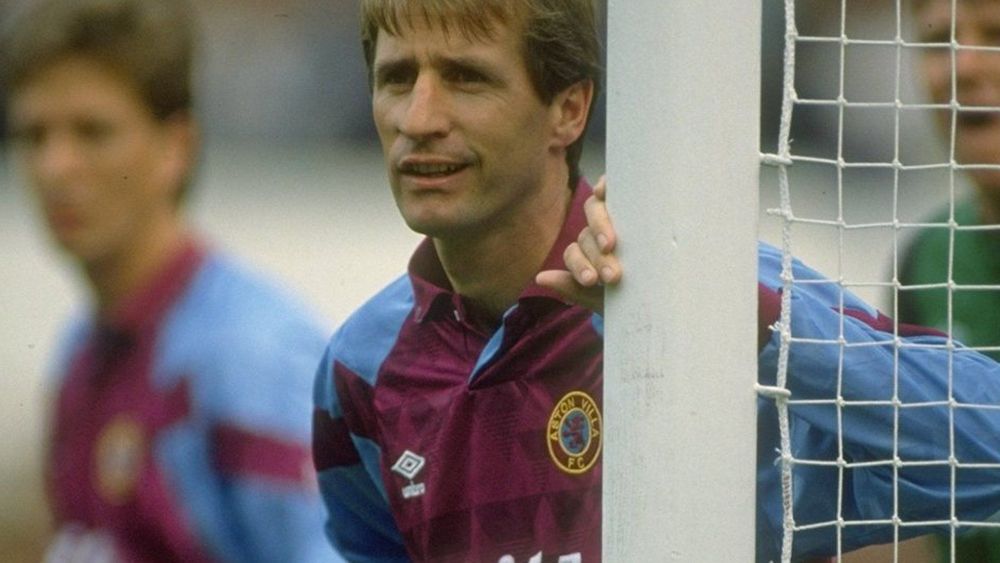
He was a local boy who had grown up watching the club's stars on television, and suddenly he was training alongside the players who had recently made Villa champions of England and Europe.
Among those senior figures, Gordon Cowans quickly became one of the people who made the transition easier.
“I mean, you had some really, really nice people in the squad, like Gordon Cowans was very approachable," Walters recalled to Football Presse. "He was very kind to me as well because at that stage I don't think I passed very often.”
Walters was a teenager finding his feet in a dressing room full of established players. His natural instinct was to express himself, but he was also taking criticism for the way he played. Cowans, rather than adding to the pressure, offered reassurance.
“I took a bit of stick for not passing, so he was very comforting to me, saying, ‘No, don't worry. Don't listen to them. Just do your thing, and pass when you can. And obviously do your thing, what you're good at, when you can as well.’”
That advice mattered to Walters because Cowans was not simply an experienced player talking to a youngster. He was someone Walters regarded as one of the outstanding footballers in the team, and his influence came as much from the way he behaved as from what he said.
“People like Gordon Cowans were very influential to me in the team. Andy Blair, he wasn't a regular, but again, he was very approachable as well in the team.
“There were players in the team who made my life a lot easier than it could've been.”
Cowans' influence was particularly significant because Walters was coming into a team where standards had already been established. Villa had won the European Cup in 1982, and the young winger was surrounded by players who had experienced the biggest nights in club football.
For Walters, Cowans was someone who embodied those standards without needing to impose himself on the dressing room.
“Oh, definitely. He not only talked the talk but walked the walk. He was one of the best players in the team.
“As I said, very approachable man. You know, gave you advice, and led by example really. He was a fantastic player.”
There was also something about Cowans' personality that Walters remembers clearly. Despite his standing within the team, he did not behave like someone who needed to remind everyone else of his importance.
“He was very unassuming as well. You think being such an influential player he'd be brash, but no, he was very, very quiet in another way.”
That quiet authority appears to have been part of what Walters admired. Cowans did not need to dominate the dressing room to influence the players around him. His example on the pitch and in training was enough.
“But as I said, he led by example and he was definitely one of the players I admired, and I do to this day, in fact. Fantastic player.”
Walters' memories of Villa are inevitably tied to the quality of the group around him. Gary Shaw, Tony Morley, Dennis Mortimer and Des Bremner were among the players who formed the core of a side that had already reached the pinnacle of European football.
For Walters, however, the important thing was not simply the number of talented individuals Villa possessed. It was how those players worked together.
“Individually they were great players, but together they made a great team, without a doubt. And they all worked hard for each other.”
That distinction helps explain why Walters remembers Cowans so warmly. He was not simply a star player who happened to be around when Walters was breaking through. He was part of the culture that allowed a young player to settle into an established team.
Walters also remembers the contrast between the Cowans he knew and the image people might have expected of a player of his importance.
“You think being such an influential player he'd be brash, but no, he was very, very quiet in another way.”
The relationship remained significant long after Walters had left Villa. When he eventually returned to face his boyhood club as a Liverpool player, the reaction of the supporters initially hurt him. Walters was a local lad who had come through the club, and being booed by Villa fans was difficult to understand.
Then he remembered what had happened to Cowans.
“When Gordon Cowans went back to Aston Villa and they booed him, then I didn't take it personally. I didn't think, if they can boo Gordon Cowans who's been there literally 20 years, then they can boo little Mark from Aston, no problem.”
It was a revealing comparison. If even Cowans, after two decades at the club, could return to Villa Park and hear the home supporters turn on him, Walters could perhaps put his own experience into perspective.
Cowans' standing in Walters' eyes was not diminished by that reaction. If anything, the memory reinforces how highly Walters regarded him.
When asked about the greatest players he had played alongside during a career that eventually took him to Rangers, Liverpool and England, Walters named John Barnes first. But Cowans remained firmly among the elite.
“The best player I think I played with is John Barnes. I thought he was a fantastic player. Gordon Cowans is in there.”
For a young Walters, though, Cowans' importance was about more than where he ranked among the best players. He was one of the senior professionals who helped make the jump from Villa supporter to Aston Villa footballer possible.
Walters had gone from watching those players on television to sharing a dressing room with them in remarkably little time. Cowans was one of the men who helped ensure that the transition did not overwhelm him.
“Two or three years before that I used to watch these guys on the TV. They had a football competition or TV programme called Star Soccer. So it was fantastic, me watching these players, and then a year later I'm actually training with them and playing in the team.”
That is ultimately why Cowans remains such a significant figure in Walters' story. The trophies and the great names around him formed the backdrop, but Walters remembers the people who helped him navigate those early years.
And among them, Cowans stands out not because he demanded attention, but because he did the opposite.
“He was definitely one of the players I admired, and I do to this day, in fact. Fantastic player.”
Mark Walters' book "Wingin' It: The Mark Walters Story" is from Pitch Publishing - which is available here.