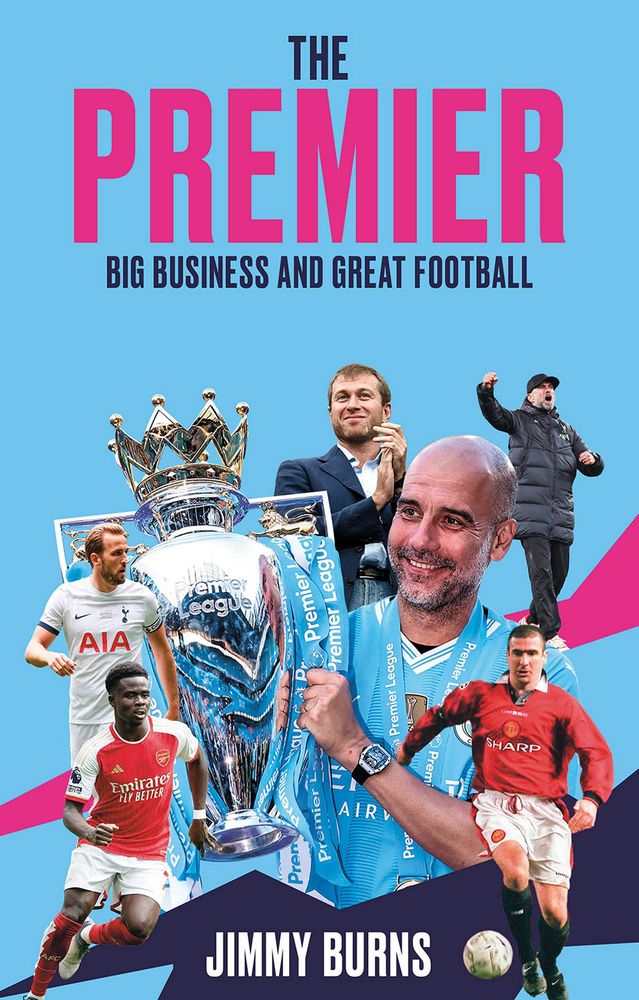
The Premier League has become football’s great financial success story, but Jimmy Burns believes there is a danger in assuming that the money machine can continue expanding forever.
Burns, the author of "The Premier", has spent decades examining football from an unusual perspective, combining his work as a football writer with a career in investigative journalism at the Financial Times.
He believes the Premier League’s next chapter may depend less on how much money it can generate than on whether football can properly regulate the wealth it has already created.
“When I get towards the end of the book, I say, ‘Oh, hang on a minute,’” Burns told Football Presse.
“No project in history, no financial project in history, has not had its potential downfall.”
Burns does not believe that means the Premier League is about to disappear.
Instead, he sees a competition that has become so financially successful that its own growth is creating new problems.
“I think the future of the Premier League lies in better regulation, particularly on foreign ownership,” he said.
“And obviously, better regulation on how transfers are made, and associated companies to ownership, which might not be as transparent as they should be.”
That question of transparency is particularly important to Burns because of his own background.
He worked for the Financial Times and spent a considerable period with its investigative unit, meaning that his understanding of football ownership is informed by years of looking at the financial and political worlds beyond the sport.
He believes football cannot simply celebrate the money entering the game without asking where it comes from, how it is structured and what consequences it produces.
“And there, you get to Manchester City, which — and I don’t particularly want to go into too detail there because it’s a subject of legal action and Manchester City has denied any impropriety,” Burns said.
“But I think there’s a question mark of how far do you go in pushing this kind of money machine?”
That question has become even more relevant as the boundaries of football’s financial model have continued to expand.
Burns believes the Premier League has become caught between its enormous commercial potential and the moral responsibilities that come with that wealth.
“Are we getting into a kind of stratosphere which is completely crazy simply because you pay a player an astronomical fee?” he said.
“In my view, it is totally immoral that with the kind of social disparities we have around Europe, in each of our countries, that simply for kicking a ball around for 90 minutes that people are earning more than a teacher or a doctor would earn in five lifetimes.”
“I just find that sort of fairly immoral.”
Burns accepts that the Premier League’s enormous revenues have helped create the greatest concentration of football talent and infrastructure in the history of the English game.
But he questions what happens when financial growth becomes an objective in itself.
“You can get into this vicious circle,” he said.
“In order to fund that, you sort of tend to cut corners and not be as transparent as you can.”
And Burns believes the consequences are not confined to owners, clubs or supporters.
The players are increasingly being asked to carry the physical burden of football’s commercial expansion.
“The other issue, which I think we’re already seeing, is that the number of games that players have to play in order to generate more and more money is getting to a point when you’re seeing players breaking up physically,” he said.
For Burns, that is one of the clearest warning signs that football’s financial growth may be reaching its limits.
“I mean, obviously the player of today compared to, say, the days of Diego Maradona or Best or whatever, I mean, they would’ve had a heart attack within two weeks of playing the level of physical demand of the Premier League or La Liga,” he said.
Burns is not suggesting that modern footballers are less gifted athletes.
His point is that advances in conditioning have allowed the game to demand more from them, rather than removing the underlying physical limits of the human body.
“But the amount…” Burns said.
“You’re already seeing in young players that they just can’t play for the national team and for their club team and also not get injured.”
“And injured from simply physical fatigue.”
The financial argument also brings Burns back to the question of the European Super League.
He believes supporters should not assume that the Super League is necessarily some distant concept that has been permanently defeated.
“We’re one step away from the Super League simply with the way that the Champions League’s been reconstructed,” he said.
That does not mean Burns believes the Premier League itself is doomed.
Quite the opposite.
He regards its commercial strategy as one of the great achievements of modern football.
But the more successful the Premier League becomes, the more important it is that its growth is controlled.
The league’s global appeal was built through a combination of television, foreign talent, powerful clubs, wealthy owners and a historic supporter culture.
The danger, Burns believes, is that the financial side eventually overwhelms the rest.
“The question is, are you surrendering your moral judgment, any sense of morality on the one hand, and are you sacrificing the heart and soul of the fans?” he said.
That may ultimately be the Premier League’s biggest challenge.
The competition has spent more than three decades turning English football into the most valuable domestic football product in the world.
Burns’ warning is that success cannot simply be measured by whether the next television deal is bigger, the next transfer fee is higher or the next international market is reached.
Football also has to decide what it is prepared to sacrifice in order to keep growing.
Jimmy Burns is the author of 'The Premier' from Pitch Publishing - which is available here.