
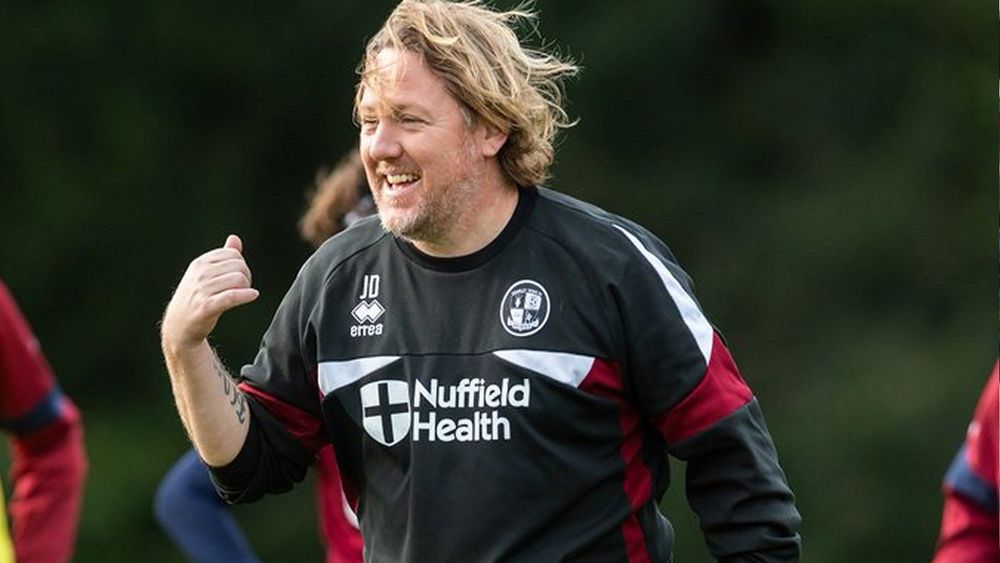
The former Arsenal and Bournemouth player took his coaching into international football with Bangladesh, an experience that tested him professionally and personally while changing the way he approached players.
Day now believes that working abroad should be actively encouraged for young coaches, even if the experience can be considerably more demanding than simply taking a job in another country.
"I would always recommend coaches going to work in different countries," Day told Football Presse.
"I think it gives you a fantastic experience. I think you learn so much, not just about coaching but about life.
"You meet new people, you see different cultures. It does take you out your comfort zone, and it can be difficult when you've got a family, you know, because sometimes your family won't travel, they'll stay at home, so there's long periods away.
"And it does test you as a person and your character."
For Day, that challenge was part of the attraction.
"I had a fantastic time, had some fantastic memories, and would do it again, you know, in the future.
"So yeah, I'd highly recommend it. It is a big jump and you have to, you know, go fully committed into it, but I think there's lots of benefits from working abroad.
"So yeah, I would highly recommend doing it for any young coach that has an opportunity to go down that path."
But Day's experience also taught him that international coaching requires an ability to adapt that cannot simply be learned from coaching manuals.
"I think what I learned from Asia is you have to adapt straight away to the culture of the country that you're in," he said.
"You have to make sure you involve the local coaches. You have to make sure you're polite. You have to learn how they live, how they train, first of all.
"And then you have to bring your ideas to it and find the balance of making sure that you're getting the correct work and detail into what you're doing, but also not overstepping the mark on how things have done before."
That balance was crucial to Day's experience in Bangladesh.
He had arrived as a young English coach with academy experience at Arsenal and Charlton, but he knew that his previous experiences did not automatically make him the expert in a completely different football environment.
"I think if you go in with that mindset, then the local coaches and players are open to listening because they want to improve," Day said.
"But I think you have to respect everyone that's around that environment, and you have to spend time speaking to people in the country that you're working in.
"You have to make sure that you're open to ideas from what they've had previously.
"And I think that then is a good ingredient for you to be able to work in that country and get respect from the local coaches and the local players.
"And I think if you do that, players respond, and then they will react and do how you want things being done to try and make the team better."
The experience left Day with something he could carry into every subsequent dressing room.
"Regardless of where you work, you're always gaining experiences," he said.
"I do think working abroad gives you a real, strong mentality because you have to live on your own and you have to go and be abroad and work for months on your own and with other coaches and missing your family and stuff.
"So I think that helps, especially, you know, when speaking to players about mindset and being mentally strong."
That is one of the less obvious benefits of coaching abroad, according to Day.
The lessons are not necessarily tactical.
Sometimes they are simply about having lived through difficult circumstances yourself.
"I think you can fall back on that and use certain experiences that I've had of working away and using that with the players when they have tough times or there's advice that needed giving," he said.
"You can give it and you've got that experience to back it up."
Day's international experience also changed the way he viewed his own career.
He found that working abroad could open doors around the world, but it did not necessarily make returning home straightforward.
"I think working abroad gives you other opportunities to work elsewhere around the world," he said.
"I found it difficult when I came back to England to get a job straight away because people sort of forget where you are unless you're really, really successful."
That was particularly frustrating because Day believed Bangladesh had been a genuine rebuilding project.
"We did a good job with Bangladesh," he said.
"We took them from nowhere and we built them up, but we didn't win loads of trophies.
"It was more of a process of getting football back again and being difficult to beat and winning matches."
That distinction matters to Day.
International coaching is often judged through tournament results and trophies, but his Bangladesh tenure was about restoring confidence and building something that had been badly damaged.
"So I did find it difficult when I originally came back," he admitted.
"But I do think it did open doors to other places around the world, but just didn't fit for me at that time with having a family.
"So, you know, I would highly recommend people going out and working abroad, but for me it didn't probably open up doors back home."
There was another lesson in that experience: coaching careers do not necessarily follow a straight line.
Day has worked at different levels of English football and internationally, and he believes every environment contributes something to the next.
"I think the experiences of working internationally, I think, can help, you know, and it has helped with speaking to players at Crawley and in League Two," he said.
"You see things and can give bits of advice that has happened previously, whether it's at international level or, you know, coaching at other clubs."
For Day, that is why the experience of living abroad has become part of his coaching identity.
"I think regardless of where you work, you're always gaining experiences," he repeated.
"I do think working abroad gives you a real strong mentality because you have to live on your own and you have to go and be abroad and work for months on your own and with other coaches and missing your family and stuff."
That experience can become especially valuable when a manager is trying to help players through difficult moments.
"I think that helps, especially, you know, when speaking to players about mindset and being mentally strong," Day said.
"I think you can fall back on that and use certain experiences that I've had of working away and using that with the players when they have tough times or there's advice that needed giving, you can give it and you've got that experience to back it up."
Day's coaching philosophy has evolved alongside those experiences.
He describes himself as increasingly relaxed in his approach, but insists that becoming calmer should never be confused with becoming less demanding.
"I think my coaching is relaxed," Day said.
"I'd like to think there's detail in it. I'd like to want to help players and give as much information as I can.
"I'd like to hear back from players and get their feedback as well.
"I think there's a lot of pressure on players to perform and do well. So I think my coaching as I've got older has been more relaxed now.
"It's not the fact, or it's not gone that I'm not caring or not as strict or disciplined, that's all still there.
"But I think the manner in which it's delivered has changed now."
That change, Day believes, is one of the natural consequences of becoming older and accumulating more experience.
"I think you mellow out a little bit as you get older and you realise, you know, getting the best out of players, there's different ways of doing it.
"And sometimes it's being really relaxed and open and having conversations. Other times you might have to, you know, be a bit more strict in your approach.
"But I think, you know, to get the best out of people now, you need to have a good manner about you and be able to deliver.
"And what you're delivering makes sense, and the information that you're given is correct.
"Then I think players buy into what you're doing."
For Day, that ability to communicate is inseparable from everything he learned overseas.
He went abroad as a coach looking to impose ideas. He came back with a greater appreciation of the importance of listening.
"You have to respect everyone that's around that environment," he said.
"You have to spend time speaking to people in the country that you're working in.
"You have to make sure that you're open to ideas from what they've had previously."
The result is a philosophy that is less about the coach having all the answers and more about creating an environment where players and staff can contribute.
"I'd like to hear back from players and get their feedback as well," Day said.
And while Day admits that every coach dreams of eventually reaching the Premier League, his international experience has made him realistic about the route there.
"I think all coaches dream of working, you know, in the Premier League," he said.
"I think you have to be realistic as well. There's lots of good coaches around the world and in England.
"So for me, it's still about trying to improve, trying to keep going up the leagues if we can.
"You know, we've worked in League One and League Two now, and I've worked obviously at international level. So, you know, you always want to try and go a little bit further."
He is not pretending the destination is guaranteed.
"I have to be realistic with it. The chances of actually working in the Premier League is very slim," Day said.
"But maybe there's, you know, an opportunity lower down at the 18s and 16s or whatever that you can look at going forward.
"But I thoroughly enjoy doing what I'm doing now as an assistant manager.
"But again, you know, all coaches want to progress and they want to develop and go to the highest level they possibly can.
"So you're always dreaming."
For all the ambition, Day's strongest argument for working overseas is ultimately much simpler.
It makes coaches better because it makes them confront themselves.
"It does take you out your comfort zone," he said.
"And it can be difficult when you've got a family, you know, because sometimes your family won't travel, they'll stay at home, so there's long periods away.
"And it does test you as a person and your character."
But Day would still do it again.
"I had a fantastic time, had some fantastic memories, and would do it again, you know, in the future.
"It is a big jump and you have to go fully committed into it, but I think there's lots of benefits from working abroad."
For a coach trying to build a career, Day's advice is therefore unequivocal.
"So yeah, I would highly recommend doing it for any young coach that has an opportunity to go down that path."