
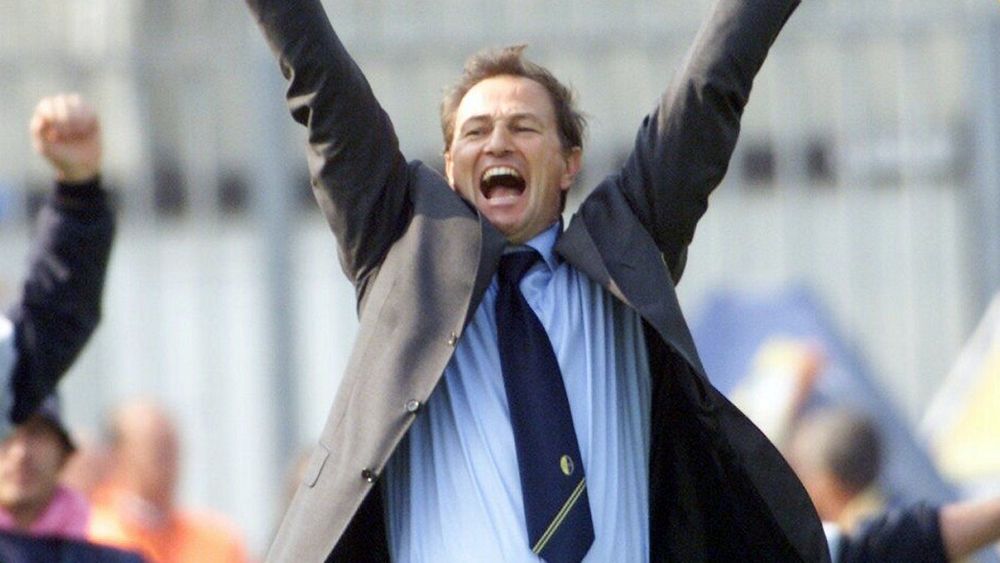
The club went from Serie C1 to Serie A in successive seasons, then finished comfortably clear of relegation in its first year back in the top flight.
For De Biasi, however, the achievement was never about one coach or one group of players. It was a project in which the people running the club shared the same idea of how the team should be built.
“The fundamental secret was the project itself, and the people who planned and developed it over the years,” De Biasi told Football Presse. “There was a joint decision-making process between the coach and the sporting director when it came to choosing players. There was unity of purpose and respect for everyone's roles. The president allowed us to work and had great faith in us.”
That structure gave De Biasi the opportunity to develop a team rather than constantly rebuild it.
Modena won Serie C1 in 2000-01, with goalkeeper Marco Ballotta and defenders Mauro Mayer and Nicola Legrottaglie among the players who became important figures in the promotion. Omar Milanetto and Paolo Ponzo formed part of the midfield, while Rubens Pasino and Andrea Fabbrini provided attacking quality.
The following season, much of the core remained. Ballotta was still in goal, with Mayer joined by Roberto Cevoli and Luca Ungari in the back three. Ponzo, Milanetto, Vito Grieco and Jacopo Balestri formed the midfield, with Pasino operating behind the attack.
It was a side that combined experience with players who were still developing, but the most important characteristic was continuity. De Biasi had a group that understood what he wanted and had already experienced success together.
Modena finished second in Serie B in 2001-02, securing promotion to Serie A for the first time in 38 years. The final confirmation came after a 0-0 draw away to Genoa on May 12, 2002, when the players then had to wait for Cosenza's result against Napoli before they could celebrate.
Fabbrini was one of the principal attacking figures, scoring 16 goals in the league. Pasino added seven, while Milanetto contributed four from midfield. Ballotta played every minute of the league campaign.
The team then took the next step together.
De Biasi remained in charge for Modena's return to Serie A and guided them to 12th place in 2002-03. The club had not simply reached the top flight; it had established itself there.
That was the achievement that made the project so significant. The players who had helped Modena escape Serie C were not immediately discarded when the level increased. The club trusted the group, added what was needed and allowed the team to grow.
De Biasi's approach was rooted in that collective responsibility.
“There was a joint decision-making process between the coach and the sporting director when it came to choosing players,” he said. “There was unity of purpose and respect for everyone's roles.”
For a coach, that kind of environment is increasingly difficult to find. De Biasi's later career would take him to Spain, Albania and Azerbaijan, but Modena remained one of the clearest examples of what he believed could be achieved when a club and its football department were genuinely aligned.
The same principle explains why he continues to follow the club's progress.
“I would say there is a solid club behind the team. Modena is a demanding football city, where there is a need to communicate in a particular way. Given the foundations that are in place, I believe Modena has a very interesting present and future.”
The names from that team remain familiar to Modena supporters: Ballotta behind Mayer and Cevoli, Milanetto and Ponzo in midfield, Pasino providing creativity and Fabbrini supplying the goals. They were not assembled as a collection of stars. They became important because they developed into a team.
And that, ultimately, was De Biasi's Modena achievement.
A club with a clear plan, a sporting director and coach working together, a president prepared to trust them, and a group of players given enough time to grow.