
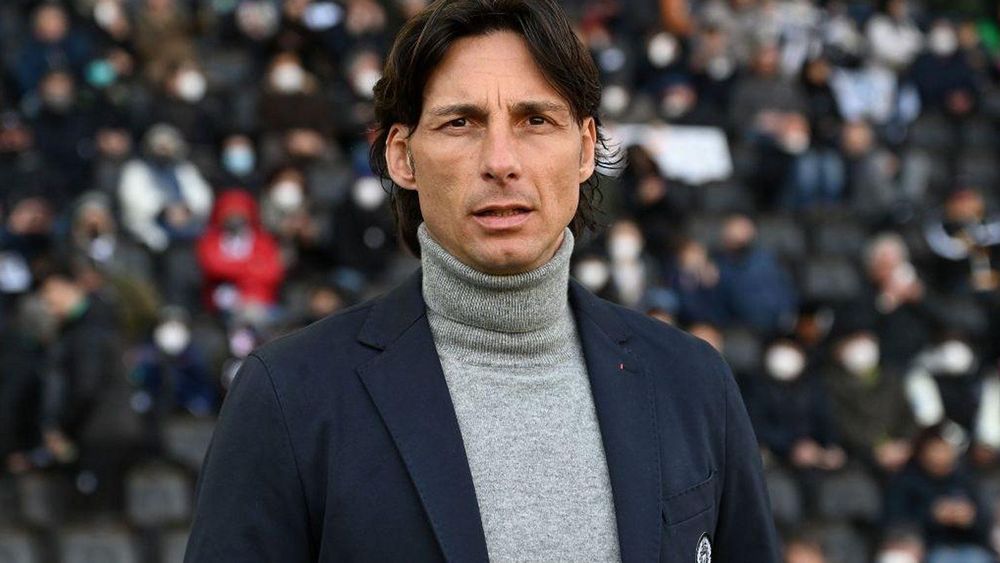
Working alongside Henk ten Cate at Al Jazira, in Abu Dhabi, became an important part of his coaching education — although some of the lessons took time to understand.
It also gave him a close-up view of a football region whose ambitions he believes have evolved beyond the pursuit of established stars.
“Working with Ten Cate was a great experience because he is a great manager from whom I learned a lot," Cioffi told Football Presse.
"I struggled to understand him immediately, but many things he told me, and many of his behaviours, are things I have recognised again since.
“I have great esteem and respect for him. I am grateful for the opportunity he gave me.”
Cioffi’s description is revealing because he does not pretend that every lesson was immediately clear. The value of working with an experienced coach sometimes becomes apparent only later, when situations arise that bring earlier conversations and observations back into focus.
His time at Al Jazira also demanded an adjustment away from the football environment he had known in England. Coming from the Championship, he encountered a dramatic change in temperature, but found the experience rewarding once he had adapted to the culture around him.
“Working in the Emirates was unusual because I was coming from the English Championship. Finding yourself dealing with a temperature change of 20 degrees in two days was, first of all, a climatic impact.
“But it was wonderful because the culture, if you have the patience to discover it, is like every culture: a very beautiful culture, very social and very connected to family.
“I had a great time there, to the extent that whenever I can, I go back on holiday or stop over in Abu Dhabi. My family and I are very attached to the place, and we have left dear friends there.”
That attachment matters when considering Cioffi’s assessment of the Gulf’s football ambitions. He is not speaking only as an outsider looking at transfer fees and high-profile appointments. His experience gave him a view of the people and structures behind the investment, as well as the changes he believes have taken place.
He draws a comparison between the early approach in the UAE and the investment that has transformed Saudi football, where prominent international names helped attract attention to the leagues.
“The investment there began in a way very similar to what is happening in Saudi Arabia today: big investments for big names.
“In the last three or four years, the trend has changed. Money has still been invested, but not in players who are, in quotation marks, at the end of their careers. Instead, it has gone towards young foreign players with interesting profiles, who have often been given residency while playing in the youth system.
“So, if you look at the Emirati league now, there are foreign players, of course, but there are also these resident players who have been developed over time — Brazilians, English players and others.”
For Cioffi, that shift is significant. The development of younger foreign players within the local system offers a different model from simply bringing in established professionals for the final stages of their careers. His comments describe the UAE’s approach as he observed it, rather than suggesting that the two countries have identical systems.
The question of money, however, remains unavoidable. Gulf clubs can offer financial packages that European teams may struggle to match, prompting a familiar argument that players and coaches move there primarily for the rewards.
Cioffi does not deny the financial attraction. He disputes the suggestion that it explains everything.
“I believe the financial factor is not only down to the fact that they have incredible resources and budgets compared with European football. It is also about attracting important players towards a new environment that is being created.
“I have studied the Saudi league very carefully, partly because I had the opportunity previously to go to Al Ahly. I don't see players who have gone there only for money. They may have gone partly for money, but the physical demands and intensity of the matches, and above all the humidity and temperature, are punishing.
“If you are not mentally focused, you struggle. I don't see that lack of commitment. I see ambitious players, because it takes very little time to be found out and sent back. Their project is very ambitious, and they don't spare anyone.”
Cioffi’s argument is not that money has become irrelevant, but that it cannot sustain a football project on its own. Players must cope with demanding conditions and compete in an environment that expects performance, while the leagues themselves seek to establish a stronger identity.
That ambition is increasingly reflected in the language of Saudi football’s own development plans, which now place greater emphasis on club development, governance and financial sustainability alongside attracting talent. The challenge is to turn investment and international attention into lasting sporting strength.
For Cioffi, the Middle East was first a place to learn from Ten Cate, adapt to another culture and build relationships that have endured beyond his time there. His view of the region’s football development comes from that experience: the spending may have attracted the headlines, but the more important test is what the investment builds next.