
Behind the scenes, the manager had created an environment in which exceptional training standards, strong personalities and an extraordinary understanding of individual players combined to produce one of the most memorable teams in English football.
One of the people Clark credits most heavily for that environment was Steve Black, the performance coach whose influence extended well beyond conventional fitness work.
He told Football Presse, “The best, the best I've ever seen, the most important. Ended up taking him to football clubs. And when I become a manager, and I'll always say this, no coincidence that my most successful periods as a manager is when I had Steve alongside us.
“And Steve was that good at various different sports, you know, went to the very top in rugby terms, top, obviously the top in football, worked with him at various different clubs.
“As you said, the individual stuff. When he, you know, was successful with the Newcastle Falcons rugby team, we'd come together as footballers and rugby players to do fitness work.
“And he had this unbelievable way of managing individuals. He knew what made different individuals tick, he knew what it was about, and he made the training fun even though it was ridiculously hard as well.”
That ability to understand different personalities was what separated Black from other coaches in Clark's experience.
“He was such a funny guy. He was the best. I've never seen anyone before or after him, not just in terms of the fitness, the overall.”
Steve Black died in 2022, but his influence on Clark and the standards he carried into management remain an enduring part of his legacy.
Taking Black into management
Black's influence on Clark did not end when their Newcastle careers moved in different directions.
The midfielder had been watching and learning from coaches throughout his playing career, and when the opportunity eventually arrived to become a manager himself, he knew exactly who he wanted alongside him.
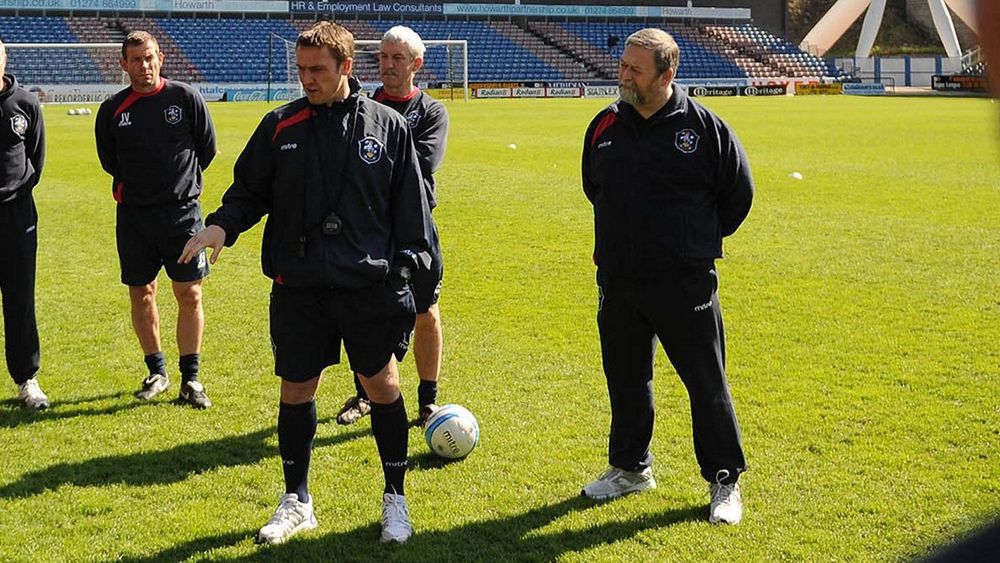
Clark appointed Black as performance coach when he took charge of Huddersfield Town in December 2008. The appointment brought their relationship into a new environment, with Black given responsibility for the wider performance operation.
“When I took him into Huddersfield, he was head of the performance, so he was dictating everything that was going on around the football club to allow me to have the best opportunity to manage the team and make them successful.
“And as I said, definitely no coincidence that my most successful periods as a manager was when Steve was alongside me, without a doubt.”
Clark's admiration was such that he wanted to continue working with Black at subsequent clubs, although circumstances sometimes made that impossible.
“The football clubs I managed unfortunately couldn't afford him because he was that good at his career.
“Even though he would come and try and help me on a one-to-one basis and we'd talk, you know, at night or whatever, and he'd always send me messages and notes and things like that.”
It was a relationship that extended beyond the formal responsibilities of a performance coach. Black remained someone Clark could turn to for advice, support and a different perspective on the challenges of management.
Keegan's standards and the Newcastle dressing room
Black was one important part of a much wider culture that Keegan had established at Newcastle United.
Clark remembers the manager's ability to recruit players who possessed not only the necessary footballing ability but also the personalities to fit into the group.
“The training was phenomenal, the standard of training, the camaraderie that the manager had created by the signings he brought in weren't just top players, they were top characters.
“And we were the lads that basically would spell it out to the new signings about what the club was about, because if you didn't know quickly and you didn't hit the ground running, you could have been overcome by it because it's so intense.”
The intensity was not confined to matchdays. Newcastle's players represented a club whose supporters wanted to discuss football wherever they encountered them, and Clark remembers how important it was for newcomers to understand that relationship.
“Everywhere you go, filling your car up in a garage, to the supermarket, to a restaurant, whatever, people would stop you, people of your age group, old women, old men, and wanted to talk about the football. That's all that mattered.
“And so sometimes that can be a bit demanding for people who haven't experienced that. So we were there basically to make sure that they were aware of what they were coming into, but to embrace it, because if they did, the people would love them.”
For Clark, the manager's approach to training reflected the same standards and expectations.
Keegan left much of the day-to-day training organisation to first-team coach Derek Fazackerley, although the manager and assistant Terry McDermott would sometimes join in.
“Kevin left that down to Derek Fazackerley. Kevin and Terry McDermott would sometimes join in, but Kevin certainly on a matchday would come into his form in terms of what he expected from the group.
“And it was all about us. It wasn't about the opposition. It was about how we played. If we played at our maximum, we'd win the game.
“It wasn't about how we wanted to stop the opponent and then try and play. It was just about how we were going to play.”
That confidence in their own approach was central to the identity Keegan wanted to establish. Newcastle were expected to impose themselves on opponents rather than spend their time worrying about how to contain them.
Clark also believes Keegan's own playing career and work ethic informed the standards he demanded.
The former England captain had won the Ballon d'Or twice during his time in European football, and Clark remembers how the manager spoke about the work required to reach that level.
“He obviously was an unbelievable footballer of his time. Ballon d'Or winner two years in a row, which has never been done by a British player.
“And so, yeah, he obviously had high standards, where he'd been and what he'd done, and he had high qualities.
“And he always used to say he wasn't born with ridiculous amounts of technical ability. He had to build that up, he had to work that, and that's what he did.
“He took out everything he possibly could from his personality and his work ethic to help him achieve being one of the best players of his generation.”
A dressing room built on relationships
The standards on the training ground were matched by the relationships between the players.
Clark remembers a group who spent considerable time together away from football, with friendships extending to their families and partners.
“He'd recruited an unbelievable group of footballers that bought into what he wanted. Unbelievable characters.
“We had a brilliant relationship off the pitch together. We socialised every time together, whether that was just the lads individually, whether that was with our families, with our partners, our wives, whatever. Everybody knew everybody.
“Each player knew everyone's mums, dads, kids, partners, whatever. The relationship was superb, and he'd created that with the characters.”
There was plenty of humour, but the competitive standards remained high.
“We loved to have a lot of fun with each other, but we knew when to be serious. And an example of that is, you know, we had loads of fun and socialised with each other, but there was plenty of times during the course of a game we'd fall out with each other because we wanted to get the result.
“Because we knew that if we didn't get the positive result, that it would affect how we felt the week after, and we didn't want that. We wanted to still be in a happy place.
“So there was many times we weren't too bothered about falling out with each other. It was respect for each other. There was no childish behaviour and, you know, falling out and then not speaking. We just got back on with the job.
“And yeah, that's what Kevin had created.”
For Clark, the importance of that environment was evident in the way the players continued to perform together, even under the enormous pressure of competing for the Premier League title.
Newcastle ultimately finished second to Manchester United in 1995-96, but the team remains celebrated for the football it produced and the connection it established with supporters.
Clark believes the foundations were built through a combination of recruitment, character, preparation and the people Keegan surrounded himself with.
Black was central to that, and the midfielder's subsequent decision to bring him into his own managerial set-up demonstrated just how much he valued what he had learned during their time together.
Looking back, Clark remains convinced that the partnership between Keegan and Black was an example of Newcastle thinking differently.
For him, the importance of Black was never simply how hard he could make players work. It was understanding why they needed to work, what motivated them and how to make them better.
It was a lesson Clark carried into management, and one that continued to influence him long after the Newcastle years had ended.