
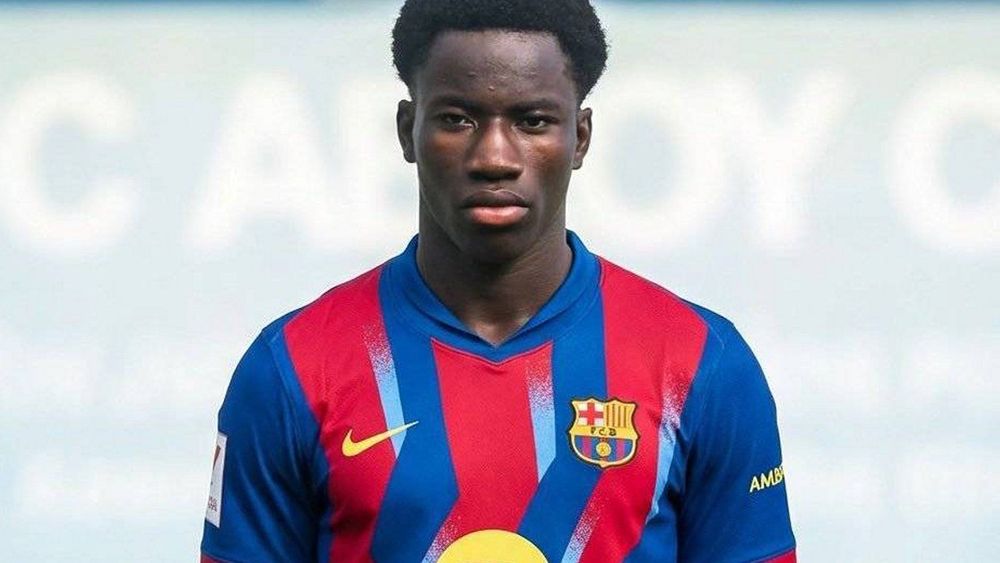
Tunkara has spent much of his young life travelling towards a dream that once seemed a world away. From playing barefoot in the streets of Gambia to training with Barcelona’s first team, the 16-year-old midfielder has already experienced a remarkable journey. His performance in Spain’s 5-0 opening victory over China at the Under-17 World Cup in Qatar offered another glimpse of what may lie ahead.
Tunkara scored a superb free-kick just before half-time and later produced a dazzling run from his own half before setting up Owen Emeka. Spain’s emphatic victory also featured a penalty from Jordi Pesquer, Emeka’s second goal and a late finish from Guillermo Trujillano.
The teenager, however, was quick to recognise the people who had made his progress possible.
“My family, who have been there supporting me from the very first moment. I owe everything to them,” he told Marca after his World Cup debut.
Before Barcelona, before La Masia and before the attention of international football, there was Lamoi in Gambia. Tunkara has recalled playing informal matches with friends, often without boots.
“We used to play barefoot in the street,” he told the Spanish football federation.
The goals were makeshift, marked by two posts, and reaching school meant walking several kilometres. His father eventually travelled to Spain in search of better opportunities for the family. Tunkara was seven when they were reunited in Mataró.
“My father made a huge effort,” he said, reflecting on the sacrifice that changed the course of his childhood.
Football began to offer a new direction after a friend of his father encouraged him to join a local team in the Cerdanyola neighbourhood. Barcelona soon noticed his ability, although his first experience of the club’s recruitment process did not go smoothly.
“I thought it was to go to the first team,” he recalled of the initial invitation. The young player struggled with the cold and the adjustment to a different environment, but Barcelona gave him another opportunity. This time he made it through, beginning his journey into one of football’s most renowned youth systems.
His development has accelerated. Tunkara signed his first professional contract with Barcelona in January 2026 and made his debut for the reserve side while still 15. Hansi Flick subsequently brought him into first-team training, and he featured in a pre-season friendly against Birmingham City.
The midfielder’s talent had already attracted attention at international level. He was named the outstanding player at the Under-17 European Championship in Estonia, where he recorded four assists and 23 key passes. He has also spoken openly about the player he admires most.
“Pedri is the one I like the most,” he told the federation.
In Qatar, his free-kick against China showed the work behind the technique. Spain coach David Cubillo revealed that the squad had spent two days practising set pieces, with the players repeatedly taking free-kicks.
“We were there for two or three days taking free-kicks,” Tunkara confirmed to Marca.
His second contribution was just as impressive. After winning possession in his own half, he carried the ball past three opponents before releasing Emeka to score.
“It feels really good, honestly. I am very proud of the match we have played,” he said.
Asked who he would contact first after the final whistle, Tunkara immediately thought of his father.
“My father, probably. I will tell him that we have won 5-0 and he will probably have watched the match. I want him to be proud of me.”
There is already a promise attached to Spain’s progress in Qatar. If the team reaches the final, his father will travel to watch him.
“If we get there, he will definitely come,” Tunkara said.
The ambition extends beyond the Under-17s. “I want to make my debut for the senior national team,” he has said.
There is a long road ahead, and early promise alone guarantees nothing in elite football. But Tunkara has already travelled from Lamoi to Mataró, from Cerdanyola to La Masia, and from Barcelona’s training ground to a World Cup stage. His family remains at the centre of that story, and he has not forgotten the sacrifices that brought him here.