It was a period that took them from the chaos of the Massimo Cellino years to Marcelo Bielsa, promotion back to the Premier League and, ultimately, another collapse and change of ownership.
For Tomlinson, the story begins with an owner who initially brought something Leeds had desperately lacked: stability.
“People slag him off now," Tomlinson told Football Presse. "There's lots of slating from the supporters about him. But I think around this, if you remember at the time what had happened, he succeeded Cellino and brought sanity and order after all that.”
Radrizzani's greatest early decision was also his most consequential. Rather than simply continuing the cycle of managerial appointments that had characterised Leeds United for years, he and Victor Orta pursued Bielsa, a coach whose name was far bigger than the club's recent standing.
“Orta and he both came up with it jointly,” Tomlinson says. “He also, from what I understand, got some support from the 49ers as to, yeah, this is the type, because they've done something similar where they are in the States.”
“I think you could have done, but I think he was just intrigued, fascinated and excited by the project or the institution as he talks about it. So you do hear that he has to know it's right for him, the entire thing. And that's what he's been fascinated through all the time.”
The significance of Bielsa's appointment was difficult to comprehend at the time because, for many Leeds supporters, the Argentine was almost completely unknown.
“I don't believe Leeds fans, generally speaking, knew a thing about him,” Tomlinson says. “He was a complete unknown from our perspective.”
“He was famous and he was on the coaching circuit. So Argentina, Chile, Mexico, Atlético, etc., or Athletic Club. So he'd certainly got a reputation, but we knew nothing about him. And even if those that did, I don't think they really expected what happened.”
What happened was a transformation.
“He took on there was an average mid-table squad. He didn't really make any changes, very, very few, but he certainly got the best out of, you know, a decent squad but not high achievers.”
For Tomlinson, that was the moment when Radrizzani's gamble began to look like genius.
“When you get the right project, you get wonderful things. And certainly wonderful things.”
But Bielsa did more than win football matches. He changed the emotional relationship between Leeds and its supporters, creating an atmosphere that Tomlinson believes has rarely been matched.
“Leeds do sincerity, Leeds do emotion, Leeds do meaning,” he says.
“I think they meant it when they said they'd sooner have gone down with him than stay up without him, and I think that was really it. It was a fantastic time to be a Leeds fan, absolutely fantastic time to be a Leeds fan.”
The Bielsa era also demonstrated the strength of the structure Radrizzani had initially put around the club.
“I think it was as much as anything, it's what he allowed other people to do,” Tomlinson says. “Cellino previously had been, you know, he drives the bus and all that. He was completely controlled, didn't allow managers to manage.”
“I think Radrizzani appointed well, he got the right people around him.”
That meant Angus Kinnear, Victor Orta and Bielsa forming what Tomlinson describes as an unlikely but highly effective combination.
“So he got Angus Kinnear and Victor Orta, and it was almost like a dream team for a period. It went off clearly later on.”
For a time, Leeds looked like a club that had rediscovered how to function.
“He restored order, he restored credibility, and he gave him his head. He gave Bielsa his head,” Tomlinson says.
“He stuck with it and he stayed out of the way.”
The rewards came in 2020 when Leeds finally returned to the Premier League after 16 years away. But Tomlinson believes that success also changed the trajectory of the club.
“He talked about when he first came in, I think he said to Timescale, I think it was five years. So if he's not got them up within five years, then it's probably — he's probably the wrong person. So it was realistic in there.”
“Now clearly he struck gold with Bielsa. And they came through probably quicker than they expected.”
The problem was that promotion brought a completely different financial and sporting environment.
“Couldn't afford to, right? When you get in the Premier League,” Tomlinson says when asked whether Leeds should have overhauled the squad immediately.
“The amount that was required, I'm not sure he had the funds for. Even if he had, Leeds would not allow themselves to fall foul of the regulations.”
“They've done what they can, but it's a big step up. There's no point buying mediocre, average players. You've got to go really for the thing.”
Leeds spent heavily, but not every signing worked. And as the Bielsa era moved towards its conclusion, the relationship between the Argentine, the club and Radrizzani became increasingly difficult to sustain.
Tomlinson believes the owner ultimately failed to recognise how profoundly Bielsa had become part of Leeds' identity.
“There was a bit of maybe jealousy about it later on,” he says.
“I think he'd always decided at some stage he would go.”
The consequences were enormous.
“I think there was this plan. Jesse Marsch would probably have come in in the summer anyway. Now, clearly he wasn't right for Leeds. Decent coach, decent coach, but he wasn't right for Leeds.”
Tomlinson sees the subsequent collapse as the other half of Radrizzani's story. The owner who had initially restored order eventually presided over a club that had lost its direction.
“I think that was the downside of it.”
The deterioration extended beyond the managerial situation. Tomlinson believes Radrizzani allowed Orta too much freedom and became increasingly detached from the mood around the club.
“He did get that, they turned on him. They call him all sorts of things.”
“A lot of people certainly blamed him for letting Victor Orta have his own way too much.”
Then came the question of Elland Road, the ground Radrizzani had bought back for the club — one of his most popular decisions — and its subsequent use as collateral.
“Remember, he was the first one that bought the stadium back. Lots of people had promised, but it never came back.”
“He got it back, and that was — he bought him a lot of kudos with the fans, but certainly when he was mortgaging against it to raise the funds, shot himself in the foot.”
For Tomlinson, that moment demonstrated the fundamental difference between running a football club and running a conventional business.
“Football is different from business, very different from business.”
“And actually, the crowd really turned.”
By then, Radrizzani's relationship with the supporters had deteriorated badly.
“I think it had already been broken, to be fair,” Tomlinson says. “So a lot of people blamed him when Bielsa went.”
The eventual sale marked the end of the era, but Tomlinson is reluctant to reduce Radrizzani's Leeds story to failure.
“I've got a lot of time for him, got a lot of time for him.”
The reason is that, for all the mistakes that followed, Radrizzani had achieved something that seemed almost impossible when he arrived.
Leeds had gone from the instability of the Cellino years to the most exhilarating period the club had experienced in decades.
“It was just this bit about we could believe again,” Tomlinson says.
“We got people that understood what this was about, were serious businessmen, did the right things.”
And ultimately, that is the contradiction at the heart of *Rise and Fall*: the same ownership that gave Leeds the belief, structure and ambition to reach the Premier League also became responsible for the decisions that helped unravel it.
“It could have gone really badly after Radrizzani,” Tomlinson says.
But for a glorious period, it did not.
“When it was going well, it went really, really well.”
And that is why Tomlinson's account of the Radrizzani years cannot simply be a story about failure. It is the story of an owner who inherited a club in desperate need of stability, made the extraordinary decision to bring Bielsa to Elland Road, helped create one of the most memorable Leeds sides of the modern era, reached the Premier League and then found himself unable to preserve the very relationship and structure that had made the rise possible.
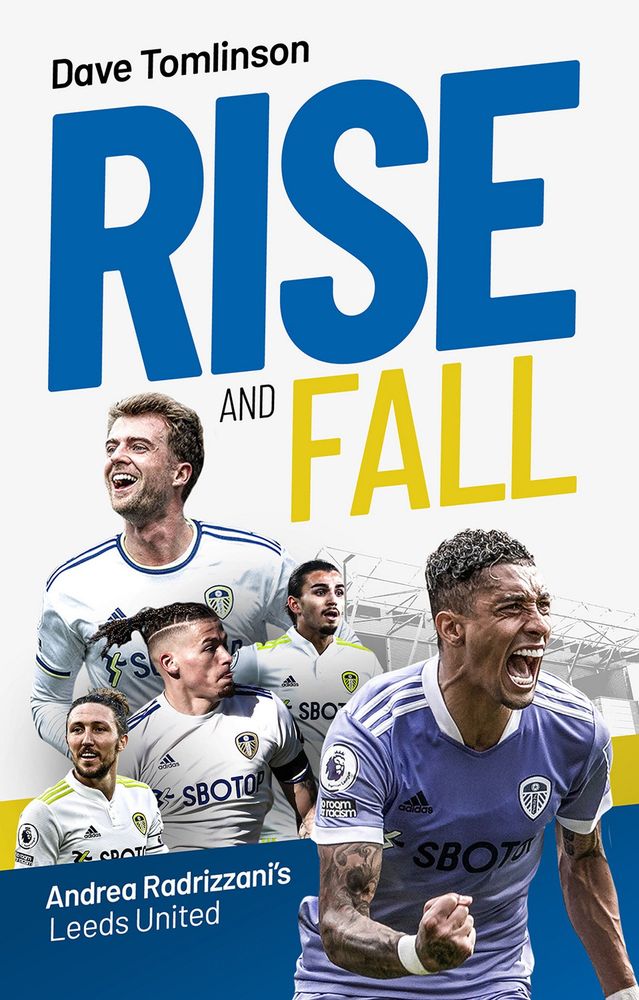
Dave Tomlinson's book "Rise and Fall: Andrea Radrizzani's Leeds United" is from Pitch Publishing - which is available here.