
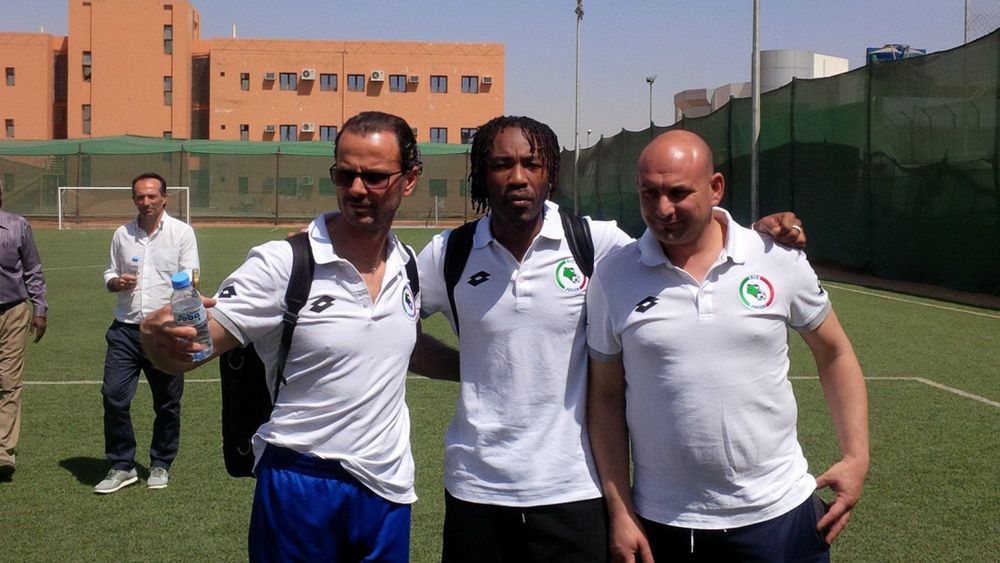
From sharing a Juventus dressing room with Alessandro Del Piero to working under Roberto Mancini and Delio Rossi at Lazio, the former winger experienced different approaches to the game, each leaving its mark on his development as a player.
The lessons he took from his coaches extended beyond tactics, however. Above all, Manfredini remembers the importance of hard work, while his time alongside Del Piero gave him a first-hand glimpse of the qualities that separate an exceptional talent from the rest.
“I spent five years in the Juventus youth system and, in the final two years, Del Piero also joined us," Manfredini tells Football Presse.
"He was already part of the first team, but he had arrived from Padova and, because he wasn't playing very much in the Juventus first team, where there were players such as Roberto Baggio and Gianluca Vialli, he came to play the final stages of the Primavera championship with us.
“You could already see that he was a different player. We were promising youngsters with good prospects, but he had something extra. I remember his performances with great affection. He was an extraordinary player, and I remember with pleasure having played alongside a phenomenon.”
Manfredini’s own path was less straightforward. After leaving Juventus, he moved through several clubs before finding an environment where he could establish himself at Chievo Verona. There, under Luigi Delneri, he became part of a team that finished fifth in Serie A, demonstrating how a clear tactical plan and collective commitment could overcome the disadvantages of competing against wealthier clubs.
Delneri's demanding approach helped Manfredini develop his understanding of the game, particularly the responsibilities of playing as a winger in an attacking system that also required extensive defensive work.
“The coach had developed a slightly attacking idea of football, with two wingers playing alongside two forwards. We could help the strikers score goals, but at the same time, when the team was defending, we had to get back into the defensive line.
“We trained enormously hard to develop the athletic strength needed to play that way. Through all that work, we gradually began to understand his ideas. Match after match, he convinced us, and we also convinced ourselves that we could make it work.”
The success at Chievo opened the door to Lazio, where Manfredini encountered two coaches with very different backgrounds and approaches: Mancini, the former international who had established himself among the leading figures in Italian management, and Rossi, who had built his career through the lower divisions.
Asked what the pair had taught him, Manfredini immediately identified a principle that connected them.
“Both of them left me with a work ethic, in the sense that you have to work hard to achieve results.
“They were different coaches, naturally, because they came from different careers and different backgrounds. Mancini had been a great player, both at club level and with the national team, and then he established himself as a great coach.
“Rossi, on the other hand, came up through the ranks, from the lower levels of football. He built himself up gradually, and he is a coach who works well with young players.”
While Manfredini speaks warmly of both men, it was Rossi who had the greater tactical influence on him. The reason was not a question of which coach was better, he stresses, but the amount of time they spent working together.
“On a tactical level, I feel more connected to Delio Rossi, but that isn't because Mancini isn't as good. It's because I spent more years with Rossi, both at Genoa and at Lazio.
“They were coaches who left me with a great deal, and I always have to thank them whenever I meet them.”
That experience also gave Manfredini an appreciation of the different routes into management. Mancini had experienced the game at the highest level as a player, while Rossi had developed his methods through years of work in the lower divisions. Both, in Manfredini's view, demonstrated that success depends on the ability to work, learn and communicate ideas to a team.
His admiration for Mancini also extends to the coach's ability to develop younger footballers. Discussing Mancini's suitability for international management, Manfredini acknowledged that he had initially questioned the decision to bring him back to the national team, but distinguished that concern from his assessment of the coach's abilities.
“He is a coach who knows how to play football very well and work with young players. He is suited to being a national-team coach.”
For Manfredini, the most important influences were therefore not defined by a single tactical system or a particular trophy. Delneri showed him what a team could achieve when its players embraced a demanding collective plan. Mancini and Rossi reinforced the importance of hard work while offering different routes to success. And Del Piero provided a reminder, from their days together at Juventus, of the extraordinary qualities that can set a player apart.
Looking back, Manfredini remains grateful for those experiences and the people who helped shape his career. His journey through Italian football was built on opportunities, adaptation and learning from those around him — lessons he hopes to pass on as he continues to follow and help develop young players.