
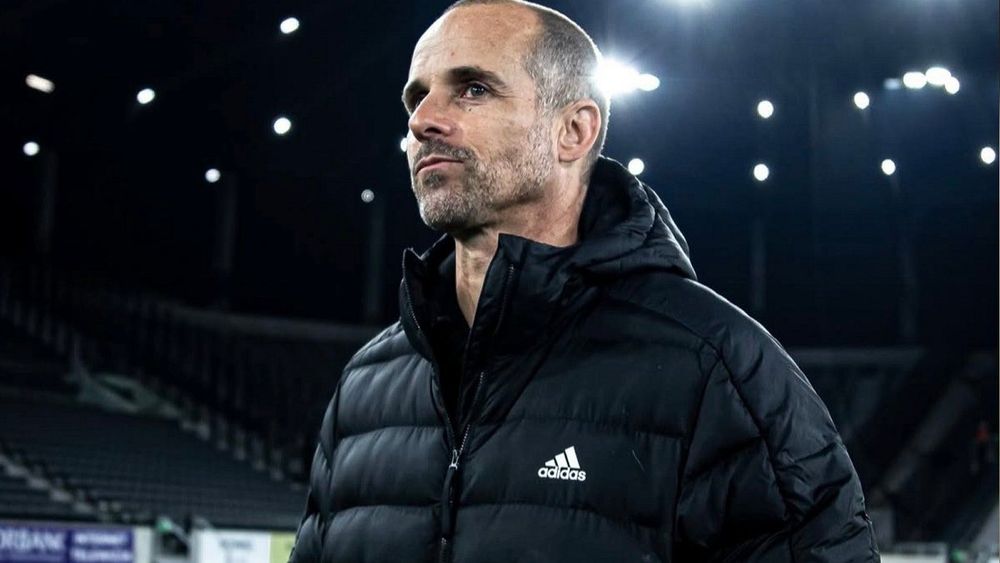
Portugal, Cyprus, Qatar, England, the United States, Bulgaria, Poland and France have all shaped him. So have the coaches he has worked with and studied, from José Mourinho and Leonardo Jardim to Sabri Lamouchi and Arrigo Sacchi.
But Baltazar does not believe in copying another coach.
“I don't idolise coaches for the way they work or play,” Baltazar told Football Presse. “I take the good and the bad from everyone.”
That philosophy has been formed through a career in which adaptation has been essential.
“Each club is different, and every country is different,” he said. “You need to adapt.”
For Baltazar, coaching has therefore been a process of continual education rather than the pursuit of one definitive footballing model.
“I grew up a lot as a coach,” he said. “I grew up a lot as a man, as an individual.”
Among the coaches who made the biggest impression on him is the most famous Portuguese manager of them all.
“José Mourinho was the driving force,” Baltazar said. “He changed the way we think about football and the way we think about coaching.”
Mourinho's rise had a profound effect on Portuguese football, but Baltazar's admiration goes beyond the trophies. He sees a coach who continually adapted to different clubs, countries and circumstances — something that resonates with his own career.
Baltazar also points to a generation of Portuguese coaches who, like him, built their reputations gradually.
“My references are coaches who had careers similar to mine,” he said. “Leonardo Jardim, Paulo Fonseca, Marco Silva and Rui Vitória.
“They built their careers step by step.”
That matters to Baltazar because his own route was far from conventional.
He started coaching in Portugal's lower divisions before progressing through the game, eventually winning the Cypriot championship with APOEL. His career has since taken him into different football cultures, including a spell alongside Lamouchi at Nottingham Forest.
“I started in the third division,” he said.
“I moved up, worked in the second division, coached in Portugal and then became champion in a European league.”
If Mourinho represents one influence from his homeland, Lamouchi provided something much more direct.
Baltazar worked with the Frenchman at Al-Jaish in Qatar and later at Forest, experiencing his methods from inside the coaching staff.
“I learned a lot from Sabri,” Baltazar said. “Sabri had a lot of Arrigo Sacchi's mentality.”
That connection was particularly important to Baltazar because Sacchi's ideas represented a different way of understanding the game.
“I learned a lot from him about tactical work and the Italian way of thinking.”
Sacchi's influence on modern coaching is enormous. His AC Milan won consecutive European Cups in 1989 and 1990, while his emphasis on collective organisation, pressing, compactness and coordinated movement helped reshape Italian football.
Baltazar absorbed those principles through Lamouchi, but did not simply reproduce them.
“Later, I adapted that more analytical and tactical way of working to my own style.”
That final phrase perhaps explains Baltazar better than any formation could.
He is an accumulator of ideas.
He takes something from Mourinho's preparation, from Sacchi's tactical organisation, from Lamouchi's Italian influence and from the Portuguese coaches who demonstrated that a career could be built progressively.
Then he adapts it to his own teams.
His football philosophy is similarly flexible.
“I like offensive and aggressive teams, organised defensively and also without the ball,” he said. “I like teams that have the ball and quality of play.”
But Baltazar is not ideological about possession.
“Of course, I know the importance of the result and I know teams have to be pragmatic.
“There has to be constant adaptation depending on the opponent and the context.”
That willingness to adapt has been tested repeatedly.
The demands of the Championship at Nottingham Forest were entirely different from those of MLS NEXT Pro with Rochester New York FC. France brought another challenge at Caen, while his work in Poland placed him in yet another football culture.
For Baltazar, each experience adds another layer.
“All the clubs, I take good things,” he said. “I bring special people, I bring new experiences.
“And all these experiences make me a better man, a better coach and more prepared for the future challenges.”
It is an outlook that also explains why he remains interested in learning rather than presenting himself as a finished product.
There have been titles, European football and successful projects. There have also been difficult spells and disappointments, including Caen, where he admitted he had failed to achieve the objective set for him.
But even those experiences become part of the education.
“Every time I go to a new club or to a new country, obviously we need to adapt to the new reality,” he said. “All this adaptation is difficult, but it's been an amazing experience.
“I grew up a lot as a coach.”
The influence of the great coaches, then, is not necessarily about becoming the next Mourinho or Sacchi.
It is about understanding why they succeeded, deciding what can be transferred to your own environment and knowing what needs to change. That is perhaps the most revealing thing about Baltazar's coaching philosophy.
He has never stopped moving. And he has never stopped learning.
“I don't idolise coaches,” he said.
“I take the good and the bad from everyone.”