
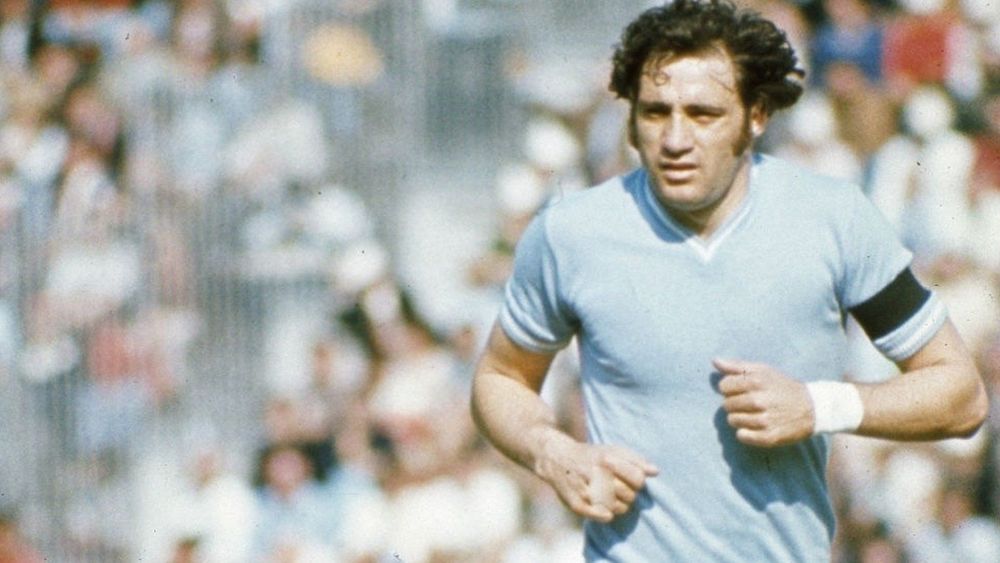
Chinaglia became the symbol of Lazio.
Giordano, in Agostinelli's eyes, was the more naturally gifted footballer.
“Giorgio Chinaglia and Lazio, to me, are the same thing,” Agostinelli told Football Presse. “You could wait a thousand years, but Giorgio Chinaglia equals SS Lazio, because he is the symbol of this club.”
But that does not mean Agostinelli believes Chinaglia was the greatest centre-forward Lazio produced.
“I'm not saying he was the best centre-forward,” he explained. “Because, for example, Bruno Giordano, who for me is like a brother, was one of the first three centre-forwards in Lazio's history in terms of technique and importance.”
It is a judgement based on having seen Giordano develop at close quarters.
Born in Rome and brought through Lazio's youth system, Giordano made his Serie A debut in 1975 and spent a decade with the club. He won the Serie A Capocannoniere award in 1978-79 after scoring 19 goals.
Agostinelli remembers not simply a prolific striker, but a player with a level of technical quality that made him stand out.
“He was Serie A's top scorer,” Agostinelli said. “But above all, look at what Diego Armando Maradona said when he was at Napoli.
“Giordano, Maradona, Careca.
“That's enough to make you understand what kind of centre-forward he was.”
There is an important detail in that observation.
Maradona and Careca were not Lazio players. Giordano left Lazio for Napoli in 1985, and it was in Naples that he became part of the famous attacking trident with Maradona and, from 1987, the Brazilian Careca. Giordano spent three seasons at Napoli, winning the Scudetto and Coppa Italia in 1986-87.
By the following season, the Napoli attack had become 'Ma.Gi.Ca.' — Maradona, Giordano and Careca — one of the most famous forward lines in Italian football.
For Agostinelli, that association is itself evidence of Giordano's standing. He is particularly emphatic because of his personal relationship with the striker.
“Bruno Giordano, who for me is like a brother, was one of the first three centre-forwards in Lazio's history in terms of technique and importance,” he said.
Giordano's Lazio career was extraordinary, but it was also interrupted by the Totonero scandal. He was suspended for three years and six months in 1980 before returning to football after the amnesty that followed Italy's 1982 World Cup victory. He subsequently helped Lazio return to Serie A before moving to Napoli.
Agostinelli's memories therefore span two very different eras of Italian football. At Lazio, he saw Chinaglia become the embodiment of the club and Giordano emerge as one of its finest attacking talents.
At Napoli, Giordano found himself alongside Maradona and Careca and helped create a team that would become historic. The contrast between Chinaglia and Giordano is therefore not about choosing one great player and dismissing another. For Agostinelli, they represented different kinds of greatness.
“Giorgio Chinaglia equals SS Lazio,” he said.
But when the conversation turns specifically to the quality of the centre-forward, his choice is clear.
“Bruno Giordano, for me, is one of the first three centre-forwards of Lazio.”
And then comes the Napoli connection that makes Giordano's career even more remarkable.
“Giordano, Maradona, Careca,” Agostinelli said. “That's enough to make you think about what kind of centre-forward he was.”
And it is difficult to argue with such company.