
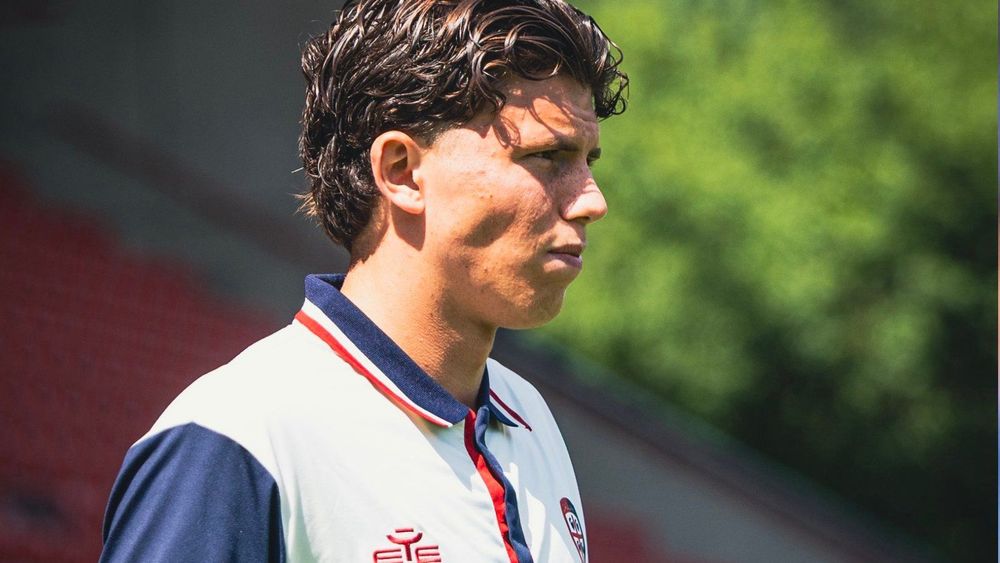
It wasn't enough. Murat Yakin travelled personally to see Romano turn out for Cagliari this season, alongside Swiss federation figures Marinko Jurendic and Davide Callà, hoping to keep hold of a midfielder who had already worn the captain's armband across several Swiss youth age groups.
Romano was not an easy player to lose: born in Winterthur to Italian parents, he made 34 appearances for Switzerland's youth national teams and was enrolled in Footuro, the federation's development programme for its most promising talents, reportedly worth around 25,000 francs a year in personal coaching, testing and career planning. Roberto Mancini's Italy won him anyway.
"It clearly wasn't easy, because I had very good conversations with coach Yakin, Marinko Jurendic and Davide Callà," Romano told Swiss newspaper Blick.
"But that's part of the game too. When you say honestly what you feel, you find understanding and respect as well. In the end I received a first-class education in Switzerland, and I'm very grateful for that."
Asked whether the Swiss federation should have done more to keep him, Romano pushed back on the suggestion.
"No. I also think the sometimes harsh criticism of the federation isn't fair," he said. "The people in charge there deserve recognition and respect for their efforts. Sport also means giving everything and still not winning — having a promising game plan that doesn't guarantee success in the end." On the disappointment of Swiss supporters, he added: "If that's how it is, I understand it. But I think what will win out is happiness that Winsley Boteli will play for Switzerland instead."
The switch will not come cheap. Because Romano signed a Footuro agreement, the Swiss federation could pursue roughly 100,000 francs in compensation for the investment made in him — a sum with precedent, after former Lugano player Andi Hajdari went through a similar process when he opted to represent Kosovo. Any penalty would fall on Romano personally rather than the Italian federation, which remains free to select him regardless.
For Romano, the decision came down to feeling rather than calculation.
"Because it's what I felt in my heart," he told Blick, explaining his choice of Italy over Switzerland. "I didn't draw up a list of pros and cons thinking about where I'd have more chances to play, or who had recently been at a major tournament. Was I surprised by how much public interest there was in my decision? Honestly, yes."
The conversation at home was more straightforward.
"We talked about it a lot among ourselves," Romano said. "In the end I was able to decide, and my family agrees with my choice and is extremely proud of it, whatever the outcome would have been."
His earliest memory of the Azzurri, he added, is second-hand rather than lived: "The 2021 European title comes straight to mind. When Italy became world champions in 2006, I was only three weeks old — obviously I can't remember that personally, so I did a bit of revision on that World Cup once I was in Italy."
Family carried Romano through a bigger upheaval than this one, years earlier. He left Winterthur as a young teenager for Roma's academy, turning down interest from SC Freiburg and clubs in London along the way.
"England was never an option for me at the time," he said. "Italy attracted me considerably more than Germany, even though I knew how good the work being done at Freiburg was — you can see that not least from Johan Manzambi's development. In the end, though, all roads lead to Rome — mine too."
The early months away from home were hard on the whole household, Romano said.
"My parents did everything to support me. It wasn't something we took for granted, because my brother Luca also plays football and my younger sister had school and synchronised swimming, which takes up a lot of her time. We have a very tight family bond, and that was ultimately what helped me hold firm."
At AS Roma, one figure in particular shaped his path: Claudio Ranieri, now the Italian federation's technical director, who first gave Romano his senior chance. Mancini made the connection explicit when explaining the call-up to reporters.
"It wasn't easy, but we believe he can be very useful for the national team's future," Mancini said. "He sees the game, he works in one touch, and so he'll be important going forward. Claudio too — Ranieri, who had him at Roma — was important."
Ranieri himself, speaking at an FIGC event in Rome, confirmed he had personally lobbied players weighing up Italy against rival federations.
"Thanks to Roberto giving me that opportunity, I spoke with the lads who were undecided between our national team and others," Ranieri said. "I spoke with all of them, and quite a few came over. That pleases me."
Between Roma and Cagliari came a Serie B education nobody outside Liguria saw coming. Stefano Melissano, Spezia's former sporting director, brought Romano in on loan in January and still marvels at what he found.
"He's a talent, with human and footballing qualities that are hard to find," Melissano told Gianlucadimarzio.com. "After a few matches, some Serie A colleagues started calling me to ask what he was like — Accardi from Cagliari among them. I told him he was a 30-year-old in a 19-year-old's body."
Even Melissano was taken aback by the speed of what followed: "I didn't think he'd reach the national team so quickly, but I did believe he could establish himself in Serie A."
That belief has been vindicated fast. Romano joined Cagliari on loan with an obligation to buy from Roma this summer, went straight into Fabio Pisacane's starting eleven, and scored on his league debut as the Sardinians won four of their opening five matches — form good enough to sit them just behind early pace-setters Roma, Lazio and Inter Milan. Juventus, Inter Milan and AC Milan are already reported by Gazzetta dello Sport to be monitoring him ahead of a permanent move.
Watching him play explains the interest as much as the results do. Romano operates as a No. 6 or 8 in Pisacane's midfield, favouring the first-time pass over an extra touch and comfortable dropping between the centre-backs to start attacks rather than simply receiving them — less a box-to-box runner than a metronome who dictates a match's rhythm from deep, the low-risk, one-touch passer international coaches tend to build midfields around rather than the flashier alternative.
Romano is refusing to get carried away by any of it.
"My goal is to train well tomorrow," he said, when asked what mattered most now that Italy had picked him. "I want to reach the highest possible level I can — whether that's with Cagliari or with the national team. The competition is everywhere. I have the chance to make an impression week after week."
His first cap arrived in a chastening 0-2 defeat to Belgium; his next opportunity comes away to Turkey, only the second match of Mancini's tenure.
Two federations spent years shaping Romano. Only one of them gets to find out what he becomes.