
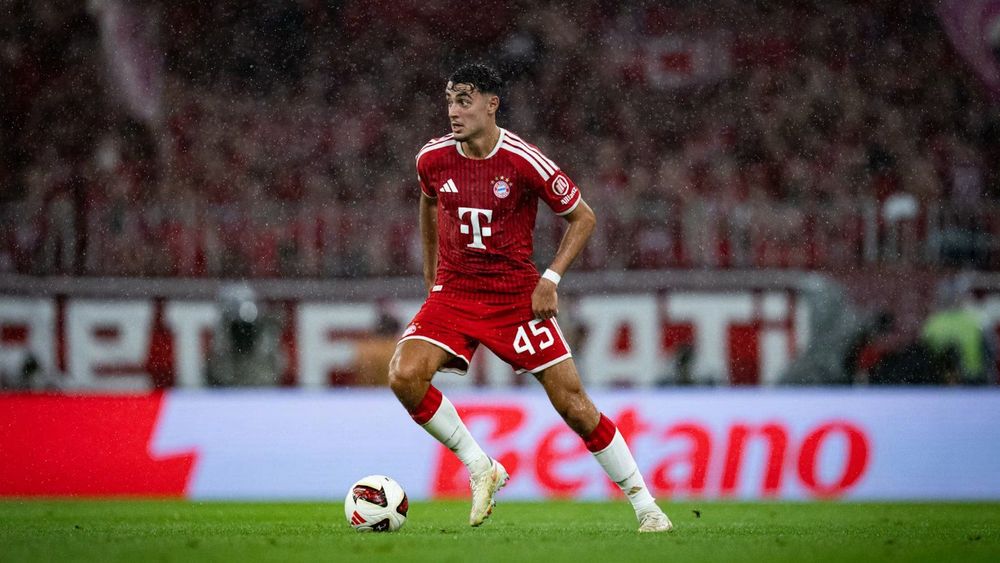
"We'd had him on our list for two years," said Dragan Stojković, Serbia's national coach, of the eligible-for-both-countries midfielder.
"We tried everything — from December we were in contact with his family, then his agent got involved, and then Aleksandar himself."
Pavlović, born in Munich to a Serbian father and German mother, chose Germany instead, and Bild's Christian Falk described City's reaction to a similar rebuff in September as one of pure surprise: "They didn't expect that. They would probably also have been ready to negotiate an even higher sum with Bayern."
Bayern president Herbert Hainer has a theory for why players like Pavlović keep saying no to leaving.
"Pavlović impresses all of us with his calm and his charisma," Hainer told the Münchner Abendzeitung. "He's a real statement player in the Bayern style. Identity is the key — FC Bayern has always been shaped by players who reflect the culture of the club."
That identity was built early. Pavlović joined Bayern's academy in 2011, aged seven, from SC Fürstenfeldbruck, and broke through under Thomas Tuchel with a Bundesliga debut in an 8-0 win over Darmstadt in October 2023. Even then, Germany's biggest names weren't convinced he was ready for the senior stage.
"Aleksandar Pavlović has played superbly recently, you have to acknowledge that, but you shouldn't turn the boy's head," Lothar Matthäus wrote in his Sky column in March 2024, arguing there was no room for him in a central midfield stacked with Toni Kroos, Ilkay Gündogan, Leon Goretzka and Pascal Groß. Mario Basler was blunter still on his podcast Basler ballert: "Pavlović? I don't even want to hear about taking a player like that to the Euros already. Please, leave it. Maybe after the Euros."
He signed a new contract through to 2029 that summer anyway, by which point he'd already made his senior Germany debut — a call-up Julian Nagelsmann was at pains to stress was earned rather than political, given his Serbian eligibility.
"It's not a political nomination," Nagelsmann said. "I didn't have to convince him to play for Germany. It was his wish. He's shown very good performances — very dominant, very stable, one of the most stable at Bayern recently, and someone who speaks up in the dressing room and coaches his teammates."
Vincent Kompany inherited that foundation and has kept building on it.
"Just like Thomas Müller or Lennart Karl, for example, Pavlo is a player from the Bayern youth set-up — they don't fear anything," Kompany said after a Champions League win over Real Madrid in which his midfielder recovered from a shaky start.
"You can always be honest and open with them. If he says his first half wasn't that good — okay. If you make two or three bad passes, the question is: how willing were you to run, to fight for the team?"
Pavlović has returned the credit in kind: "Vincent Kompany has a huge influence. He simply knows how I play football and how I think, and he's also taken me to another level defensively. That's why he's so important, and it's a lot of fun to play under him."
On the pitch, the profile Manchester City were chasing makes sense: a left-sided, ball-playing six who can both shield the back line and dictate tempo from deep, at 1.88m unusually difficult to dispossess for a passer of his range. It isn't a coincidence that City wanted him as insurance for the departing Rodri — the resemblance, in build and role if not yet in trophy count, is real: a deep-lying metronome content to take the ball under pressure and break lines with a single pass rather than carry it himself.
Matthäus himself has since come all the way round. Two years on from doubting his readiness, the record Germany international reached for a very different comparison on Sky90 this March: "He's a playmaking six who goes and wins the ball back himself.
"Pavlović is an important player, at Bayern and in the national team. Pavlović has something of Toni Kroos about him."
Oliver Kahn, watching from the boardroom perspective, sees the same midfield rather more critically: after Bayern's Champions League exit to Paris Saint-Germain, the club's former CEO argued the type of player Bayern actually lacked was someone unlike Pavlović altogether.
"The types of player in Bayern's midfield — with Leon Goretzka, Aleks Pavlović and Joshua Kimmich — are all very similar in style," Kahn said on Sky. "What's missing is someone like Thiago was for us: that special technique, playing your way past opponents, those exceptional passes. That type of player is missing right now."
It hasn't all been smooth progress. Pavlović endured a difficult 2026 World Cup, prompting a pointed column from Germany great Philipp Lahm.
"In this tournament, Aleksandar Pavlović has not really impressed so far; I see an incredible number of simple ball losses. He is not ideally positioned on the pitch," Lahm wrote in Kicker, arguing for Joshua Kimmich to replace him in central midfield.
Nagelsmann had sounded a similar note before the tournament even began, tying Pavlović's international standing directly to his club game-time: "If his rhythm stays as it is now, at most 50 per cent of games, it will be tight. You have to be a regular at your club, or at least play 70 to 80 per cent of matches."
He has answered that challenge since. By the two-and-a-half-month mark of this season, Pavlović had played 757 minutes to Lamine Yamal's 621 — 60 per cent of Bayern's available game-time against Yamal's 53 per cent at Barcelona — reclaiming his place ahead of Leon Goretzka in the games that mattered most. It's that version of Pavlović, restored to his best after a rocky international summer, that Manchester City tried and failed to sign for up to €100m in September.
For now, his ambitions stay close to home. Team-mates and coaches alike point to the same thing: a player who was shaped by this dressing room and wants to lift the Champions League in it before he looks anywhere else.