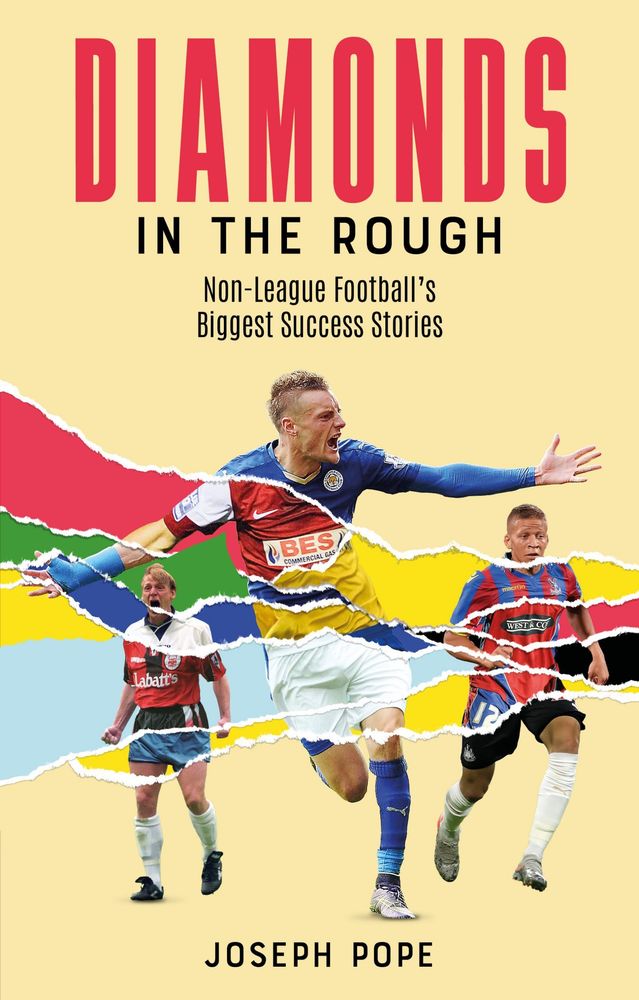
But England C offers non-league footballers something increasingly valuable: the chance to represent their country while still fighting their way towards the EFL.
Joseph Pope believes that opportunity deserves far more recognition.
The author of "Diamonds in the Rough", which charts the careers of players who climbed from non-league football to the highest levels, has followed England C closely and travelled to watch the team himself.
“I was really proud to champion in the book, because I don’t think it gets championed enough,” Pope told Football Presse.
“I’m actually on a podcast called NL Full Time, and we’ve been real staunch supporters of England C over the last couple of years.”
For Pope, this is not simply an abstract argument about the importance of a representative side.
He has made the effort to see England C in action, travelling to watch them against Wales C and following the team beyond England.
“I went to Llŵynefli to watch them play Wales C,” he said. “I went to Old Trafford to watch them play Wales as well.”
And what he saw convinced him that the team remains an important part of the non-league ecosystem.
“It’s brilliant,” Pope said. “It’s a great platform to recognise the best players from non-league.”
That phrase — the best players from non-league — is important.
England C is not simply a consolation prize for footballers who have failed to reach the professional game. It is a national team built around players who are competing outside the EFL, giving them an opportunity to be recognised on a national stage.
“I think it’s definitely something that we need to keep,” Pope said.
“Because it is a good pathway for players from non-league to get that recognition for being the best in non-league.”
The history of the side shows why that pathway matters.
Former England C players have included George Boyd, who went on to become a Scotland international after a successful Football League career, while Andre Gray and Sam Clucas also represented the side before reaching the Premier League.
That makes England C part of a much bigger story than simply providing players with a one-off international experience.
It can be a shop window.
It can be recognition.
And, for some players, it can be another step towards professional football.
Pope believes the pride of representing England should not be underestimated, either.
“Obviously you would not be surprised at how much pride there is in those players to hear the national anthem with their England shirts on,” he said.
“Representing, you know, because it is a big privilege.”
That matters particularly for footballers who have spent much of their careers away from the spotlight.
“They are the best players from non-league,” Pope said. “And given that non-league’s improving now, to be the pick of non-league players, you know, it’s quite a badge to wear.”
“So yeah, definitely a lot of pride, and they take it really seriously.”
For Pope, England C also provides something that the wider football pyramid does not always offer: a formal acknowledgement that a player performing outside the professional game can still be operating at a high level.
That is particularly important as non-league becomes more professional and the gap between the best clubs below the EFL and League Two continues to narrow.
Pope's own experience of following Torquay United has given him a close-up view of that change.
He believes the standard of football has improved dramatically, making England C's role in identifying the best players increasingly relevant.
And he does not believe the team should be allowed to disappear.
“Obviously, years ago, it was a much bigger thing in terms of they used to play a number of different countries,” Pope said.
“And before I joined NL Full Time, they actually went out to Estonia to cover England C.”
That international history is part of what Pope believes should be preserved.
He also has enormous respect for the people who have continued to make the team work.
“I hope it stays because they’ve got some fantastic people working there,” he said.
“Mick Payne, who obviously is now commentating for Dagenham, and Paul Fairclough, who’s done really well in non-league before.”
Pope believes their work deserves recognition because of the number of careers England C has helped advance.
“They do such great things for non-league, and they’ve helped so many players come through and get that opportunity,” he said.
“Hence why they obviously get a chapter in the book.”
That connection between England C and the professional game is perhaps the most important argument for its continued existence.
Pope's wider research is full of players who were overlooked, released or forced to take unconventional routes before eventually climbing the pyramid.
England C gives some of those players an opportunity to be seen while they are still on that journey.
And Pope believes the players themselves understand exactly what the occasion represents.
“They are the best players from non-league,” he said again.
“To be the pick of non-league players, you know, it’s quite a badge to wear.”
The significance is heightened by the fact that England C players are representing their country while still playing outside the professional leagues. Unlike the senior England team, this is a side whose players are selected specifically because they remain in the non-league game.
That gives the team a unique purpose.
Pope is not arguing that every England C player will become a Premier League star. His own book demonstrates how varied the journeys can be.
But the opportunity to represent England can provide confidence, exposure and recognition to players who might otherwise remain invisible beyond their own clubs.
“I think it’s definitely something that we need to keep,” Pope said.
“It is a good pathway for players from non-league to get that recognition for being the best in non-league.”
For a football pyramid increasingly interested in finding talent wherever it exists, that seems difficult to ignore.
England C may never command the attention of the senior national team. But for the players who wear the shirt, it can represent something just as important: proof that their football has been noticed.
And for Pope, that is reason enough to make sure the opportunity remains.
Joe Pope is the author of 'Diamonds in the Rough' from Pitch Publishing - which is available here.