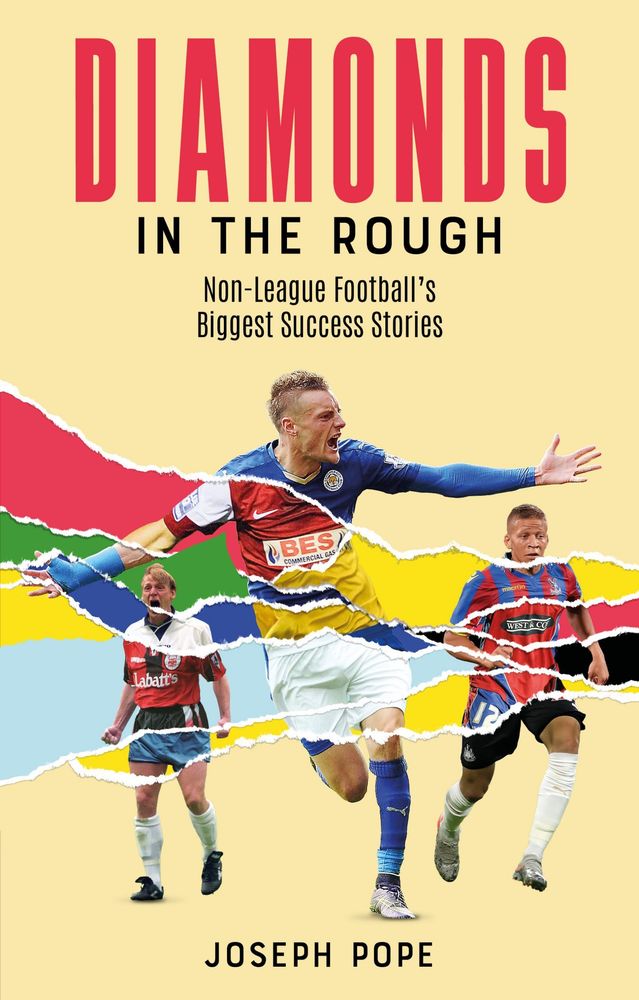
The author of "Diamonds in the Rough", which charts the journeys of 100 players who progressed from non-league football to the professional game, has found a recurring pattern in his research: players released by professional academies can rebuild their careers in the lower leagues before eventually reaching — or even surpassing — the level they were once told they were not ready for.
“There are so many examples of players who perhaps aren’t quite ready for making the grade sort of at an academy to then play in, say, the Premier League or the Championship, that have to drop down, and then obviously get that move,” Pope told Football Presse.
For Pope, that is one of the most interesting aspects of the modern football pyramid.
The conventional academy system asks clubs to assess talent at an extraordinarily young age. But physical development, confidence, opportunity and circumstances can all alter a player's trajectory after that assessment has been made.
Josh Stokes provides one of Pope's clearest examples.
The midfielder was released by Ipswich Town before rebuilding his career with AFC Sudbury, deep in the non-league pyramid. He then moved to Aldershot Town and quickly found himself back on the professional ladder.
“He was in an academy at Ipswich, he got released and he then went and played for AFC Sudbury, who are step three or four of non-league,” Pope said.
“He then got a move to Aldershot, and then within a year he’s got a move to the Championship.”
For Pope, the significance is not simply that Stokes eventually found a professional club.
It is that he effectively worked his way back towards the level at which Ipswich had previously decided he was not ready.
“Even though he didn’t make it through Ipswich, he’s then dropped into non-league and then made that progression back up to the level he would have been at with Ipswich,” Pope said.
“So definitely a good pathway.”
But Stokes is not the only example that caught Pope's attention.
Will Wright is another striking case. The forward came through Salford City's academy before making his senior debut and eventually attracting the attention of Liverpool, who signed him in August 2025.
When asked whether Wright represented a talent that might have been missed by the traditional academy system, Pope did not dismiss the suggestion.
“Yeah, potentially,” he said.
The answer is significant because Wright's story demonstrates how quickly perceptions of a young player can change.
Pope's wider research suggests that the question should perhaps not always be whether a teenager is good enough when an academy makes its decision, but whether he has finished developing.
“Certainly if you went back say five to 10 years ago, I think it would definitely be seen as rare,” Pope said of players progressing from non-league into professional football.
“The number of teams were less reticent to take on players from non-league.”
Now the lower levels can provide players with the opportunity to develop outside the academy structure and force professional clubs to reassess them later.
Pope believes that is one reason the pathway has become increasingly important.
“I think the pathway is probably still fairly rare, in terms of players that have played, say, played in the EFL or, you know, the high levels in Scotland,” he said.
“But no doubt as we go forward it will become less rare, as more and more players make that step up.”
And then there is Richard Kone, whose story takes the idea of a second chance to another level.
Kone began playing extremely low down the English pyramid after moving to the UK from Africa. His progress was complicated by visa issues, but his goals eventually attracted the attention of clubs higher up the system.
“Richard Kone’s got a really, really fascinating story,” Pope said.
“Started, was born in Africa and then migrated to the UK, played really low down in the pyramid for a team called Athletic Newham.”
The circumstances surrounding Kone's journey make it particularly unusual.
“There was sort of a couple of problems that potentially stopped him from making that move sooner with visas, etc.,” Pope explained.
“But Wycombe took that plunge after him scoring so many goals right down in the pyramid. And they’ve certainly made their money now. Obviously got that massive move to QPR.”
For Pope, however, the story is about considerably more than a football transfer.
“Somebody who can come to England through the hardships of growing up in Africa,” he said, “and then, you know, they go on and improve and progress their, not just their careers, but their lives through non-league football.”
Pope was fortunate enough to interview Kone for "Diamonds in the Rough", giving him an insight into how significant that opportunity had been.
“I’m sure if you ask Richard Kone, as we do in the book, because we were lucky enough to interview him, if it wasn’t for non-league football, he wouldn’t be where he is today,” Pope said.
“It’s a really, really special story. And there’s so many of those in the book.”
That may be the most important lesson in the stories Pope has collected.
Football's talent identification system is not necessarily getting every decision wrong. A player may genuinely not be ready at 16 or 18. But the decision to release somebody does not mean their development has stopped.
Sometimes the player simply needs a different environment.
Pope's own experience of following non-league football has convinced him that those opportunities are becoming increasingly valuable.
“You see a lot of players from, say, top-level academies at the Premier League and the Championship who actually get released and then get a deal in, say, the National League and are then able to move their way up through the pyramid,” he said.
“That’s why I think we’re seeing so many players come through from non-league is because it is a very good standard of football.”
The route from academy football to the Premier League remains the traditional dream. But Pope's research suggests football needs to be careful about deciding too early who belongs on that road.
Some players develop inside the academy system.
Others need to leave it before they can show what they are capable of.
And for those players, non-league may not represent the end of the professional dream.
It may be where the second chapter begins.
Joe Pope is the author of 'Diamonds in the Rough' from Pitch Publishing - which is available here.