
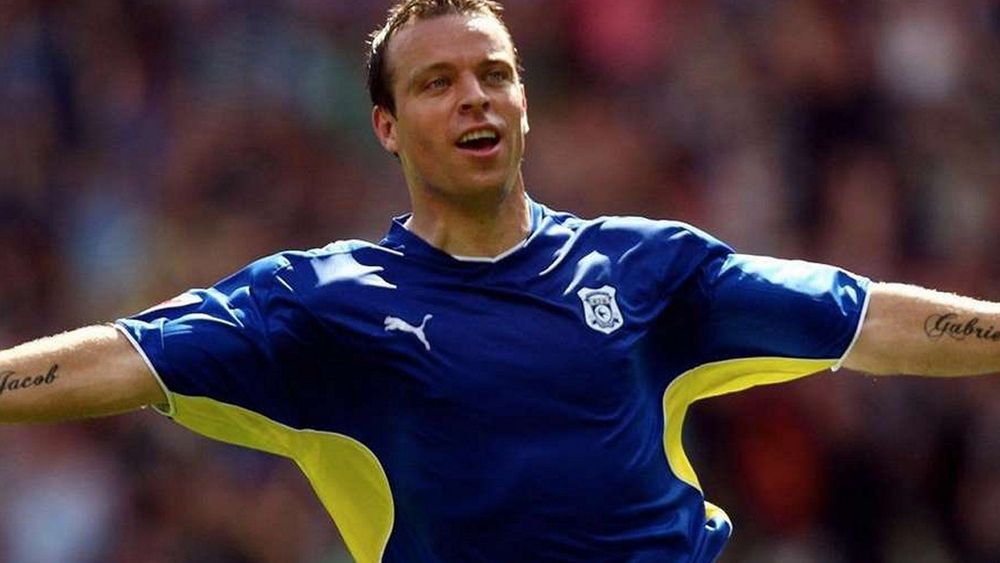
Gavin Rae’s first year in professional football was a struggle. The midfielder had left school determined to make it, but quickly discovered that being a promising youngster was no guarantee of success in a competitive dressing room.
“From my early days at Dundee, the standout memories are leaving school and becoming a full-time scholar, with an aim to become a professional football player," Rae tells Football Presse.
"I think the first year was really difficult, trying to adapt to the environment and getting used to training every day, having to compete with others from all over Scotland, basically, that were at a good level.
“I really struggled that first year, to be honest. I struggled to get to grips with it, and it wasn't towards the end of the season that I started to score a few goals and get a bit more confidence. Luckily, I was kept on for the second year, when things really started to change. I was able to join in with the reserves and then even play first team in my second year as a YTS.
“Tough to get used to, tough environment, how competitive it is with everyone obviously trying with the same aim to become a professional player.”
The experience taught Rae how quickly a young player’s prospects can change. He credits two people in particular with helping him progress at Dundee: manager Jim Duffy, who gave him his first-team opportunity, and Ray Farningham, an experienced midfielder who helped him understand the finer details of his role.
“Jim Duffy was really influential. He brought us on and gave me the opportunity. By the end of my second season, I actually played in the first team with him. He was still player-manager at the time.
“He was an amazing central defender. I actually played left-back in my starting debut, but he was quality, a great guy, really knowledgeable, an excellent player and a brilliant coach.”
Farningham offered a different kind of guidance, passing on lessons that Rae could apply directly to his own game.
“He was very good with the younger players and gave loads of good advice, especially for myself. He was a similar player, a similar position to me. You know, an attacking midfielder who tried to get goals now and again.
“He also gave me some really good advice about my timing of runs into the box and stuff like that. I'm still in touch with these people today. They were really influential on both my life and career.”
Those early years eventually led Rae to the club he had supported as a boy. Growing up in Aberdeen, he had hoped to join the local side after school, but the opportunity never arrived. Instead, Dundee became the place where he learned his trade.
“Playing for Aberdeen, you know, it's something I always wanted to do. And I was close when I was younger. I never really got an opportunity to sign from school to Aberdeen, so that's why I went to Dundee.
“And then there was a couple of times when I was at Dundee and doing well that I had interest from Aberdeen but never really materialised. And then obviously finally to get there and play for the club that I supported as a boy and went to watch as a boy was amazing.”
The move eventually came in January 2012, after Rae had returned to Dundee following four years at Cardiff City. He joined Aberdeen from Dundee and spent the following 18 months at Pittodrie before returning to Dens Park once more in 2013.
His journey back to his hometown club gave a different meaning to the ambition he had carried since childhood. Aberdeen had not been the starting point of his career, but he eventually got to wear the shirt he had once watched from the stands.
Rae also has a wider perspective on Scottish football, having seen the game develop throughout his professional career. He believes the changes have been substantial, particularly in the technical and tactical demands placed on players.
“I think Scottish football, from the time that I started to when it finished, has evolved a lot like other countries in terms of football. It's a lot more technical than it used to be, a lot more technical and tactical than it used to be.
“And, you know, it's good to see. I think Scottish football is always entertaining, you know. If you watch Scottish football on the telly, all the games are really competitive and exciting and, you know, really full-paced and full pelt, kind of match the personality of Scottish people. So it's always a good watch, I feel.”
That combination of technical development and competitive intensity is what Rae sees as a continuing strength of the Scottish game. His own career took him from a difficult introduction at Dundee to international football, Rangers, Cardiff and, finally, the boyhood club he had always wanted to represent.
The early setbacks remain an important part of that story. Rae did not find professional football easy at first, but the opportunity to learn from Duffy and Farningham helped him find his footing — and the career that followed gave him the perspective to appreciate how much the game around him had changed.