
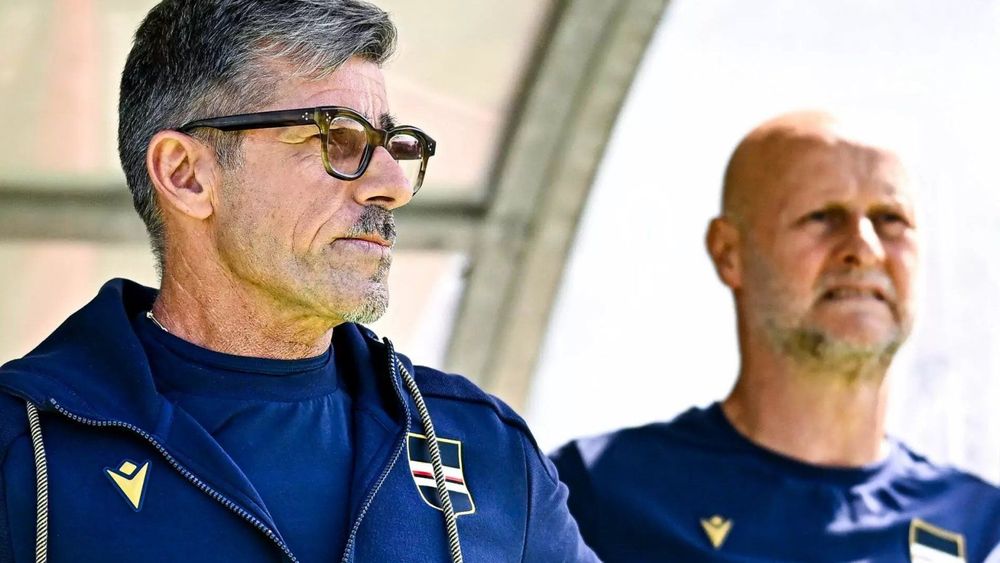
A European Cup winner, Serie A champion and European Championship-winning coach with Italy, Evani lived through the rise of one of the greatest club sides football has ever seen. At AC Milan, he shared dressing rooms with icons like Marco van Basten, Ruud Gullit, Frank Rijkaard and Paolo Maldini, while working under visionary coach Arrigo Sacchi during Milan’s revolutionary rise in the late 1980s.
But speaking to Football Presse, Evani reflects on it all with remarkable humility.
“Milan was my second family,” Evani said. “I arrived when I was 14 and left when I was 30. I grew up there.
“At the beginning it was difficult. We were relegated, even if we came straight back up. But those experiences shaped me.”
Everything changed with the arrival of Silvio Berlusconi, whose takeover transformed Milan from an underachieving giant into a global powerhouse.
“The arrival of Berlusconi transformed the club completely,” Evani said. “He brought innovative and risky ideas. He took a coach from Serie B who nobody really knew. It was a huge risk, but he had vision.
“I still remember his first speech. He told us we would become the best team in Italy, then the best team in Europe, then the best team in the world. At first it sounded impossible. But then everything he said happened.”
Under Sacchi, Milan became one of football’s defining sides — aggressive, tactically organised and physically relentless. Evani believes the mentality of the squad was every bit as important as the talent.
“We had extraordinary players, but also incredible professionalism,” he explained. “Van Basten had everything — physical power, technique, acrobatics, heading, fantasy, pure class.
“When Gullit accelerated, it was almost impossible to stop him. Rijkaard gave us quality, intelligence and balance. But what impressed me most was that they were serious professionals and fantastic people.”
Stopping Maradona
That legendary Milan side developed one of football’s great rivalries with Napoli and Diego Maradona, whom Evani still describes with enormous admiration.
“He could win matches alone,” Evani said. “He was one of the strongest players of all time.
“He was less professional than the Dutch players, but he had so much talent that he almost didn’t need to train.”
Stopping Maradona required collective sacrifice rather than individual marking.
“At first teams followed him everywhere man-to-man,” Evani recalled. “But under Sacchi we defended differently. Nobody focused on him individually anymore. We surrounded him with two or three players through movement. That was the only way to stop him.”
After leaving Milan, Evani later enjoyed an important spell with Sampdoria — another club that remains close to his heart.
“Sampdoria was a wonderful surprise,” he told Football Presse. “The supporters, the passion, the atmosphere — it became a special connection.”
That emotional attachment led him back to the club during one of the darkest moments in their modern history. Last season, Evani returned as coach with only six matches remaining as Sampdoria fought desperately to avoid relegation.
“It was an extremely difficult situation because the team was broken mentally,” he admitted. “But I knew what Sampdoria means to the supporters, and I couldn’t say no.”
Against the odds, Sampdoria survived through the relegation play-outs — an achievement Evani still treasures.
“It’s something I carry in my heart because of what the club means to people.”
Winning the Euros
Evani’s coaching journey has also taken him through Italy’s national-team setup, where he worked alongside Roberto Mancini during Italy’s triumphant UEFA Euro 2020 campaign.
“We were not the strongest team technically,” Evani said. “But we had unity, sacrifice and spirit. That group became one.”
Now 63, Evani remains open to another challenge in football — potentially even abroad.
“As a player, Italians rarely moved overseas in my era,” he states. “Now I would love an experience outside Italy. I still want to learn and improve.”
Listening to Alberico Evani reflect on his career now, what stands out most is not ego or nostalgia, but perspective.
He witnessed one of football’s greatest dynasties from the inside, played alongside some of the sport’s immortals and helped shape modern football under Sacchi’s revolution.
Yet he still speaks less like a legend reliving glory years — and more like a student of the game who never stopped learning.