
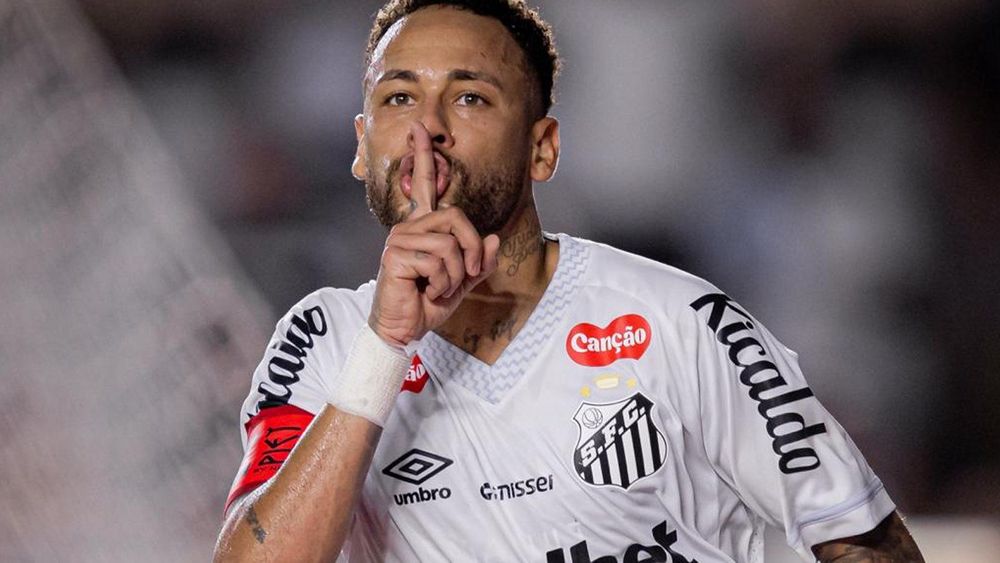
For more than a decade, Neymar was Brazilian football’s answer to every question.
He was the next great Santos prodigy, the heir to Pelé, the player expected to deliver Brazil’s sixth World Cup and the one footballer capable of restoring a country’s lost confidence. Even now, as his international career appears to be over, Brazil remains divided over what Neymar represented and what his career might have become.
Tim Vickery has followed that story from the beginning. He saw the talent emerge at Santos, watched Neymar become a global superstar at Barcelona and Paris Saint-Germain, and observed the increasingly difficult relationship between the player and his country.
“Neymar was given two jobs,” Vickery tells Football Presse. “Win Brazil the World Cup and win the Ballon d'Or. Anything less was failure. And I think Neymar never learned to lose emotionally.”
That burden was visible long before the injuries and controversies that came to define the later years of his career.
Vickery remembers watching Neymar’s first major international tournament, the 2009 Under-17 World Cup, when Brazil were eliminated in the group stage.
“It was dreadful,” he says. “They needed a goal in one of the games and Neymar was substituted. That was very early, but I remember thinking that perhaps the mental side wasn't as strong as people assumed.
“It's very difficult when you're told from such a young age that you're the one who is going to save Brazilian football. You are not simply a talented boy any more. You become a national project, and then every disappointment becomes something much bigger than losing a football match.”
Neymar nevertheless became an extraordinary player. His acceleration, close control, imagination and ability to create something from nothing made him one of the defining attacking talents of his generation.
But Vickery believes that the player Brazil celebrated was also a product of a changing football culture.
“Neymar isn't a street footballer,” he says. “He's a futsal player. And that's an important distinction.
“The street player learns survival. He learns when to release the ball, when to pass, when to dribble and when not to dribble because if he loses it, the game carries on and nobody is going to protect him. Neymar's defence is the referee. He's always looking for the foul.”
For Vickery, that instinct became increasingly damaging as Neymar moved into European football.
“The internet reels show you all the tricks, and the tricks are wonderful. But winning games is something different. Neymar often gets involved in personal duels, looking for fouls in areas of the pitch where he should be trying to make something happen.
“He doesn't always interpret space in the way Messi does. Messi understands where he needs to move and when he needs to move. Neymar can become attracted to the individual battle.”
That distinction was particularly evident at Paris Saint-Germain, where Neymar’s transfer in 2017 was supposed to establish him as the central figure of a European superpower.
Vickery considers the move a mistake.
“The idea behind going to Paris Saint-Germain was noble,” he says. “He wanted to become the main man. He wanted to get away from Messi's shadow and have a team built around him. But he underestimated the physicality of French football and the amount of contact involved.
“Then the injuries started to come. And once you're injured, you lose rhythm, you lose confidence in your body and you start making decisions differently. You don't want to be hit in certain areas because you know what it might mean.”
The injuries became a defining feature of Neymar’s career. He missed crucial periods with ankle and foot problems, suffered a serious knee injury in 2023 and repeatedly struggled to maintain a sustained run of matches.
Yet Vickery does not believe the physical decline explains everything.
“I watched pretty much every Santos game Neymar played that year because I wanted to see whether there was still something there,” he says. “And there was. The talent was still there.
“But physically, he wasn't right. His balance was off. He wasn't moving naturally. Perhaps a sequence of games could have restored that, but then he was injured again and couldn't train properly for three weeks before the tournament.
“That is why I found it so strange that Ancelotti eventually allowed himself to be drawn into the whole thing.”
The relationship between Neymar and the Brazil national team had become increasingly complicated by the time Carlo Ancelotti took charge.
Neymar remained Brazil’s most recognisable player and its all-time leading scorer, but he was no longer physically reliable. His return to Santos brought moments of brilliance and renewed optimism, yet the question remained whether the national team could afford to build around him.
Vickery believes Ancelotti initially handled the problem correctly.
“At the call-up, it was a giant circus,” he says. “And Ancelotti seemed to be thinking, ‘I know it's a circus, but I control it.’ Neymar wasn't physically ready.
“He came on against Scotland when Brazil had already won, and he looked far off the pace. I thought Ancelotti was giving people what they wanted. He was saying, ‘Look, Neymar's here, he's been involved, but I'm not going to use him again unless it's late in a game we've already won.’
“Then he brought Neymar on against Norway. I still can't understand it.”
The decision was particularly difficult for Vickery because Neymar had become surrounded by a powerful emotional constituency in Brazil.
“Neymar is surrounded by a sect,” he says. “There are people who genuinely believe he should have started, and former players saying Brazil didn't use him enough.
“What fascinates me is how Ancelotti and Paul Clement became kidnapped by this pro-Neymar sect. I would love to know how that happened, because until then Ancelotti had handled it wonderfully. He understood that Neymar wasn't physically ready. He had seen what happened against Scotland. Then, suddenly, in the biggest game, he gives in to the pressure.”
For Vickery, Neymar’s inability to cope with defeat was one of the central weaknesses of his career.
“He never learned to lose,” he says. “And I don't mean that in the simple sense that nobody likes losing. I mean emotionally. He never learned how to absorb defeat and come back from it.
“Look at the Champions League final against Bayern Munich. Once Bayern scored, Neymar's game collapsed. He couldn't do the simple things any more. That is something great players have to learn: the game is not always going to give you what you want, and you have to remain yourself when it doesn't.”
Vickery sees a similar problem in the way Neymar reacted to physical challenges and refereeing decisions.
“There was a game where he was losing 2-0, he took an age over a penalty and then provoked the goalkeeper. He should have been getting the ball back and trying to score. Instead, he was involved in something else.
“Pekerman used to teach his players how to lose. That sounds strange, but it's essential. You have to know what to do when the game turns against you. Neymar never really developed that.”
The criticism became sharper because Brazil expected Neymar to carry responsibilities that no individual player could reasonably fulfil.
He was expected to replace Pelé as the nation’s footballing symbol, win the World Cup, dominate Europe and become the best player in the world. Even his success was often judged against what he had failed to achieve.
“He won the Olympics and the Confederations Cup with Brazil,” Vickery says. “Those are significant achievements. But outside Brazil, he isn't always respected in the way his talent deserves, partly because people look at what he didn't win.
“And in Brazil, the expectation is even more extreme. If you are not winning the World Cup, people start asking what went wrong with you.”
That question also reflects Brazil’s difficulty in understanding its own football history.
The country still measures every generation against Pelé’s Brazil of 1958, 1962 and 1970. Neymar inherited that burden, but he also became the clearest symbol of a modern Brazil struggling to reproduce the conditions that once made it dominant.
“Brazil is always trying to produce the next Neymar,” Vickery says. “And then it pushes these players out towards the wing because that's where the space is and that's where the European market wants them.
“Wide strikers are easier to sell. They have acceleration, they can play one against one and they fit the modern market. But then you lose the central players who can control a game.”
Neymar was different from many of those players. He could operate centrally, drift wide, create chances and finish. But his development also reflected the disappearance of the Brazilian street game that once produced players with a broader understanding of football.
“If Neymar had been born 20 years earlier, he would have grown up as a different player,” Vickery says. “He would have had more street football in him and less protection from referees.
“Ronaldo was probably one of the last normal kids. Until he was 15 or 16, he was playing football in a relatively normal way before the whole world descended on him. Now players are being hothoused from eight years old. They are trained, protected and managed before they have properly learned the game.”
That does not diminish Neymar’s talent. Vickery remains convinced that he was the greatest attacking talent Brazil produced after the generation of Ronaldo, Rivaldo and Ronaldinho.
But he believes the circumstances around Neymar made it harder for him to become the complete player his talent suggested was possible.
“The defects were always there,” he says. “They didn't suddenly appear at Paris Saint-Germain. You could see things in his game that would later become problems.
“But the talent was extraordinary. He could change a game by himself. He could create goals that other players couldn't even imagine. The tragedy is that Brazilian football needed him to be more than a footballer. It needed him to be a solution to everything.”
That expectation ultimately became part of the problem.
Neymar’s career gave Brazil unforgettable moments, but it also exposed the country's dependence on individual brilliance. When he was injured, Brazil struggled to replace him. When he was available but not at his best, the team often became trapped between using him and moving on.
His legacy will therefore remain contested. To some, he was the greatest Brazilian player of the post-Pelé era. To others, he represents a generation that promised to restore Brazil’s supremacy but never quite delivered.
For Vickery, both interpretations contain some truth.
“Neymar was a fabulous talent,” he says. “But talent isn't enough. You need the right development, the right mentality, the right physical preparation and, sometimes, the right luck.
“He had some of those things, but not all of them. And because he was Neymar, every missing piece became a national argument.”
Brazil will now attempt to move beyond him. Ancelotti’s first post-World Cup squad has excluded Neymar, while younger players such as Estêvão and Endrick are expected to carry the attacking future.
But the shadow Neymar leaves behind will be difficult to escape.
“He was asked to be the answer,” Vickery says. “And perhaps the biggest problem was that everybody forgot he was still just a footballer.”
Tim Vickery's book "Mundials: A South American History of the World Cup" is from Pitch Publishing - which is available here.
