
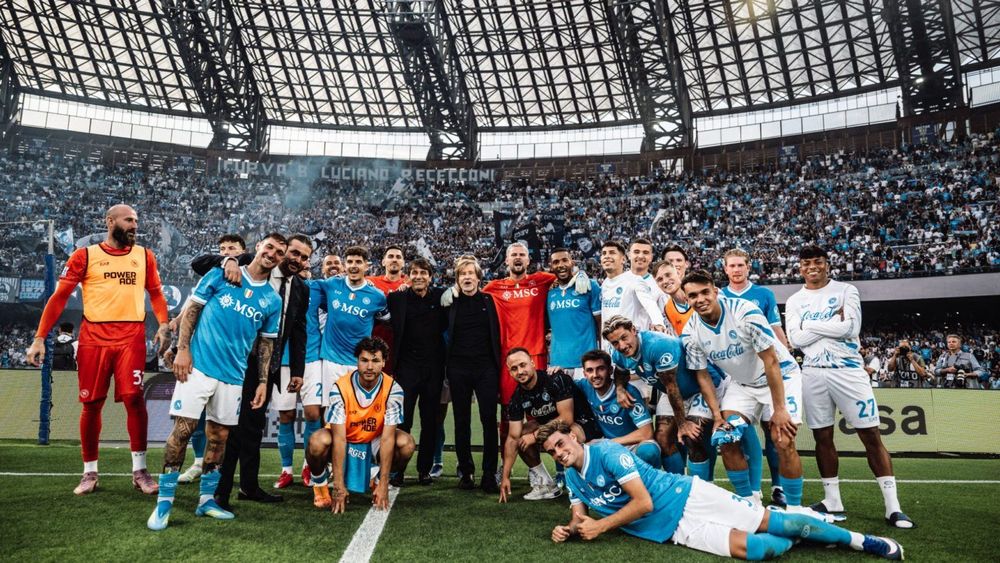
And Meluso's comments may offer the clearest explanation yet for why one of Italy's strongest squads struggled to build a lasting dynasty.
Speaking exclusively to Football Presse, Meluso reflected on the turbulent period that followed Luciano Spalletti's title-winning campaign and suggested the coaches who followed were fighting a battle they could never fully control.
His remarks have taken on renewed significance this summer following Antonio Conte's departure and the appointment of Massimiliano Allegri, with Napoli once again entering a new chapter despite remaining among Serie A's elite.
Conte restored Napoli to the upper reaches of Italian football after a difficult period, but even his exit highlighted the challenges that continue to surround the club behind the scenes. For Meluso, that is why it would be wrong to judge Napoli's recent history solely through the lens of managerial appointments.
"The coaches who followed at Napoli – Garcia, Mazzarri and Calzona – all found themselves working in very difficult situations," Meluso told Football Presse.
"Garcia arrived after Spalletti had won the Scudetto. Mazzarri was seen as a caretaker and arrived at a moment when the difficulties were enormous. The same was true for Calzona.
"They had very little responsibility for how the season went."
Napoli's dramatic decline after winning the title surprised much of European football. With stars such as Victor Osimhen and Khvicha Kvaratskhelia still at the club at the time, many expected the Partenopei to challenge again for domestic and continental honours.
Instead, the campaign unravelled.
Meluso, who was working at the club during that period, insists the problems were not always visible from the outside.
"I went to Napoli in a very particular moment," he explained.
"There was enormous enthusiasm after winning the Scudetto. But the squad had some internal problems which, for reasons of confidentiality, I cannot reveal.
"It was a difficult year and the team did not perform to its true potential."
While Meluso declined to elaborate on the nature of those issues, his comments suggest there were factors beyond tactics and team selection contributing to Napoli's decline.
The former sporting director nevertheless spoke positively about his relationship with president Aurelio De Laurentiis.
"I had a very good relationship with De Laurentiis," he said.
Now, with Allegri tasked with leading Napoli into a new era, the challenge is not simply about replacing Conte. It is about creating the stability that has often proven elusive, despite winning two Scudetti in the last three years.
Meluso knows better than most how quickly momentum can disappear in football.
Having built a respected reputation at clubs including Lecce and Spezia before arriving in Naples, he has experienced both remarkable success and difficult rebuilding projects. Yet he still regards his time at Napoli as one of the defining chapters of his career.
"I have been fortunate," he said.
"I achieved important results, I reached the Champions League with Napoli and worked at a club with huge ambitions."
Those ambitions remain unchanged today.
Napoli continue to possess one of the strongest squads in Italy and will once again be expected to compete at the top of Serie A under Allegri. But Meluso's reflections serve as a reminder that success is rarely determined by talent alone.
The departures of Spalletti and later Conte have often focused attention on the men in the dugout. Meluso's assessment points elsewhere.
For him, Napoli's difficulties were never simply about changing managers.
Instead, they stemmed from deeper challenges within the club at a time when expectations had never been higher.
As Allegri prepares for his first season in charge, solving those issues may prove just as important as any tactical decision he makes on the pitch.